Protect the Lawn During a Football Garden Party: Traffic, Buffer Zones and Compaction
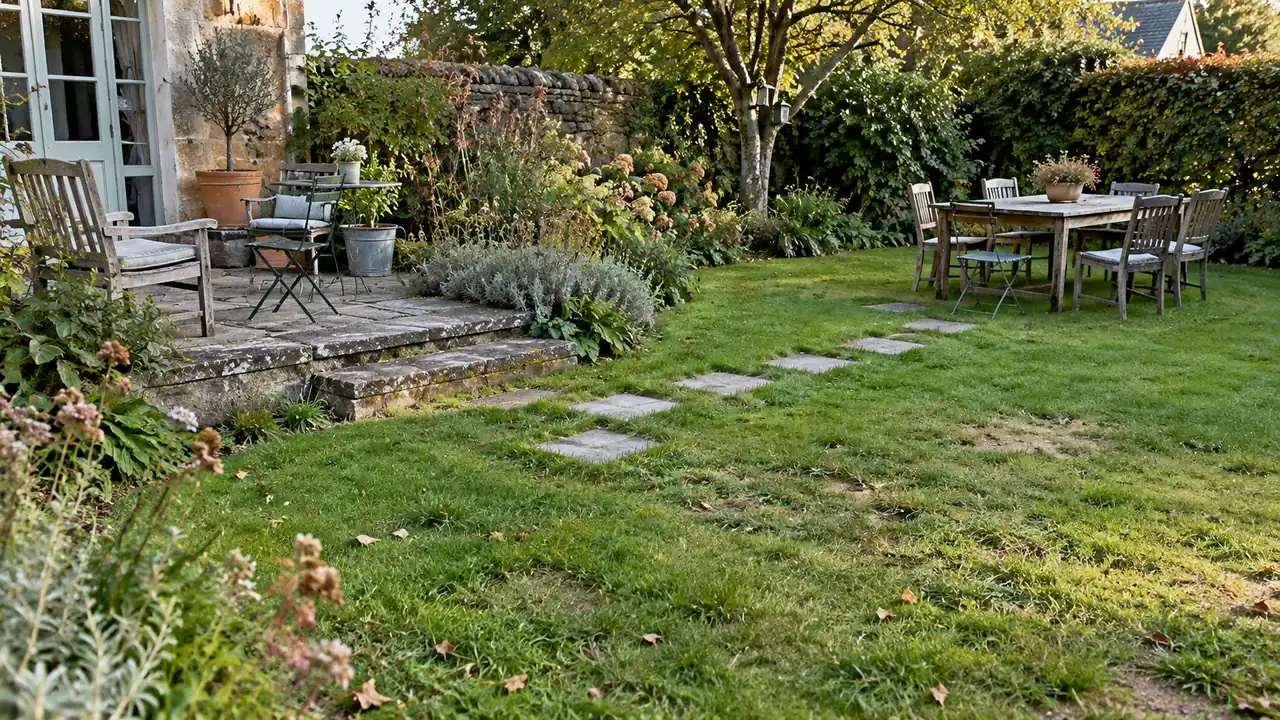
A lawn suffers less from guest numbers than from three combined factors: damp soil, repeated traffic in one spot and static furniture weight. Move standing zones to hard ground, create temporary paths and keep the grass high, surface-dry and free of weight as soon as the match ends.
Generic advice says to be careful with the lawn. That is not enough for a World Cup evening. You need to decide where guests may stand, where chairs can remain, where the bar is forbidden and which early signs show compaction before it turns into a repair job.
This guide belongs to Garden Care and Permaculture and to the 2026 World Cup event series by Les Jardins d'un Châtelain.
Why this deserves a real field protocol
Turf copes better with a short load than with nervous repetitive traffic. A football match creates exactly that pattern: people stand, step back, return and comment. Put emotional movement on resistant surfaces such as terrace, stepping stones, stabilised gravel, an old path or temporary matting.
Mowing should protect the plant. Higher grass keeps reserves and shades the soil. Cutting very low to look neat exposes the crown, increases evaporation and makes bruises visible. If the lawn is already heat stressed, accept a less perfect look.
Surface moisture changes everything. Watering on the morning of a party to make the lawn green is risky if guests walk on it in the evening. Soft soil compacts and holds footprints. Water several days before if needed, never as make-up just before an event.
The best protection is often social design: make the route obvious. Guests follow the easiest line. If the temporary path is visible, lit and more comfortable than the diagonal across grass, no lecture is needed. Design replaces prohibition.
Questions to ask before installing anything
The useful question is not only “where does it look good?” but “where would a mistake be expensive?” For protect lawn garden party football, mistakes become expensive when damp soil, cables, standing guests and last-hour decisions combine. If two of those are present, simplify the setup.
Ask who will clear up. A setup understood only by the host becomes fragile after full time. Label bags, group cables, keep stakes together and leave a clearing route that does not cross already tired ground.
Ask what the garden will look like at noon tomorrow. Night hides the cable left behind, shiny turf, a moved pot, crushed edge or bare soil. That mental picture pushes the design toward lighter and reversible choices.
Site diagnosis
| What to observe | Why it matters | Practical decision |
|---|---|---|
| Shiny patch | Blades are flattened and the surface is beginning to seal. | Close the area, lift gently and do not water immediately. |
| Dark sticky trace | The soil is too wet or organic. | Stop traffic and let it dry before any repair. |
| Chair leg sinks | Point pressure is too high. | Add a board, open mat or move to hard ground. |
| Diagonal shortcut | The garden offers an easier route than the path. | Redirect with pots, light and a comfortable temporary path. |
| Bar on turf | Guests stand too long in one place. | Move the bar to terrace edge or mineral surface. |
The Chatelain Estate protocol
Watching a match in the garden is not only a matter of seats and a screen. It is a flow problem: guests arrive together, move in low light, look for drinks, celebrate, queue near food and leave over grass that may be damp. Good design begins with a map of use, not with a purchase.
Think in three rings. The viewing ring must stay stable, dry and correctly aimed at the picture. The service ring holds drinks, cables, bins and slow circulation. The breathing ring protects lawn, borders, young trees and technical access. When one ring tries to do everything, the evening feels pleasant for twenty minutes and the garden pays for it afterwards.
The useful number is not the guest count but the pressure per square metre. Ten people seated on a terrace do little harm. Ten people standing around a bar on moist turf can bruise the soil before half-time. Photograph sensitive areas before the event so that the next day you repair the right places instead of treating the whole garden blindly.
Keep the design reversible. Anything installed for the match should be removable in under an hour without tearing, compacting or soaking the ground. Temporary paths, open-grid mats, low markers, outdoor-rated cable protection and grouped containers often do more for the estate than a spectacular setup that keeps the garden hostage for a week.
Decision Matrix Before Kick-Off
Before approving protect lawn garden party football, ask five questions in order: which risk dominates, which threshold changes the plan, who watches during the match, how the garden recovers and what is kept for the next fixture?
| Criterion | Decision |
|---|---|
| Risk | The main risk is invisible repetition: ten small passes in one place do more harm than one heavy crossing. |
| Threshold | The warning threshold appears when grass becomes shiny or guests naturally choose a diagonal shortcut. |
| Observation | Warn guests before arrival with a positive instruction: “the route is here” works better than “do not walk there”. |
| Recovery | Protection continues after the match: remove mats, open routes, let dry and prevent traffic from returning. |
| Next match | For the next match, turn the most-used trace into an intentional path. |
The first reading separates desire from constraint. Desire says bigger, brighter, more festive. Constraint answers with living soil, changing weather, unpredictable guests and real neighbours. Until both voices are written down, the decision usually favours what looks good in a photograph rather than what survives a whole evening.
The second reading is the threshold. A threshold is not a vague worry but a testable sentence: if wind moves the picture, if turf shines, if a diagonal shortcut appears, if red overwhelms the planting, the plan changes. That sentence must be agreed before kick-off because the mood of the match makes people tolerate what the garden will pay for later.
The third reading is estate memory. Each match gives information: where people gather, which cable annoys, which plant invites shortcuts, which area dries quickly and which keeps moisture. Recording those points turns a one-off party into a repeatable method. That is the value of this series: it does not sell decoration, it builds a way to host without losing the garden.
One final arbitration helps when two solutions both look good: choose the one that leaves the garden the most freedom the next day. The best option is therefore not always the most spectacular or even the most comfortable during the first five minutes. It is the one that keeps access, a resting area, a simple teardown route and a local repair possible. If a solution requires moving many guests to correct one detail, it is too fragile for a match evening.
This matrix avoids two extremes: over-equipping the garden for one evening or hosting without a strategy. It also creates useful evidence when several matches follow one another, because each decision can be improved instead of restarted from zero.
Action timeline
| Moment | Action |
|---|---|
| Five days before | Check moisture, shade, slope, access and places where water lingers. |
| Three days before | Mow high, remove obstacles and test furniture feet. |
| One day before | Install temporary paths, protect standing zones and block weak shortcuts. |
| Match day | Do not water, keep the bar off grass and limit heavy chairs. |
| During the match | Watch where groups form; if they gather on turf, move table or light. |
| Next day | Let dry, aerate locally if sealed and overseed only bare patches. |
Mistakes to avoid
- Watering on the day to make grass look green.
- Putting coolers, bar or beer tap directly on turf.
- Leaving a solid mat all day in sun.
- Allowing the shortest diagonal shortcut.
- Raking hard while the soil is wet.
- Overseeding before relieving compaction.
FAQ
How long can a mat stay on grass?
A few hours if dry and breathable. Remove it as soon as the event ends.
Can a table stand on the lawn?
Yes if soil is dry and weight is spread. Avoid heavy coolers and thin legs.
What if footprints appear?
Do not fill them immediately. Let the soil dry, aerate if needed, then level lightly.
Is yellow grass after a party dead?
Not necessarily. Wait for blade lift and inspect the base before reseeding.
Do mats damage the lawn?
Solid mats left too long can smother it. Open mats for a few hours are usually better than repeated traffic.
Should I topdress before the party?
No unless the lawn is dry and level. Sand is a fine correction, not last-minute make-up.
How do I handle children?
Create a separate play area; otherwise they orbit adults and multiply compacting short runs.
Do shoes matter?
Yes. Heels, studs and narrow soles concentrate pressure. A simple note before the party prevents many marks.
When can the lawn reopen?
When it is no longer shiny, soil no longer sticks and blades lift after hand brushing.
Related guides in this series
- Set Up a Garden to Watch France Play Without Damaging the Grounds
- Outdoor Projector and Inflatable Screen: Show a Match in the Garden Safely
- Repair a Lawn After a Match Party: 24-Hour Diagnosis, Aeration and Overseeding
- Blue White Red Flower Border: A French Flag Garden That Still Looks Elegant After the World Cup
Useful sources
Written and checked by the editorial team of Les Jardins d'un Châtelain.