Mosquito Control for a Garden Wedding: Plan Ahead Without Harming Pollinators
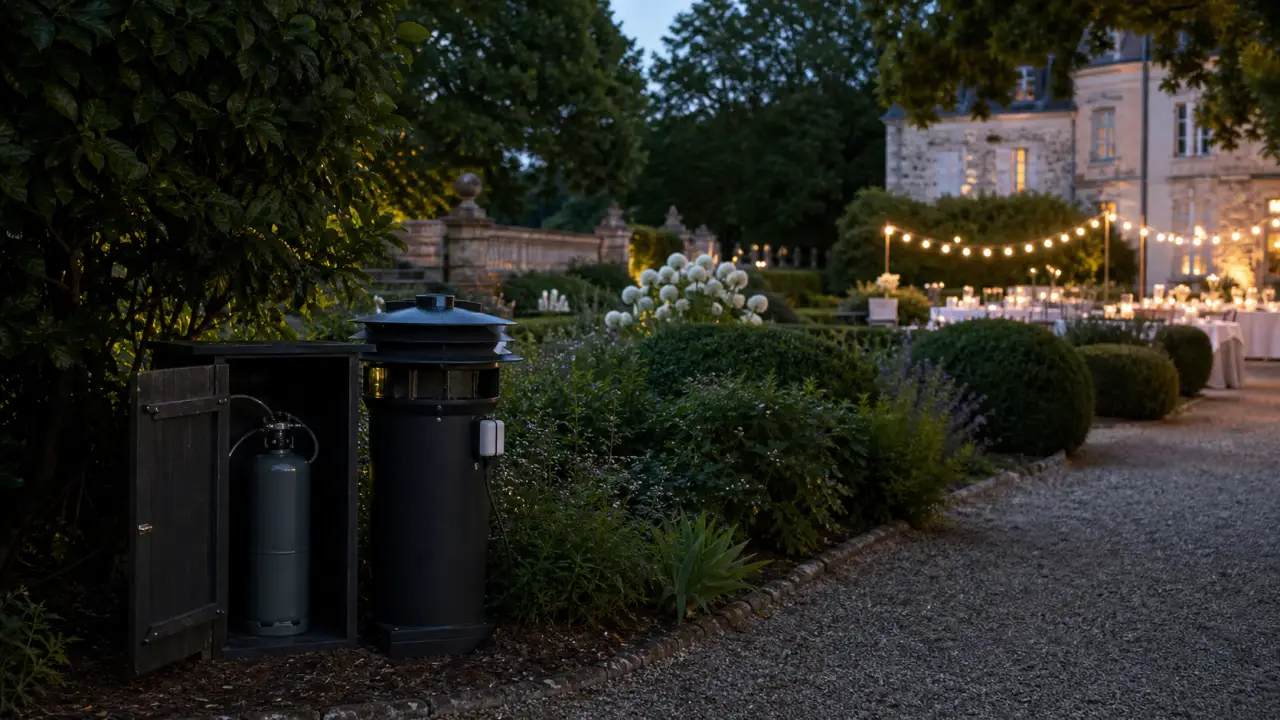
Start mosquito control several weeks before a garden wedding. Remove or cover small artificial sources of standing water, record where and when biting activity occurs, then ask a competent provider whether a professionally sized CO2 trap system is justified. For this one-off event, the approved editorial choice is to prefer hiring. That preference is not evidence that hiring is more effective, cheaper or universally more practical than buying, and only the written offer establishes what the service actually includes.
This is a reduction plan, not a promise of a mosquito-free wedding. A trap switched on that morning does not create an instant protective bubble around the guests. Keep physical barriers, suitable clothing and label-compliant repellents available on the day, and reject any quotation that guarantees no bites.
Les Jardins d’un Châtelain is an editorial gardening website. It does not hire wedding venues, mosquito equipment or pest-control services, and it does not rank brands. Site-specific advice from the selected venue, the equipment instructions, public-health authorities and competent contractors always takes priority over this guide.
Check the garden before choosing equipment
A machine cannot compensate for a site full of small breeding containers. Walk the entire area with the person responsible for the garden. Check saucers, buckets, watering cans, blocked gutters, tarpaulin folds, open water butts, toys, temporary signs, parasol bases and anything else that retains rain or irrigation water. Repeat the inspection after wet weather; a dry-day survey can miss the problem completely.
Empty, turn over, securely cover or properly maintain each artificial container according to its purpose. A useful water butt needs an appropriate lid or screen, while a discarded pot can simply be stored upside down. Build repeat checks into the wedding timetable because one inspection followed by another shower is not a control programme.
Do not use this exercise as permission to drain a wildlife pond, wetland margin or functioning rain garden. These habitats require an ecological and site-specific assessment. Do not add a larvicide, other biocide or fish on the assumption that it must help. Products need to be legal for their intended use and applied exactly as directed; a garden wedding team should not improvise public-health treatment.
Apply the Chatelain Method
The Chatelain Method gives the preparation four stages: observe, diagnose, correct and prevent.
Observe. Visit at the times when guests will occupy the garden. Record biting reports, sheltering vegetation, damp shaded edges, artificial water and the usual wind direction. One visit cannot reliably identify a species or forecast the wedding evening, but a dated record is far better than choosing a trap position from a brochure.
Diagnose. Ask the provider what organism the system is intended to catch and what evidence supports that choice. Mosquitoes, biting midges and other nuisance insects are not interchangeable. This matters in the UK, where a service advertised for midges may not carry the same evidence or configuration as one intended for container-breeding mosquitoes. A universal recommendation made without a site visit should be treated cautiously.
Correct. Deal with artificial breeding water first. If trapping is appropriate, place the system in a technical zone away from the reception and maintain it throughout the agreed period. Consumables, cleaning, capture checks and adjustments are part of the correction. A machine left running without inspection is not a monitored intervention.
Prevent. Prepare a second layer for the day itself: screened spaces where feasible, covering clothing, ventilation approved within the temporary electrical plan, appropriately authorised repellents used according to their labels, and clear information for guests. Retain an indoor or more sheltered option if observed nuisance becomes incompatible with the event.
What a hired CO2 trap can and cannot do
Carbon dioxide is one of the host signals used by some traps to attract host-seeking female mosquitoes. Depending on the model, an additional lure and a fan may be involved. CO2 is also used as bait in entomological surveillance, including UK survey protocols. Its value for finding insects does not by itself prove that a particular machine will protect an entire wedding.
The most directly relevant evidence review located for trap efficacy was published by the French health agency Anses. It found that active or passive trapping may help reduce some Aedes populations over the medium or long term when devices are maintained and deployed at sufficient density. We use that review as a clearly identified foreign evidence source, not as UK regulatory guidance. Its conclusion does not validate every model, specify a universal radius or promise the absence of bites.
Performance can change with species, initial pressure, vegetation, wind, site layout, competing hosts and the continuity of operation. Ask the provider to explain which of these variables informed the proposal. A quoted coverage area without the model instructions, assumptions or limits is not enough.
Hiring does not make an otherwise identical trap biologically stronger. The preference in this guide is an editorial decision for temporary use, not the conclusion of an independent hire-versus-purchase comparison. We found no independent evidence establishing that hire is inherently more effective, cheaper or simpler. In the UK, Midge Tech advertises Mosquito Magnet and midge-machine hire for weddings, gatherings and outdoor events. This commercial page proves only that event hire is available; it does not prove performance at this garden or the superiority of hiring.
Offers therefore need to be read individually. Our comparison checklist suggests recording the model, installation and collection dates, consumables, maintenance, fault contact and cylinder responsibilities. These are editorial questions for comparing offers, not standard service inclusions or mandatory contract clauses.
The start date must be justified for the actual site and equipment. Do not copy a fixed number of days from a manufacturer page into the contract. There needs to be time to confirm that the trap is operating, review catches and move or supplement it if the agreed monitoring indicates a problem. A provider who offers only morning-of installation alongside a total guarantee is selling certainty that the evidence does not support.
Use this checklist to audit a hire quotation
The table is an editorial set of comparison questions. It is not a model contract, does not impose any clause and is not a substitute for professional sizing.
| Suggested question | Information needed for comparison | Signal for not selecting the offer |
|---|---|---|
| Garden diagnosis | Visit, mapped observations, likely activity periods and explicit assumptions | Coverage claimed without a visit, measurement or stated assumption |
| Programme | Installation date, interim checks and conditions for adjustment | Day-of installation accompanied by a no-bite guarantee |
| Sizing | Number of units and limits linked to the model, wind and vegetation | A universal radius with no instructions or limitations |
| Positioning | Plan outside guest routes and service areas, with maintenance access | Unit or cylinder placed beside seating, play or an exit route |
| Consumables | CO2, lure and collection parts listed with frequency and responsibility | Unpriced consumables or no response to a supply interruption |
| Maintenance | Cleaning, catch records, adjustment and a fault contact | No visit between installation and the wedding |
| Safety and compliance | Identified equipment, instructions, cylinder plan, insurance and venue acceptance | Unsecured cylinder, improvised connection or unventilated enclosure |
| End of hire | Collection, condition record and responsible disposal of consumables | Equipment abandoned or trap contents emptied into the garden |
Ask what the provider proposes to record. Catch counts alone do not prove an equal fall in biting, but they can show that the unit has been working and whether conditions changed. Our comparison note can include downtime, cylinder and lure changes, cleaning and movements of a unit when the chosen service records them. Without such evidence, it is difficult to interpret poor performance or make a defensible adjustment.
Treat vague environmental claims as marketing until they are supported. Words such as “natural”, “eco”, “smart” and “professional” do not identify target species, by-catch, consumption or safety. Request the exact model, current instructions and whatever data the provider is willing to relate to this garden.
Position the equipment as a technical installation
The correct location comes from the equipment instructions and the diagnosis. It is not normally achieved by putting the trap underneath the dining table so that it can “suck mosquitoes away”. Create a separate technical area outside guest, child, staff and emergency routes, while keeping access for checks and servicing.
Wind direction, boundaries and sheltered vegetation may affect positioning. The provider must assess power, weather protection specified by the manufacturer, stability and cable routing. Temporary power belongs in the wedding’s overall electrical design; it should not be added with a domestic extension lead after the last safety check.
Keeping equipment out of sight does not mean locking a CO2 cylinder in a sealed box. A release of gas can displace oxygen in a confined space, while a pressurised cylinder needs protection from impact, heat and falling. The supplier and venue should agree ventilation, secure upright storage where required, safe handling, transport and public separation. HSE cylinder guidance provides transferable safety principles, but the exact installation still depends on the supplier’s risk assessment and instructions.
Reduce risk to pollinators and other wildlife
A trap should not automatically be described as selective. The Anses review records potential catches of non-target organisms, particularly in rural and natural settings. Ask what is known about by-catch for the proposed model, how trap contents will be inspected and whether the position or operating plan can be refined. “Pollinator friendly” is an objective to test, not an absolute claim to print without evidence.
Avoid blanket spraying simply to add reassurance. It can affect non-target insects and does not resolve the containers that will keep producing mosquitoes. Where a genuine public-health or severe infestation issue requires control, it belongs with the relevant authority and qualified professionals, not the styling team.
Scented plants, candles and decorative fragrances may contribute to the atmosphere but should not be sold as a reliable barrier. Choose seasonal flowers for a rustic wedding table for their design and horticultural value, not as mosquito treatment. Do not improvise essential-oil skin blends or airborne mixtures: “natural” does not mean effective, legal for that use or harmless.
Prepare day-of protection as a separate layer
Two or three days before the wedding, repeat the standing-water walk and review continuity with the hire company. Confirm consumables, alarms or faults, cylinder security, the weather forecast, any screened or ventilated zones and the escalation contact. Do not move the unit after the provider’s final check without obtaining new instructions.
Make suitable repellents available in their original packaging with legible directions. Children, pregnant guests and people with particular sensitivities need to follow the product precautions and seek professional advice where necessary. Decanting repellent into an anonymous decorative bottle removes information guests may need.
Give calm practical information in advance: a note can mention covering clothing for the evening and where compliant repellent will be available. Fans may disrupt the flight of some mosquitoes and improve comfort, but their stability, weather exposure, noise, cables and electrical load all need approval. They supplement the plan; they do not replace diagnosis or the shelter arranged in the outdoor wedding weather plan.
Close the service properly after the wedding
If collection is included in the selected offer, record its timing and conditions in writing. The provider can then remove the cylinders, equipment and consumables allocated to that service. Do not tip captured material or lure into a flower bed without an authorised disposal instruction. Check the agreed handover rather than assuming that every hire offer includes the same removal service.
Ask for a short record of actual operating time, faults, consumables, observed catches and positioning changes. It is not a scientific trial, but it can help the venue decide whether a longer-term prevention programme is warranted. If nuisance remains high outside the wedding, investigate artificial water with neighbours and appropriate local services instead of adding machines without a diagnosis.
FAQ
Will a CO2 trap work if it is installed on the morning of the wedding?
It should not be relied upon as an instant solution. A suitable CO2 trap may contribute to longer-term reduction when it is correctly selected, positioned, maintained and operated with enough lead time, but it cannot guarantee a bite-free event. For a one-off wedding, our editorial preference is to hire; this carries no performance or price promise. Check the actual offer for its start date, diagnosis, monitoring, consumables, cylinder responsibilities and collection instead of assuming that these are included. Keep artificial water under control and retain physical barriers, suitable clothing, label-compliant repellents and a more sheltered fallback for the wedding itself.
Evidence, method and limits
Our contribution. The timeline and hire-audit table connect garden prevention, the bounded evidence for traps, CO2 cylinder safety and separate day-of protection. They let a reader compare proposals without inventing a coverage radius or universal start date.
Method. We compared UK search intent for outdoor wedding mosquito control and machine hire with UKHSA prevention and surveillance material, HSE cylinder guidance and the Anses evidence review. The Midge Tech commercial page is used only to establish that hire for weddings and outdoor events exists in the UK; it is not efficacy, value or service-standard evidence.
Limits. Without a visit, species identification, capture history, garden plan, current instructions, contract and venue rules, we cannot guarantee performance, size a system, set an operating period or approve a gas installation. Public-health authorities, the venue and competent contractors retain their responsibilities.
Sources and further reading
-
UKHSA — Mosquito control, for managing standing water and mosquito prevention in residential settings.
-
UKHSA — Snapshot Wetland Mosquito Survey, for the bounded use of CO2-producing bait in surveillance rather than a promise of event protection.
-
UKHSA — National contingency plan for invasive Aedes mosquitoes in England, for container habitats and trained surveillance within its public-health scope.
-
HSE — Drum and cylinder handling, for transferable precautions around pressurised cylinders; equipment-specific approval remains with the supplier and venue.
-
Anses — Evidence review of mosquito traps, used as an explicit foreign-source exception for qualified medium- and long-term efficacy limits, not for UK regulation.
-
Midge Tech — Midge Machine Hire, used only to document that a UK supplier advertises machine hire for weddings, gatherings and outdoor events, never as evidence of efficacy, price advantage or standard inclusions.
Written and checked by the editorial team of Les Jardins d'un Châtelain.