Trifoliate orange (Hardy orange)
Citrus trifoliata — the deciduous hardy orange
The familiar citrus relative that drops its leaves and withstands a British winter. It is grown less for resinous fruit than for its roots: a major cold-climate rootstockThe root and base onto which a variety is grafted to give it vigour or resistance., provided its limits are understood.
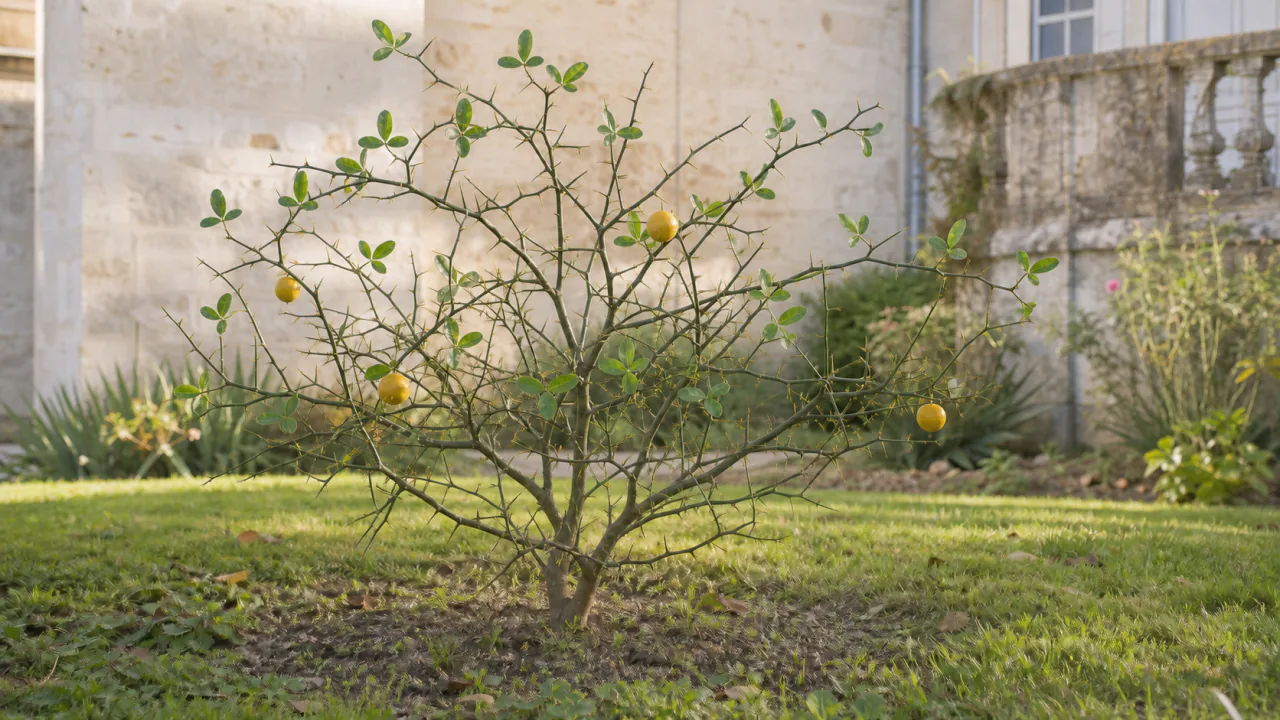
Trifoliate orange is an exception among familiar citrus: the only widely cultivated deciduousDescribes foliage that falls in autumn and regrows in spring. one, and by far the most cold-hardy of this group; the RHS rates it H5 in UK conditions. Native to central China and adapted to temperate seasons, it forms a thorny shrub with three-part leaves, green shoots that remain decorative in winter, and white flowers before or with the leaves. Its small yellow fruit is downy, resinous, bitter and very seedy and is not intended for ordinary eating. Its main function lies elsewhere: it is a major citrus rootstock for cool-climate orchards.
The misconception to correct. Grafting citrus on trifoliate orange does not make the scion as hardy as the rootstock. The stock supplies root hardinessA plant's ability to survive winter cold without protection. and vigour control; the cold tolerance of the above-ground scion remains the scion’s own. A second point: its fruit should not be eaten raw.
Its contorted form, Flying Dragon, is a sought-after dwarfing cultivarA variety produced through selection or cultivation, distinct from the wild original plant.. Trifoliate orange is the rootstock mentioned for many plants, including Owari satsuma, yuzu and lemons.
The reliable facts before you buy
The cold-climate rootstock — and its soil limits
Trifoliate orange is the cold-climate rootstock: it provides excellent root resistance to winter cold, useful vigour control for more compact trees and can support concentrated fruit quality. That is why it recurs in cool-climate citrus growing. But its limits are clear: it dislikes active lime and resulting chlorosisYellowing of the foliage caused by poor iron uptake, often linked to chalky soil., tolerates salts poorly, and is sensitive to exocortis viroid; certified healthy grafting material therefore matters.
As a garden plant in its own right it is also used for defensive hedging because the thorns are formidable, and for ornament with green winter shoots and white spring flowers. Allow for possible suckering and self-seeding according to site.
| Trifoliate orange as rootstock | Contribution | Limit or trade-off |
|---|---|---|
| Root hardiness | Outstanding resistance to cold soil conditions | ⚠️ Does not transfer equal hardiness to the above-ground scion. |
| Vigour and tree size | Controls vigour, producing more compact trees and potentially concentrated quality | ⚠️ Reduced vigour: reserve for soils where it performs well. |
| Soil | Best in free-draining acid to neutral soil | ⚠️ Chlorosis on active lime and poor salt tolerance. |
| Plant health | Established, available rootstock | ⚠️ Sensitive to exocortis: begin with certified healthy material. |
A trifoliate-orange year: easy in suitable open ground
Straightforward in UK open ground where soil is free-draining and non-calcareous; its deciduous cycle marks the seasons. RHS H5 applies to the species, not to a grafted scion.
| Jan | Feb | Mar | Apr | May | Jun | Jul | Aug | Sep | Oct | Nov | Dec | |
|---|---|---|---|---|---|---|---|---|---|---|---|---|
| Plant in open ground, free-draining soil | ||||||||||||
| Winter dormancy (deciduous species) | ||||||||||||
| White flowering before or with the leaves | ||||||||||||
| Collect fruit for seed or rootstock production | ||||||||||||
| Trim a hedge outside hard frost | ||||||||||||
| Feed only if active growth needs it |
Use trifoliate orange where it belongs
Soil first
Before choosing trifoliate orange, assess the soil: it is an excellent rootstock in free-draining non-calcareous ground and disappointing where active lime or salinity dominate.
Chlorosis or a frozen scion
Yellowing in calcareous soil signals chlorosis; a frozen scion shows that the stock protected the root system, not the canopy. Do not confuse the two.
Match the rootstock to the site
On active-lime soils, choose another documented stock; reserve trifoliate orange for suitable ground and use material certified healthy against exocortis.
Control thorns and seedlings
Handle formidable thorns carefully and monitor suckers or spontaneous seedlings when it is grown as hedge or ornament.
Read the symptom, trace the cause, correct and prevent
Very hardy, trifoliate orange is chiefly limited by soil and graft plant-health issues.
| What you see | Likely cause | Correct | Prevent |
|---|---|---|---|
| Yellow leaves with greener veins | Iron chlorosis from active lime or salinity — a known weakness | Check drainage, pH and irrigation first | Reserve for free-draining acid to neutral soils |
| Cracked bark and decline in a grafted tree | Exocortis viroid in a susceptible combination | Seek a diagnosis, replant healthy material and disinfect tools | Certified healthy scions and rootstocks |
| A frozen scion while the roots remain alive | The scion’s aerial cold tolerance was exceeded, not the rootstock’s | Protect the above-ground scion | Choose a scion suited to the climate rather than relying on the stock |
| Thorny suckers at the base or seedlings nearby | Suckering or spontaneous seedlings | Remove suckers and seedlings promptly | Monitor hedges and ornamental plants; collect fallen fruit |
| Cottony masses or aphids on young growth | Mealybugs, scales or aphids | Identify, remove locally and protect beneficials | Inspect tender spring flush |
Keep treatment proportionate. Exocortis is a graft plant-health issue: start with certified material and follow current UK official plant-health advice where a regulated problem is suspected.
The citrus fruit that is not for eating
To be clear, trifoliate-orange fruit is not table fruit. Resinous, bitter, downy and packed with seeds, it should never be eaten raw. At most, its zest or dried peel has marginal, strongly aromatic uses for well-informed experimenters. Its value is horticultural, not culinary: a cold-climate rootstock, formidable hedge and winter ornament with green shoots.
What standards do — and do not — say
Trifoliate orange has no size scale because its fruit is not a commercial table product.
- Market category: outside the cited grades; its value is rootstock, hedging and ornament.
- Useful measure: vigour and root hardiness in the exact graft combination, not fruit size.
No generic yield is published: scion, soil and climate determine performance. Evaluate the actual combination.
What growers most often ask
Does trifoliate-orange rootstock make my citrus hardier?
Not the canopy to the same degree. It adds root hardiness and vigour control, while the scion keeps its own aerial cold tolerance; the stock does not simply ‘transfer’ its hardiness.
Can the fruit be eaten?
Not raw: the fruit is resinous, bitter and very seedy, with no fresh-eating role. Only marginal uses of zest or dried peel exist.
Why does it yellow on calcareous soil?
It is sensitive to active lime and salinity, which can cause chlorosis. Reserve it for free-draining acid to neutral soils.
Can it spread?
It may sucker or self-seed according to the site, and its thorns are formidable. Monitor suckers and seedlings in hedges or ornamental planting.
Accession evidence and claim control
Evidence checked 4 August 2026. RHS H5 is explicitly UK-scoped; rootstock performance and soil behaviour must be verified for the exact scion-site combination.
- Royal Horticultural Society — Citrus trifoliata: deciduous habit and H5 rating in UK conditions.
- UC Riverside — Citrus Variety Collection: trifoliate orange as rootstock, soil limitations and exocortis context.