Rose
Rosa, thousands of varieties from wild species and hybrids
The flower of the great gardens, demanding only where it is misunderstood. Its success rests on two precise moves: recognising its type, which governs pruning, and preventing disease through air and hygiene before any spray.
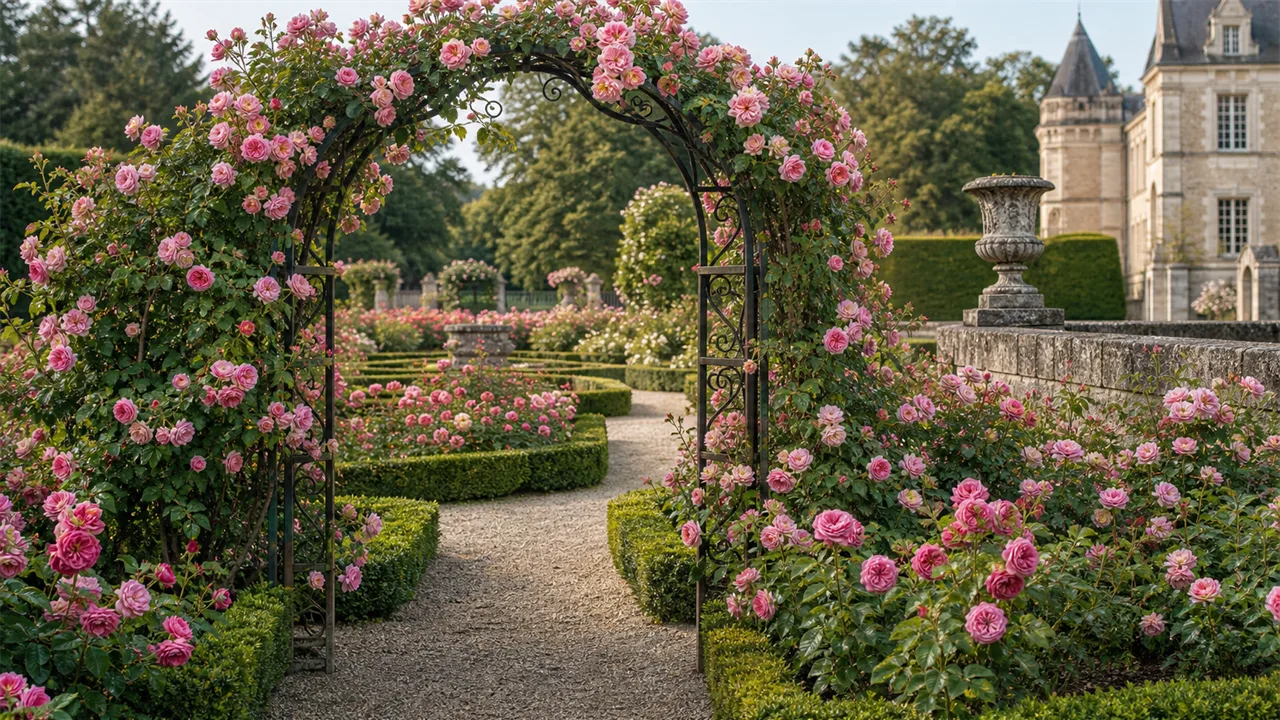
The rose wants sun, at least five hours a day, a rich, cool soil that drains well, and air around its foliage. Two decisions make all the difference: its type, which decides how to prune, and disease prevention, which is settled first by position and hygiene, not by the sprayer. A well-placed, well-pruned rose asks little.
To compose around it, pair the rose with a clematis, its partner on the same arch, with a peony for an old-world border, or with a wisteria for tall vertical scenes.
The reliable markers before planting
Which rose do you have? The question that governs pruning
The word « rose » covers very different plants, and it is the type, not the colour, that decides the care. A few main groups matter in the garden.
Bush roses — hybrid teas with a single large flower and floribundas in clusters — flower on the current season’s growth: prune them back in late winter. Shrub and old roses want a lighter prune, about a third. Repeat-flowering climbers bloom all summer: prune after flowering, keeping the main framework and cutting the side shoots back. Rambling roses flower once, around June, on last year’s wood: prune them just after that flush, never in winter.
The rule is simple: a rose that repeats all summer is pruned in late winter; a rose that flowers only once is pruned after its flush. Get the timing wrong and you sacrifice a whole year of flowers.
When to plant, prune and care for a rose
This calendar targets the useful gestures. The prune row is for bush roses; repeat climbers are pruned after the first flush and ramblers after their single summer flowering. Bare-root roses are planted from autumn to winter, out of frost. In the UK, prune mid-February in the south and March further north.
| Jan | Feb | Mar | Apr | May | Jun | Jul | Aug | Sep | Oct | Nov | Dec | |
|---|---|---|---|---|---|---|---|---|---|---|---|---|
| Plant | ||||||||||||
| Prune (bush roses) | ||||||||||||
| Flowering | ||||||||||||
| Watch for disease |
How to succeed with a rose for the long term
Read the sun and the air
Count the hours of sun and watch how air moves. A rose pressed against a wall with no ventilation, shaded in the afternoon, dries slowly after rain and falls ill.
Recognise the type
Does it repeat all summer or flower once? Bush, climber or rambler? The answer fixes the date and severity of pruning for the plant’s whole life.
Prune at the right time
Bush roses short in late winter, above an outward-facing bud to open the centre. Repeat climbers after flowering, ramblers after their single flush.
Cut off the spores’ route
Water at the base, never over the foliage; gather fallen and pruned leaves; disinfect the secateurs. Foliage that dries quickly catches little black spot.
Black spot, mildew, rust: prevent rather than treat
The three great rose diseases are fungi: black spot (Diplocarpon rosae), powdery mildewA foliage disease caused by a fungus, recognisable by its white, powdery coating. (a white bloom) and rust (orange pustules under the leaves). All spread the longer the foliage stays wet. Real prevention is therefore not a product but a situation: full sun, good air circulation, watering at the base and a mulchA layer of material (bark, straw…) laid on soil to retain moisture and limit weeds. that limits splashing spores.
The most effective control comes before the disease. Choose varieties known to be resistant, space the plants so air can pass, and remove the first spotted leaves at once, never leaving them on the ground. A healthy rose, well fed and well aired, usually needs no spray at all.
If disease sets in despite this, act first by hygiene: remove affected parts, gather the leaves, review the watering. Treatment comes only after, as a complement, never as a substitute for a good position.
Which rose to choose by scene
A selection of the main types to guide the choice, without turning the page into a catalogue. Pruning depends on the type, given for each.
| Rose type | Main interest | Pruning and use |
|---|---|---|
| Hybrid tea (large-flowered) | Single large flower, often fragrant, repeat-flowering | Hard prune late winter, border, cutting |
| Floribunda (cluster-flowered) | Abundant clusters, near-continuous flowering | Prune late winter, border, edging |
| Shrub and old roses | Full habit, old-rose charm and scent | Light prune by a third, specimen, loose hedge |
| Repeat-flowering climber | Blooms all summer, trained on a support | Prune after flowering, arch, wall, pergola |
| Rambler | One very generous June flush, very vigorous | Prune after flowering, large tree, long fence |
| Ground cover and miniature | Low, dense habit, reduced upkeep | Minimal prune, bank, edging, pot |
Why does a rose flower little or decline?
The first cause of a poor display is lack of light. Under five hours of sun a rose grows lank, flowers little and catches more disease. Moving it beats feeding it.
The second cause is pruning at the wrong time. Pruning a rambler in winter removes the June flowers; never pruning a bush rose lets it exhaust itself in old wood. Each type has its date: it is the diagnosis, not the severity, that matters first.
Finally, not removing the faded flowers of a repeat rose slows the rebloom: the plant puts its energy into hips rather than new buds. Regular deadheading keeps the flowering going into autumn.
The rose is thought fickle; it is mostly badly placed. Give it the sun, the air of an open border, the prune suited to its type, and it keeps the promise of the château rose gardens without effort. A rose’s health is decided on planting day, not on spraying day.
– Les Jardins d’un Châtelain
Frequently asked questions about roses
When should I prune a rose?
It depends on the type. Bush roses are cut back in late winter, February to March. Repeat-flowering climbers are pruned after flowering, and ramblers just after their single June flush. Never prune a rambler in winter.
How do I tell a repeat rose from a once-flowering one?
Watch the flowering: a repeat rose blooms in flushes all summer; a once-flowering one flowers only once, usually in June. This difference sets the pruning date.
How do I avoid black spot on a rose?
First by position: full sun, moving air, watering at the base without wetting the foliage. Gather fallen leaves, choose resistant varieties and remove the first affected leaves quickly.
What exposure suits a rose?
Full sun, at least five hours a day, in an airy spot. Avoid the shade of trees and confined corners, where the foliage stays wet and disease takes hold.
Can you grow a rose in a pot?
Yes, especially compact, ground-cover and miniature forms. Use a large container, rich free-drainingDescribes soil that lets water flow away easily, without pooling around the roots. compost, steady watering and a feed in late winter and early summer for repeat types.
Sources and editorial control
- RHS – Rose pruning: general tips: pruning by type and timing from late winter to after flowering.
- RHS – Rose pruning: climbing roses: distinguishing climbers from ramblers and how each is pruned.
- Kew Science, Plants of the World Online – Rosa: taxonomic frame and family Rosaceae.