Wisteria
Wisteria, mainly Wisteria sinensis (Chinese) and Wisteria floribunda (Japanese)
The climber of the great pergolas, spectacular but thought fickle. The secret is not in the feed: it is a two-step prune that decides the flowering, on a support built to last.
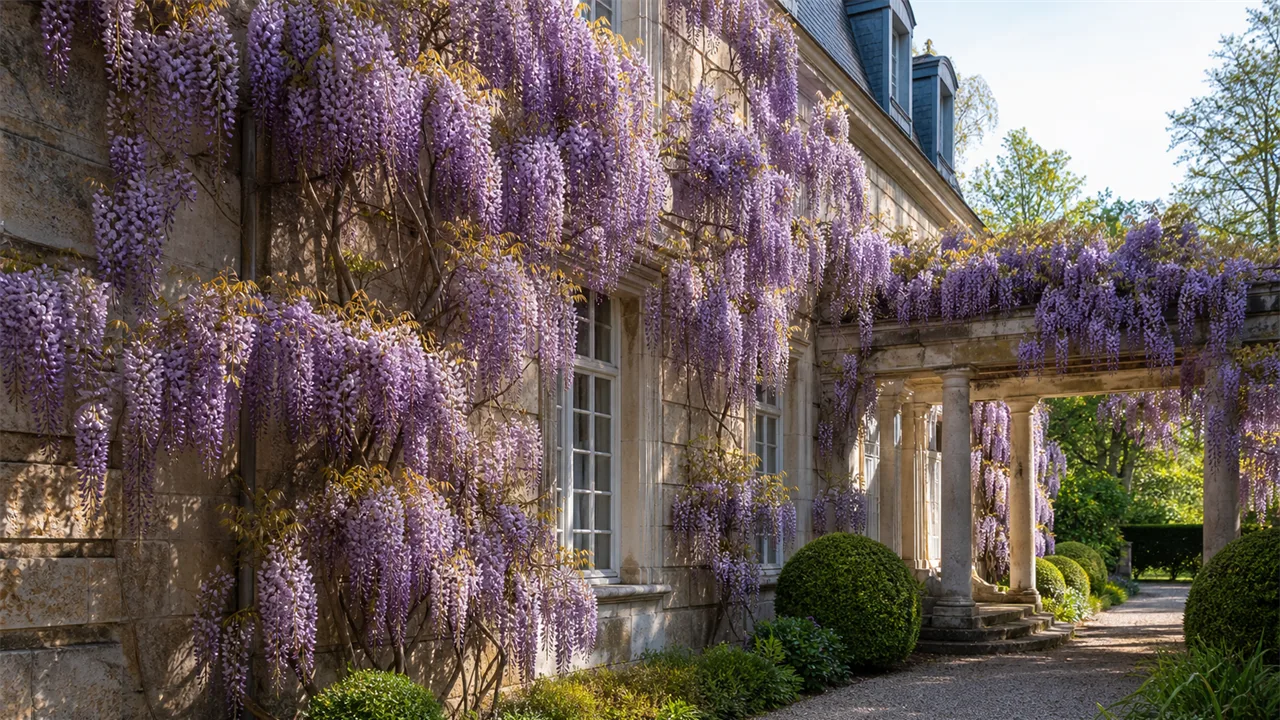
Wisteria wants full sun, a well-drained soil that is not too rich, and a solid support from the day it is planted. Its long racemes barely depend on feeding, but on a two-step prune: in summer you shorten the young shoots, in winter you cut them back hard. It is this move, not the variety, that turns a leafy wisteria into a flowering one.
For tall vertical scenes, compare it with the estate’s other climbers: the rose on the same arch, the clematis to extend the flowering, or the honeysuckle for scent.
The reliable markers before planting
Chinese or Japanese wisteria: what does the species change?
Two species dominate in gardens, and the choice shows mostly in the flowering. Chinese wisteria (Wisteria sinensis) flowers early, often before the leaves, in racemes of 20 to 30 cm: the effect is a lilac explosion on bare wood. Japanese wisteria (Wisteria floribunda) flowers a little later, with the leaves, but in far longer racemes, sometimes over 50 cm, superb hanging beneath a pergola.
A useful field detail: the stems of the two species twine in opposite directions. Chinese wisteria twines anticlockwise, Japanese wisteria clockwise. This helps identify a plant and train it without forcing the natural direction of the stem.
For a safe purchase, choose a grafted plant or a named variety, seen in flower if possible. Seed-raised wisterias are vigorous but can go ten years without flowering: one of the great causes of disappointment.
When to plant, prune and enjoy wisteria
The heart of the care lies in the two prunes. In summer you discipline the long shoots of the year; in winter you cut them back to the spurs that will bear the racemes. Plant in autumn or spring, on a support already in place.
| Jan | Feb | Mar | Apr | May | Jun | Jul | Aug | Sep | Oct | Nov | Dec | |
|---|---|---|---|---|---|---|---|---|---|---|---|---|
| Plant | ||||||||||||
| Winter prune (2-3 buds) | ||||||||||||
| Flowering | ||||||||||||
| Summer prune (5-6 leaves) |
How to get a wisteria that truly flowers
Read the sun and the age
Count the hours of full sun and the age of the plant. A young, shaded or seed-raised wisteria makes wood and leaves before it flowers: time and sun are part of the diagnosis.
Check the support and the soil
The support must carry a very heavy woody trunk without bending. The soil must not be gorged with nitrogen: excess vigour drives the plant up instead of into flower.
Prune in two steps
In July-August, shorten the long shoots of the year to five or six leaves. In winter, cut those same stems back to two or three buds. This repeated shortening builds the flowering spurs.
Feed lightly, not richly
Avoid nitrogen-rich feeds. A potassium feed in spring supports flowering without triggering wild growth. Wisteria is tamed by the prune, not by fertiliser.
Why the two-step prune makes all the difference
Wisteria flowers on short spurs, not on the long wandering shoots of the year. Left free, it endlessly extends those leafy shoots and neglects the spurs. The summer prune shortens these young stems to five or six leaves: the sap then concentrates at the base, where the flower buds form in late summer. The winter prune cuts those same stems to two or three buds and brings the spurs into full light.
A wisteria that climbs magnificently but will not flower almost never needs feeding: it needs shortening. The two prunes, summer then winter, are the real lever of flowering. Without them the plant stays a fine vine with no racemes.
It is also the prune that protects the building: an unchecked wisteria lifts tiles, forces gutters and works under render. The annual discipline therefore serves both the flowering and the fabric of the house.
Which wisteria to choose by scene
A short selection to guide the choice, without turning the page into a catalogue. Raceme lengths vary with age, climate and pruning.
| Species or form | Main interest | Recommended situation |
|---|---|---|
| Wisteria sinensis (Chinese wisteria) | Early flowering on bare wood, racemes 20-30 cm, very vigorous | Large wall, façade, load-bearing trunk |
| Wisteria floribunda (Japanese wisteria) | Very long racemes, up to 50 cm and more, slightly later | Pergola, arbour where racemes hang free |
| Wisteria floribunda ‘Multijuga’ / ‘Macrobotrys’ | Exceptionally long racemes | Large pergola of character |
| Wisteria white-flowered (‘Alba’) | Pale racemes, luminous and refined effect | Dark wall, elegant scene |
| Wisteria trained as a standard (on a stem) | Free-standing form, no large wall support needed | Border, terrace, trained specimen |
Why a wisteria fails to flower, and a note of caution
The causes of non-flowering are almost always the same: a plant too young or seed-raised, lack of sun, soil too rich in nitrogen, and above all no pruning. Before any other remedy, set the plant in full sun, stop nitrogen feeds and establish the two annual prunes. Patience counts too: even well managed, a wisteria may take a few years before its first great flowering.
A safety point, stated without drama: the seeds and pods of wisteria are toxic if eaten. That is no reason to give it up, but you site it knowingly where young children might be tempted by the pods.
Wisteria adorns great houses because it asks for what time provides: a support worthy of it and a hand that prunes it twice a year. Well managed, it drapes a pergola in racemes as few plants can. Badly managed, it swallows the house. Everything lies in the measure.
– Les Jardins d’un Châtelain
Frequently asked questions about wisteria
When and how do I prune wisteria?
Twice a year. In July-August, shorten the long shoots of the year to five or six leaves. In winter, cut those stems back to two or three buds. This two-step prune builds the spurs that bear the racemes.
Why is my wisteria not flowering?
Most often because it is too young or seed-raised, lacks sun, gets too much nitrogen, or is not pruned. Correct the exposure, the feed and the two-step prune before any other treatment.
Chinese or Japanese wisteria: which to choose?
Chinese wisteria flowers early on bare wood, in racemes of 20-30 cm. Japanese wisteria flowers a little later, with much longer racemes, ideal hanging under a pergola. Both are superb when well managed.
What support does wisteria need?
A solid, durable support from planting: a metal pergola, steel wires tensioned on a wall, a robust arbour or an old tree. Wisteria becomes a very heavy woody trunk; a flimsy trellis will not do.
Is wisteria toxic?
The seeds and pods are toxic if eaten. The rest of the plant is admired safely, but avoid leaving the pods within reach of young children.
Sources and editorial control
- RHS – Wisteria pruning: the two prunes (summer and winter) and their effect on flowering spurs.
- RHS – How to grow wisteria: full sun, support and training as an espalier, causes of non-flowering.
- Kew Science, Plants of the World Online – Wisteria: taxonomic frame and family Fabaceae.