Clematis
Clematis L. — garden clematis
Pruning follows the flowering group; watering follows the rootballThe block of soil left around a plant's roots when it is planted or moved. and soil; feeding is justified by need, not by the calendar alone.
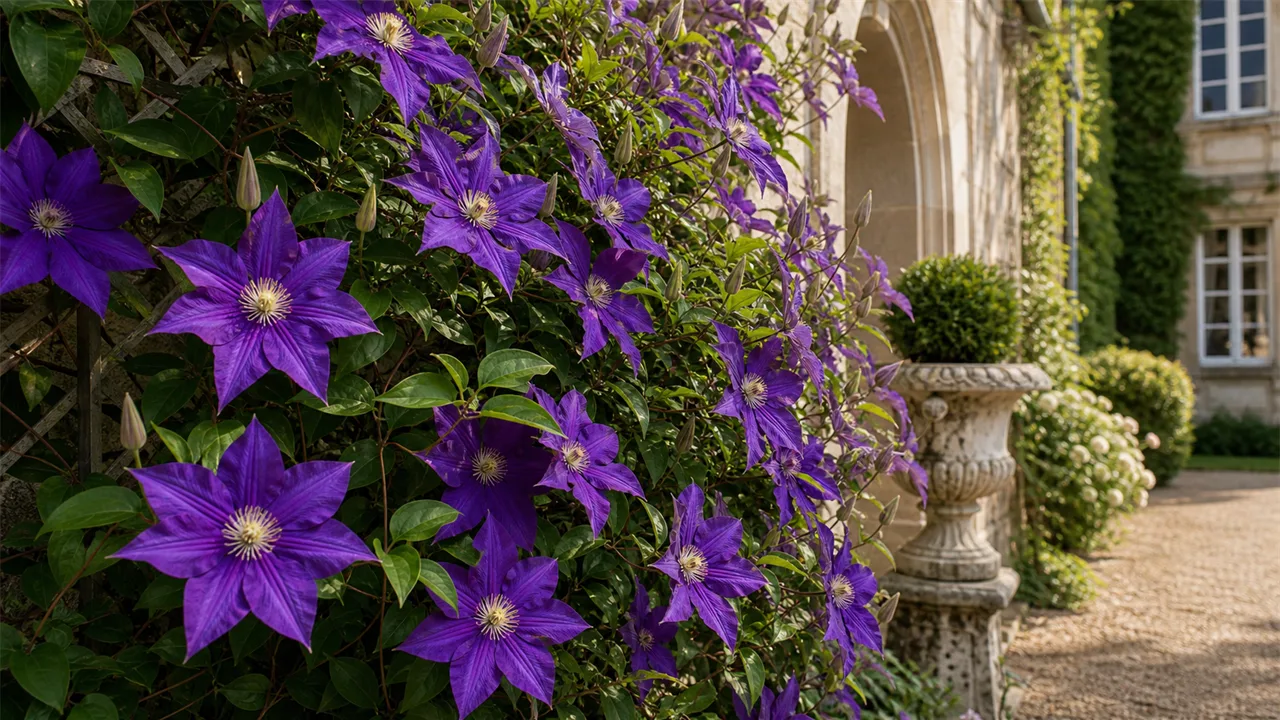
A clematis is not simply a vine to cut down every winter. The genus includes woody climbers, evergreenDescribes foliage that stays on the plant all year, even in winter. species and non-climbing herbaceous plants. Before pruning, watering or feeding, establish the flowering group and inspect the root zoneThe area of soil occupied by a plant's roots, where water and nutrients matter most.. That prevents two common losses: removing next season’s flower buds and keeping roots in waterlogged soil. Young clematis roots are shallow and vulnerable; only after two or three seasons does the plant build the deeper roots that carry it through drought — which is why steady watering matters most early on, and why an established plant resents being moved.
In our climate The challenge is not getting a clematis to climb but keeping its feet cool: Riviera sun heats the root zone fast. We shade the base — mulchA layer of material (bark, straw…) laid on soil to retain moisture and limit weeds., a groundcover or a flat stone — and water only when the soil has truly dried.
In the UK, most garden clematis are RHS-rated H4 to H6, hardy throughout the country, and the cooler, moister British climate spares plants the summer root stress common further south. The main threat remains clematis wilt, a fungal disease that mostly affects large-flowered hybrids rather than herbaceous types.
For a coherent border, compare its conditions with the rose and the hydrangea, then browse the full plant encyclopedia.
Which clematis are covered here?
Scope. This is a guide to ornamental garden clematis. It does not turn the size, hardinessA plant's ability to survive winter cold without protection. or planting depth of one cultivar into a genus-wide rule. The collection entry for ‘Clematis Lucky Charm’ remains a separate cultivar profile.
Where and how should clematis be planted?
Match the site to the label first: a compact patio cultivar does not behave like a vigorous C. montana. Install a suitably fine, sturdy support at planting time, leave air around the lower stems and avoid a hollow where rainwater sits.
The RHS recommends deep, fertile, moisture-retentive but well-drained ground. Large-flowered hybrids can be set with the top of the rootball about 5–7.5 cm below soil level, encouraging shoots from below ground; other groups are normally planted with the rootball top just below the surface. This difference rules out one planting depth for every clematis. Water to settle soil around the roots, then mulch while keeping wet material clear of the stems.
When and how far should clematis be pruned?
| Group | Where flowers form | Pruning decision | Main mistake |
|---|---|---|---|
| Group 1 | Early flowers on growth made the previous year. | No routine pruning; shape immediately after flowering only when needed. | Cutting in late winter removes established flower buds. |
| Group 2 | First flush on old wood, often a second flush on new growth. | In late winter remove dead wood and shorten lightly to strong buds; tidy after the first flush if required. | Hard pruning sacrifices the early display. |
| Group 3 | Summer or autumn flowers on the current year’s shoots. | In late winter or early spring cut each stem above a sound pair of low buds. | Leaving it unpruned often creates a bare base with flowers high overhead. |
Unknown group? Avoid hard pruning for one season. Record when it flowers and whether blooms are carried on old or new growth, then use the matching group next year.
When should you plant, inspect, feed and prune?
A temperate UK guide. Flowering group, weather, actual soil moisture and plant condition override the month.
| Jan | Feb | Mar | Apr | May | Jun | Jul | Aug | Sep | Oct | Nov | Dec | |
|---|---|---|---|---|---|---|---|---|---|---|---|---|
| Plant in workable soil | ||||||||||||
| Check the root zone | ||||||||||||
| Spring feed if justified | ||||||||||||
| Prune groups 2 and 3 | ||||||||||||
| Prune group 1 after bloom |
When does clematis actually need water?
At planting and during establishment. Check below the surface within the rootball zone. If it is beginning to dry at depth, water slowly over a broad area; if it remains moist, wait. The RHS advises soaking ground to roughly 30 cm rather than repeating small surface splashes. Rain counts only when it penetrates that layer.
Established in open ground. Fertile soil that retains moisture does not justify a fixed routine. Increase inspections during prolonged heat, dry weather or wind, especially on light soil. Iowa State cites one inch, or 25.4 mm, a week in Iowa; this is a foreign climate comparison, not an automatic UK target. Subtract effective rain and apply nothing when the soil is already moist.
In a container. Limited compost dries faster. Feel below the top layer, lift the pot where practical and make sure the drain holes work. Water thoroughly only when the rootball needs it, allow excess to escape and empty the saucer. A hot, windy pot may require a daily check without requiring daily watering.
Stop signal. Wilt does not prove drought. If the compost is wet, inspect for a damaged stem, slug grazing, blackened crown or root disease before adding more water.
Which NPK should clematis receive, and when?
There is no genus-wide NPKThe three main nutrients in a fertiliser: nitrogen, phosphorus and potassium. prescription. The RHS states that clematis in fertile open ground do not need regular feeding. An annual mulch of mature organic matter can support soil structure and moisture without obliging the gardener to add mineral fertiliser. A vigorous, flowering plant needs restraint rather than a programme.
If poor soil, testing or weak growth establishes a need on an established plant, Iowa State Extension documents a low-number general garden fertiliser in spring, such as NPK 10-10-10 or 5-10-5. These are alternatives, never products to stack, and the examples do not transfer an American rate to the UK. Use a product labelled for the purpose, follow its rate, apply to moist soil and avoid the high-urea or high-ammonia products flagged by that source.
Too much nitrogen produces leaves at the expense of flowers. Do not feed a wilting, newly planted or waterlogged clematis. For a container plant, a general-purpose liquid feed may be used from spring into summer at the label rate and only on moist compost; stop late feeding that encourages soft growth.
Four steps before adding water or fertiliser
Read plant and soil
Record group, growth stage, infiltrated rain, rootball moisture and the exact position of symptoms.
Combine more than one sign
A black spotted stem requires a different response from a light dry pot or a shoot grazed by a slug.
Make one measured change
Water a drying root zone, feed only when a need is proven, or remove diseased tissue with a clean tool.
Record and review
Date rain, watering, feeding and response; maintain drainage, support, airy mulch and checks of new shoots.
Wilt, black stem, white coating or pest damage?
Wilt is a symptom, not a diagnosis. Locate the damage and check the roots before intervening; seek diagnosis for rapid or repeated collapse.
| Observed sign | Possible cause | Useful distinction | First action |
|---|---|---|---|
| One stem collapses suddenly, with brown-black leaf or petiole lesions and black tissue inside the stem. | Clematis wilt Calophoma clematidina | Most associated with large-flowered hybrids; small-flowered plants are generally less susceptible. | Cut back to sound tissue, dispose of debris, clean tools and watch for regrowth. |
| Wilt without characteristic black lesions; dry rootball, pinched stem or silvered grazing. | Water stress, injury or slugs | The RHS stresses that many wilt cases are not caused by the fungus. | Inspect the rootball, crown and whole stem before watering or cutting. |
| Dark base, damaged roots and wilt despite wet ground. | Waterlogging or root disease possible Phytophthora | Persistent moisture and poor drainage are stronger clues than heat alone. | Stop irrigation, improve drainage and obtain a diagnosis if decline continues. |
| Thick, frothy or slimy foul-smelling ooze from a stem, often in spring. | Bacterial slime flux | Smell and wet exudate distinguish it from a dry collapsed stem. | Remove badly affected tissue with clean tools and prevent further stem injury. |
| White powdery growth on leaves, often after water stress. | Powdery mildewA foliage disease caused by a fungus, recognisable by its white, powdery coating. | The surface coating does not explain a wet black crown. | Reduce stress, improve airflow and avoid excess nitrogen. |
| Curled young leaves, insect colonies and sticky honeydew. | Aphids | Sooty mould may grow superficially on the honeydew. | Allow predators to work and dislodge small colonies gently without soaking the root zone. |
| Grazed new shoots, silvered stem surfaces or bitten buds, mainly at night. | Slugs, snails, earwigs or capsid bugs | Inspect after dusk and identify the animal before choosing a control. | Protect emerging shoots and reduce immediate slug refuges. |
| In pots, notched leaf edges followed by decline and roots eaten away. | Vine weevil | Adults notch leaves; cream larvae feed inside the compost on roots. | Check the rootball carefully and choose a labelled response only after identification. |
Why is a clematis not flowering?
Start with pruning group. A group 1 plant cut hard in late winter has lost its flowering wood; an unpruned group 3 may bloom only at the top of bare stems. Then check cultivar-appropriate light, maturity and winter injury to old growth.
Review the record as well. Saturated ground restricts roots, drought during establishment delays growth and excess nitrogen drives foliage. Correct the verified cause instead of applying water, feed and pruning together.
Let the flowers climb without losing the garden’s structure
A successful clematis need not hide its support. Fan out a few main shoots, then let their leaf stalks take hold. Pair it with a structure or shrub strong enough for the mature mass, without setting its rootball among large competing roots. Clear flowers against stone or dark foliage often read better than an uninspectable tangle of climbers.
Five mistakes that cost the most flowers
Pruning before identifying the group removes buds from early-flowering plants.
Watering on fixed days ignores rainfall, soil texture and drainage.
Stacking compost and fertilisers can push weak, overfed growth.
Calling every wilt disease overlooks drought, slugs, injury and suffocated roots.
Using a support that is too thick or weak defeats the grasping leaf stalks or fails in wind.
Frequently asked questions about clematis
How can I identify my clematis pruning group?
Keep the label. Otherwise observe one season without hard pruning: very early flowers on old growth suggest group 1, two flushes often indicate group 2, and summer flowers on new shoots indicate group 3.
How often should clematis be watered?
No interval suits every garden. Inspect the rootball below the surface, more often during establishment, heat and wind. Water deeply only when the root zone begins to dry.
Which NPK fertiliser should I use?
None routinely in fertile ground according to the RHS. Where a need is established, Iowa State cites a low-number spring product such as 10-10-10 or 5-10-5, at the label rate and without stacking products.
Does every wilted stem have clematis wilt?
No. Drought, stem injury, slug grazing, root disease and waterlogging can look similar. Look for black lesions and internal discolouration, then inspect the rootball and entire stem.
Can clematis grow in a container?
Yes, with a suitable cultivar, stable drained pot and firm support. Check moisture more often, water according to the rootball and feed only as the label directs on already moist compost.
Botanical, cultivation and plant-health sources
- Royal Botanic Gardens, Kew — Clematis L. : accepted genus and family.
- Royal Horticultural Society — How to grow clematis : groups, planting, water, soil, feeding and containers.
- Royal Horticultural Society — Clematis pruning guide : the three pruning decisions.
- Royal Horticultural Society — Clematis problems : failure to flower, pests and differential diagnosis of wilt.
- Royal Horticultural Society — Clematis wilt : Calophoma clematidina, signs and lookalikes.
- Royal Horticultural Society — Clematis slime flux : bacterial flux and hygiene.
- British Clematis Society — Pests and diseases : mildew, aphids, earwigs and container pests.
- Iowa State Universeity Extension — Growing clematis in Iowa : declared US comparison for 10-10-10, 5-10-5 and one inch per week; no American rate is transferred to the UK.