Rhododendron
Rhododendron L., garden species and hybrids
Success depends less on adding a bag of ericaceous compost than on maintaining an acidic, airy and evenly moist root zoneThe area of soil occupied by a plant's roots, where water and nutrients matter most., then responding to what the plant shows.
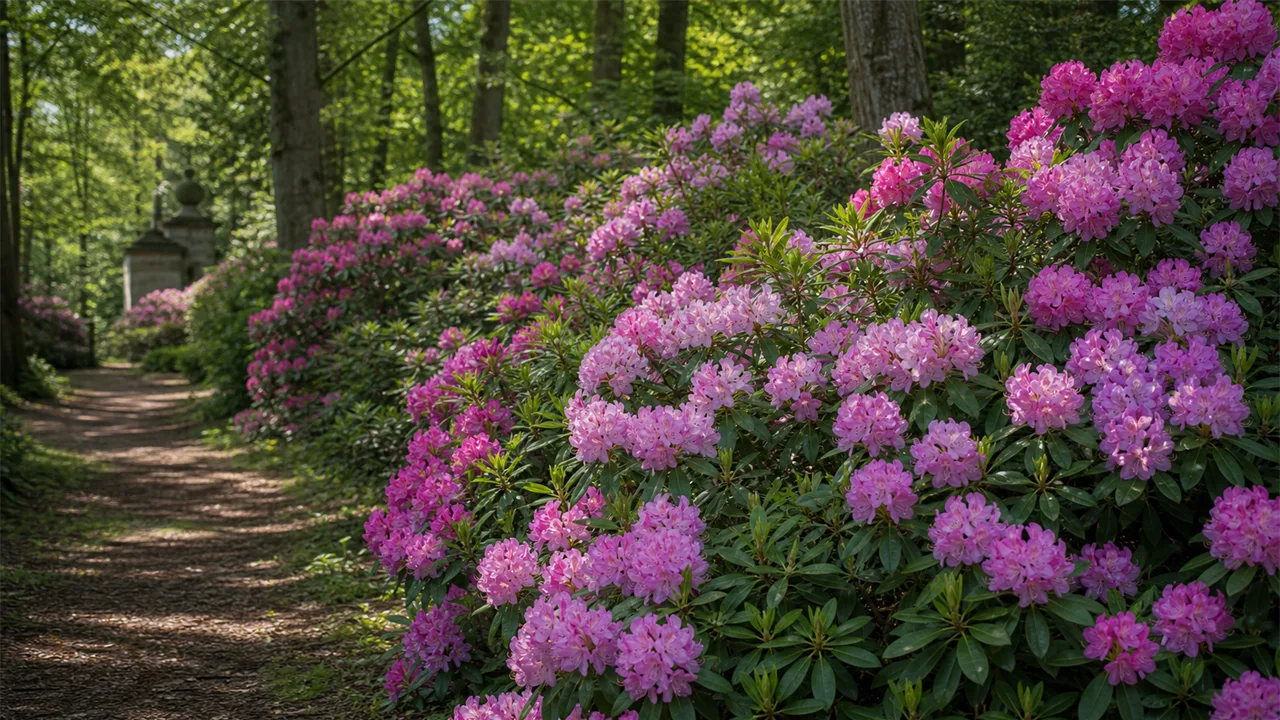
Rhododendrons carry a mat of fine roots close to the surface. A light shower can leave the rootballThe block of soil left around a plant's roots when it is planted or moved. dry, while compact wet ground can deprive the same roots of air. Neither a fixed watering interval nor an automatic feed holds here. It helps you decide from plant stage, infiltrated rainfall, soil pH, drainage and visible signs. This root mat is so fine that just one hour of exposed roots — mulchA layer of material (bark, straw…) laid on soil to retain moisture and limit weeds. pulled back, sun and air on bare soil — can be enough to kill the absorbing root network, which is why bare soil around the base is never a good idea.
In our climate The rhododendron is one of the most demanding subjects in our Mediterranean climate: it refuses lime and suffers from the dry heat of the Riviera. We keep it to partial shade, a decidedly acid and cool soil, and shelter from drying winds — otherwise chlorosisYellowing of the foliage caused by poor iron uptake, often linked to chalky soil. sets in, as on an underfed citrus.
In the UK, rhododendrons cope with cold easily; the real constraint is soil, since much of the country sits on chalk. On alkaline ground, the RHS recommends raised, well-drained beds with at least 30cm of lime-free ericaceous soilAcidic, peat-based soil used for plants that dislike lime and are prone to chlorosis., or lime-tolerant INKARHO rootstocks.
For a moisture-retentive border, compare its requirements with hydrangea care and Japanese camellia care, then browse the full plant encyclopedia.
Which rhododendrons are covered here?
Essential limit. This is a vast genus. Always check the cultivar label for eventual size, hardiness and light. An azalea is not a separate genus to exclude, but its leaves and seasonal cycle may differ from the large evergreen rhododendron used as the main reference here.
Where and how should a rhododendron be planted?
Test the soil pH before buying. Naturally acidic, humus-rich ground that stays moist without losing air is the most durable setting. In distinctly alkaline soil, a small pocket of ericaceous compost is not a long-term solution: roots eventually enter the surrounding ground and alkaline water can raise pH. A large drained container, a genuinely isolated raised bed or a cultivar grafted on a declared lime-tolerant rootstockThe root and base onto which a variety is grafted to give it vigour or resistance. is more controllable.
Plant in early autumn or spring, avoiding frost, heat and saturated ground. Make a wide rather than deep hole. Moisten the rootball, gently loosen circling roots and set its top level with the soil, slightly proud on heavier ground. Improve structure and drainage across the bed, backfill without heavy compaction and water slowly to settle soil around the roots.
Finish with a moderate layer of composted leaves or composted bark, kept clear of the stem base. Mulch reduces moisture loss and weeds; it replaces neither compatible soil nor an analysed fertiliser. Do not hoe beneath the shrub because its surface roots are easily injured.
When should you plant, check water, feed and inspect?
The plant’s actual stage, local weather and cultivar outrank the month. Pale dots mark a possible window, never an instruction.
| Jan | Feb | Mar | Apr | May | Jun | Jul | Aug | Sep | Oct | Nov | Dec | |
|---|---|---|---|---|---|---|---|---|---|---|---|---|
| Plant outside extremes | ||||||||||||
| Check rootball and drainage | ||||||||||||
| Feed after bloom if justified | ||||||||||||
| Deadhead / lightly prune | ||||||||||||
| Inspect leaves, buds and collar |
When should a rhododendron be watered without drowning its roots?
At planting. Check inside the rootball under the mulch, not only the surrounding soil. Rain can sit on foliage or dampen the surface without reaching roots. If the rootball begins to dry, apply water slowly across it; if it remains moist, wait. A permanently glossy rootball or a hole that retains water calls for drainage correction first.
During establishment. Shallow roots make young plants sensitive to wind and warm spells. Check more closely beneath eaves or trees that intercept rain. Sandy soil needs checking sooner than clay, but in both cases “often” describes inspection, not watering.
Established plants. Lift the mulch at the edge of the original rootball. Give nothing while the root zone remains moist and airy. When it has genuinely begun to dry during a period without effective rain, water slowly and deeply, then allow air to return. Pay particular attention in summer, when next year’s flower buds develop. In a dry winter, inspect evergreen plants on a frost-free day, but never water frozen or saturated soil.
Water source and signs. Rainwater is preferable where mains water is hard. Drooping or rolled leaves followed by brown margins may follow drought, but wilt in wet ground can indicate oxygen shortage or root disease. Adding water in the second situation increases risk.
Which NPK should a rhododendron receive, and when?
Begin with the no-feed option. The RHS and Clemson indicate that a vigorous established rhododendron in good acidic soil with mulch often needs little extra fertiliser. Pale leaves alone do not prove hunger: compaction, high pH, too little or too much water, pests and root disease can look similar.
The exact documented reference, only after that diagnosis, is an NPKThe three main nutrients in a fertiliser: nitrogen, phosphorus and potassium. ratio of 3:1:2 or 3:1:3, with 12-4-8 and 15-5-15 as examples in Clemson Extension’s factsheet. These US formulations document a ratio, not a UK dose or a product to seek at any cost. Select a locally labelled ericaceous fertiliser, compare its label with the reference, follow its rate and never feed a drought-stressed or waterlogged plant.
If feeding is genuinely warranted, apply after flowering to moist soil and stop by about mid-July in a climate with cold winters, avoiding late soft growth. Do not stack rich compost, general fertiliser and ericaceous feed. In a container, the RHS advises a slow-release fertiliser in spring or a liquid ericaceous feed only as directed.
An amendment and a fertiliser do different jobs. Composted leaves or bark support structure, aeration and moisture storage; the three NPK numbers describe nutrients. Mulch does not justify blind chemical pH correction, and fertiliser cannot repair poor drainage.
What should you do when leaves turn yellow?
Young yellow leaves with greener veins point towards chlorosis, often because high pH reduces iron availability. Test soil and, if possible, irrigation water before concluding. Also inspect the setting: nearby lime-rich concrete, a dry rootball, standing water, dark roots or vine-weevil larvae can alter the diagnosis.
Do not add vinegar, lemon juice, sulphur or iron by reflex. Naturally alkaline ground is difficult to change reliably around a large shrub. A container with ericaceous compost or a lime-tolerant rootstock is usually more controllable. If analysis confirms a deficiency in freely drained ground, use only a locally labelled solution suited to the result.
Four checks before adding water, iron or fertiliser
Read the stage and the whole plant
Record newly planted or established, container or open ground, flowering, weather and symptom location. One ageing yellow leaf is not the same as chlorotic new growth.
Inspect the root-zone evidence
Lift mulch and check the rootball, infiltrated rain, pH and drainage. Examine leaf undersides and the root collar before naming a deficiency or disease.
Change one probable cause
Address water, soil air, exposureThe amount of sunlight a spot in the garden receives (full sun, part shade, shade). or hygiene first. Fertiliser is considered only after these causes have been excluded, with the product label as the limit.
Record and compare
Date rain, watering, pH, feeding and the response. A simple history prevents water, iron and fertiliser being piled onto one symptom.
Chlorosis, drought, Phytophthora or a pest?
One sign is not a diagnosis. Photograph both sides of leaves, check the rootball and isolate a recent purchase that declines rapidly. Ask a plant-health service to confirm progressive dieback or any suspected regulated problem.
| Observed symptom | Possible cause | What distinguishes it | First action |
|---|---|---|---|
| Young leaves yellow while veins stay green. | High-pH chlorosis | The pattern starts on young foliage; hard water or alkaline soil are common, but damaged roots can interfere too. | Measure pH, moisture and drainage before adding iron or an acidifier. |
| Drooping or rolled leaves, dry margins and loss of older leaves after dry weather. | Water deficit | The rootball is dry beneath mulch and rain did not penetrate; severe cold can also make foliage droop temporarily. | Water slowly if the soil is thawed and dry, then watch the response. |
| Wilt, yellow or sparse foliage and dying shoots while soil remains wet. | Waterlogging, Phytophthora or another root disease | Dark degraded roots, an unpleasant smell or standing water; drought and honey fungus may resemble it. | Stop watering, prevent run-off into the area and obtain a diagnosis before replanting. |
| Rounded notches on leaf edges; legless white larvae close to roots. | Vine weevil | Adults feed at leaf margins, mainly at night; larvae damage roots and the collar, especially in pots. | Inspect after dark and examine the rootball; remove visible adults and seek locally appropriate biological control. |
| Fine yellow mottling above, brown-black dots or crusting below. | Lacebug | Insects and droppings occur beneath leaves, often in warmer sites; chlorosis more often follows the vein pattern. | Turn over several leaves, reduce site stress and identify before intervening. |
| Brown buds remain attached with small black projections; striped green leafhoppers may occur. | Bud blast | The dead bud does not drop. Leafhoppers are associated with the problem, but transmission is not treated here as proven. | Remove and dispose of affected buds, then monitor without spraying blindly. |
| White coating, circular spots, swollen galls or petals collapsing in wet weather. | Powdery mildewA foliage disease caused by a fungus, recognisable by its white, powdery coating., leaf spot, gall or petal blight | Shape, leaf side and wet-weather link separate these problems; aphids or scale add insects or honeydew. | Remove only badly affected tissue, improve airflow, water at the base and seek confirmation if it spreads. |
How do you keep a rhododendron in a pot?
Choose a compact cultivar and a stable pot with several unobstructed drainage holes. A peat-free ericaceous compost can work, but its structure changes over time. Check drainage, never leave the saucer full, and repot or refresh compost when the rootball compacts and water moves through poorly.
A pot dries faster in summer and may stay sodden in winter. Judge by weight, the feel of the compost and outflow, not the calendar. Prefer rainwater in hard-water districts. Feed only if needed, with a slow-release product in spring or during growth according to the label, without adding a second feeding programme.
Why does it not flower, and when should it be pruned?
Next year’s buds develop from late summer. Drought then, very deep shade, excess nitrogen or late pruning can reduce flowering. Also check cultivar, age and frost damage. After bloom, snap off faded trusses carefully without injuring new shoots where the plant’s size makes this practical.
Rhododendrons need little pruning. Remove dead or broken wood, then make light shaping cuts just after flowering. Hard renovation depends on the cultivar’s ability to break from old wood; spread it over several years rather than applying one rule to the whole genus.
Use the flowers to create depth in the garden
A rhododendron works better at a woodland edge than stranded in a hot lawn. A high, light canopy provides the dark contrast that makes flowers luminous without enclosing the foliage. Leave air around the plant’s mature volume and pair it with plants for compatible soil; the border becomes clearer and its watering more coherent.
Actions that weaken a rhododendron for the long term
Burying the top of the rootball deprives shallow roots of air.
Making a small acidic pocket in alkaline ground postpones the conflict without isolating roots or water.
Watering by calendar ignores intercepted rain, sheltered pots and soil that is already saturated.
Treating every yellow leaf with iron can hide drainage failure or root disease.
Feeding at planting or late in summer risks root scorch and soft growth vulnerable to cold.
Rhododendron questions
What pH suits a rhododendron?
A general range of pH 4.5–6.0 suits many garden rhododendrons. Test before planting. In markedly alkaline soil, a large drained pot or lime-tolerant rootstock is usually more reliable than a small hole of acidic compost.
How often should it be watered?
There is no universal interval. Check the rootball beneath mulch and count only rain that actually wet it. Water slowly when it begins to dry; wait while it remains moist, and diagnose rather than irrigate if it is saturated.
Which NPK fertiliser should I choose?
A healthy plant in good acidic soil may need none. Once need is established, Clemson documents ratios of 3:1:2 or 3:1:3, for example 12-4-8 or 15-5-15. They are references, not a UK dose: choose a locally labelled ericaceous product, follow its rate and apply after flowering, not late in summer.
Do yellow leaves always mean iron deficiency?
No. Young yellow leaves with green veins suggest high-pH chlorosis, but hard water, drought, waterlogging and root damage must also be checked. Measure before adding a corrective product.
Can a rhododendron grow in a pot?
Yes, with a suitable cultivar, a large free-drainingDescribes soil that lets water flow away easily, without pooling around the roots. pot and airy ericaceous compost. Check moisture more closely, empty the saucer, prefer rainwater in hard-water areas and refresh the compost when it compacts.
Botanical, cultivation and plant-health sources
- Royal Horticultural Society — How to grow rhododendrons: soil, rainwater, containers, limited feeding and water-stress signs.
- Royal Horticultural Society — Rhododendron diseases: bud blast, mildew, galls, spots and root disease.
- Royal Horticultural Society — Phytophthora root rot: non-specific decline and wet-soil differential.
- Clemson Cooperative Extension — How to grow rhododendrons: need gate, rootball watering and NPK ratios 3:1:2 / 3:1:3.
- Oregon State Universeity Extension — Spring care: pH 4.5–6, shallow roots and the late-feed limit.
- Kew Science, Plants of the World Online — Rhododendron L.: taxonomic scope and Ericaceae.