Hydrangea
Hydrangea, mainly Hydrangea macrophylla and Hydrangea paniculata in gardens
The generous shrub of cool half-shade. Success starts with identifying the species or cultivarA variety produced through selection or cultivation, distinct from the wild original plant., then matching the pruning and, for colour-responsive forms, the soil management to it.
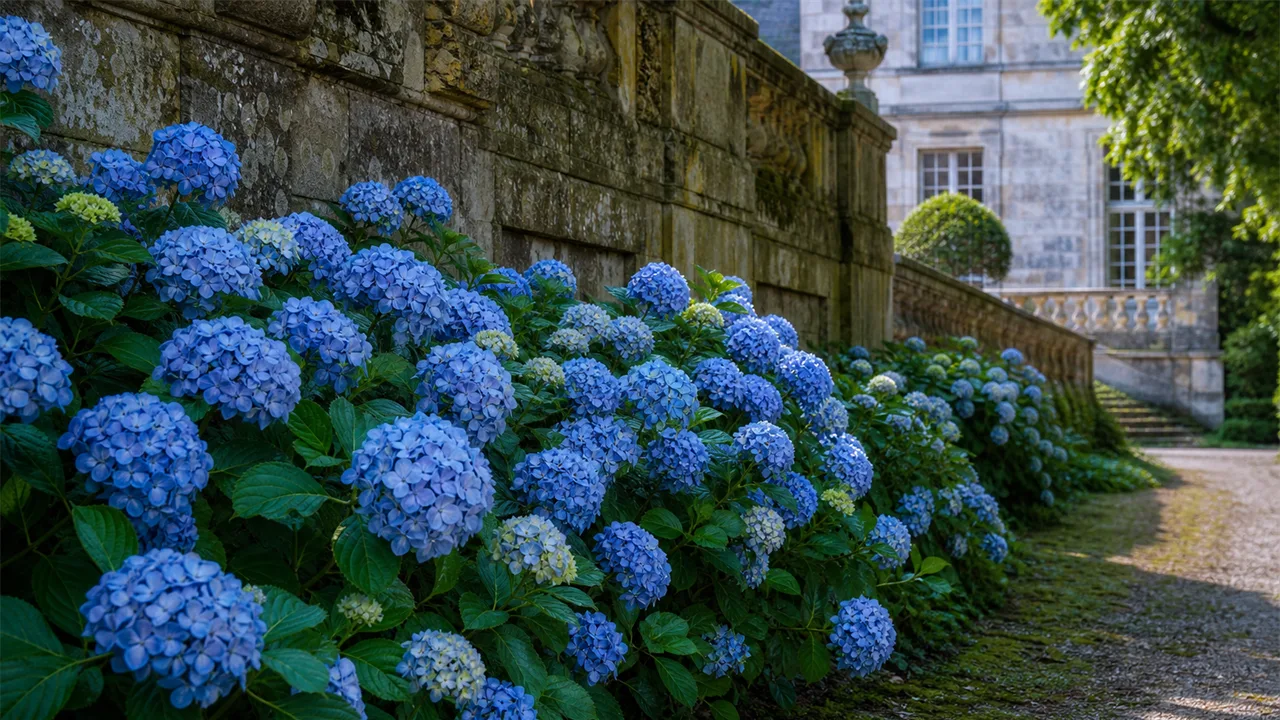
The hydrangea is a shrub for cool half-shade, planted in humus-rich soil that never dries out completely. It flowers from summer into autumn in blue, pink or white. Its type guides pruning; in colour-responsive macrophylla and serrata cultivars, pH and available aluminium influence blue or pink. Poor flowering is often linked to pruning or frost, but dense shade, water stress and excess nitrogen also matter.
To move around the encyclopedia, compare it with panicle hydrangea, which is more sun-tolerant and pruned differently, and with camellia and rhododendron, which share its taste for cool, acid soils. These comparisons remain plain text until their profiles are published.
The reliable markers before planting
Which hydrangea do you have? The question that governs pruning
Before colour, before variety, one marker changes everything: the species. It sets the hardiness, the sun tolerance and, above all, how you prune. There are four main garden types.
The bigleaf hydrangea (Hydrangea macrophylla), the most common, and the mountain hydrangea (Hydrangea serrata) flower mainly on last year’s wood: the buds form in late summer and overwinter on the stems. The panicle hydrangea (Hydrangea paniculata) and smooth hydrangea (Hydrangea arborescens) flower on the current season’s wood, so they accept stronger early-spring pruning when their framework or size calls for it.
This distinction explains many green shrubs with few or no flowers. Cutting every macrophylla stem back in autumn or spring can remove formed buds; some reblooming cultivars also flower on new wood, so check the cultivar label. Panicle hydrangeas tolerate harder pruning because they flower on fresh shoots, but do not require it every year.
When to plant, prune and enjoy a hydrangea
This calendar targets the actions that change the result. The prune row is mainly for macrophylla: keep the faded heads through winter and remove them in mid-spring, after the main frost risk, cutting only to the first or second strong pair of buds.
| Jan | Feb | Mar | Apr | May | Jun | Jul | Aug | Sep | Oct | Nov | Dec | |
|---|---|---|---|---|---|---|---|---|---|---|---|---|
| Plant | ||||||||||||
| Prune (faded heads) | ||||||||||||
| Flowering | ||||||||||||
| Steady watering | ||||||||||||
| Feed if needed |
How much water does a hydrangea need, and when should you feed it?
Track watering by the week, including rainfall. In open ground, use 25 litres per square metre as a normal-weather checkpoint; a hot, dry week can raise the need towards 50 litres per square metre. These figures are metric conversions of the one- and two-inch checkpoints published by the US university extension cited below, not a UK norm or an automatic dose. Subtract the rain that actually reached the root zoneThe area of soil occupied by a plant's roots, where water and nutrients matter most., then apply the balance at soil level in one or two slow, deep soakings. Reduce it in cool, mulched clay soil; watch more closely in sand, sun, the first growing season and containers. Check the soil 5-8 cm down before watering: if it is still cool and moist, wait. Leaves that droop only through the hottest hours and recover by evening may be signalling too much sun rather than dry roots.
Do not feed an established hydrangea by routine. In humus-rich soil, a healthy plant usually needs no more than mature compost at the surface as growth resumes. On light, poor soil, or where growth remains weak despite adequate moisture, apply a light dose of balanced 10-10-10 NPKThe three main nutrients in a fertiliser: nitrogen, phosphorus and potassium. in March-April: this is an example formulation published by the US university extension cited below and must be adapted to a soil assessment and the local product label. A second light feed in May-June is only warranted if vigour remains poor. To retain blue flowers on H. macrophylla and H. serrata, the same source gives a slow-release, low-phosphorus 12-4-6 as an alternative, because surplus phosphorus reduces available aluminium. Stop feeding by mid-August: excessive nitrogen drives soft foliage at the expense of flower buds and increases frost risk.
How to succeed with a hydrangea without fighting it
Read the shade and the water
Look for soft light without midday sun and a soil that stays cool. If the foliage flops in the afternoon and lifts again by evening, the plant lacks water or shade, not fertiliser.
Identify the type
Round mopheads or flat lacecaps that overwinter on the stems: macrophylla, prune lightly. Large conical panicles on new shoots: paniculata, cut back in spring.
Prune at the right time
On a macrophylla, remove only the faded heads in mid-spring, just above the first or second strong pair of buds. On a paniculata, cutting back by one-third to two-thirds in early spring is an option if you want a denser or smaller framework, not an annual requirement.
Protect the buds
In cold areas, keep the faded heads on through winter: they protect macrophylla buds from late frosts, another frequent cause of a flowerless year.
Why does a hydrangea turn blue or pink?
This is the hydrangea’s signature question. In colour-responsive cultivars of Hydrangea macrophylla and H. serrata, the shade depends on both varietal potential and soil chemistry: the flower pigment delphinidin combines with available aluminium. A pH around 4.5 to 5.5 favours blue when aluminium remains available; around pH 6 to 6.5 the flowers tend towards pink or red.
Two practical consequences. First, the same plant can be blue in your garden and pink next door: it is the soil talking. Second, white hydrangeas do not change colour, lacking this pigment, and paniculata and arborescens never turn blue either. Trying to blue a white one is wasted effort.
A true blue needs two conditions: acid soil and available aluminium. Test pH first. On soil that is already acid, organic mulchA layer of material (bark, straw…) laid on soil to retain moisture and limit weeds. mainly helps retain moisture; it will not reliably acidify chalky ground. On strongly alkaline soil, use a large container with peat-free ericaceous compost. Apply aluminium sulphate or lime only after testing and exactly to the product label.
This works over time, never in a single watering. A blue obtained by a one-off dose drifts back to mauve as soon as the soil re-buffers. The stable colour is the one that matches the true nature of the estate’s soil.
Which hydrangea to choose by use
A short selection to understand the uses, without turning the page into a catalogue. Pruning behaviour depends on the wood type, given for each species.
| Species or form | Main interest | Pruning and situation |
|---|---|---|
| Hydrangea macrophylla | The classic mophead or lacecap, blue or pink by soil | Old wood, light prune, cool half-shade |
| Hydrangea paniculata | Large conical panicles, white ageing to pink, very hardy | New wood, spring prune, gentle sun |
| Hydrangea arborescens ‘Annabelle’ | Wide white domes, reliable even after a hard winter | New wood, hard prune, half-shade |
| Hydrangea serrata | Fine outline, delicate lacecaps, shifting tones | Old wood, light prune, sheltered spot |
| Hydrangea quercifolia | Oak-like leaves with strong autumn colour, cream panicles | Old wood, minimal prune, drained soil |
| Hydrangea petiolaris | Self-clinging climbing hydrangea, ideal for a cool wall | Trained, prune after flowering, shade |
Why does a hydrangea fail to flower or wilt?
A frequent cause of no flowers is hard or ill-timed pruning on a non-reblooming macrophylla: cutting every stem back in autumn or spring removes buds formed the previous summer. The plant returns vigorous and green but without flowerheads. The response is not extra feed; limit pruning to faded heads and dead wood, while checking the cultivar.
Another frequent cause is spring frost, which damages buds already breaking. A frost pocket, an exposed site or autumn pruning that left buds unprotected increases the risk. In cold areas, keep the faded heads until the main frosts have passed.
Foliage that flops in full day is not always short of water: it is often too much sun. If the leaves lift again by evening, move the plant to half-shade rather than drowning the roots. Real drought stress is corrected by a thick mulch and steady watering, especially in the first year and in pots.
The hydrangea rewards patience and a true reading of the place. Give it bright half-shade at a woodland edge without strong root competition, evenly moist soil and the pruning suited to its type. The deep blue of great parks comes from the combination of an acid pH and available aluminium.
Frequently asked questions about hydrangeas
When should I prune a hydrangea?
It depends on the type. A bigleaf hydrangea (macrophylla) needs very little: remove faded heads in mid-spring. A panicle hydrangea flowers on the current season’s wood; in early spring, cutting it back by one-third to two-thirds is optional and depends on the size and framework you want.
Why is my hydrangea not flowering?
Hard or ill-timed pruning of a non-reblooming macrophylla is common, but also check late frost, dense shade, drought, excess nitrogen and the age of the plant. Some reblooming cultivars also flower on new wood.
How do I make a hydrangea blue?
Colour-responsive macrophylla and serrata cultivars need acid soil, around pH 4.5–5.5, and available aluminium. Test first; on chalky soilSoil rich in lime, often unfavourable to plants that prefer acidic conditions., prefer a large container of peat-free ericaceous compost. Use aluminium products only to their label. White hydrangeas never turn blue.
What exposure suits a hydrangea?
Cool half-shade, away from midday sun. In hot, dry sun the foliage wilts and the flowers scorch. Paniculata tolerates more light than macrophylla.
Can you grow a hydrangea in a pot?
Yes, in a large container with cool, acid compost and steady watering. Pots dry quickly: watch the water in summer and shelter tender types from hard cold.
Sources and editorial control
- RHS – How to grow shrubby hydrangeas: UK watering, mulching, feeding limits and pruning by type.
- Universeity of Connecticut – Hydrangea: weekly water demand, deep soakings and the late-season feeding limit.
- Mississippi State Universeity Extension – Hydrangeas: balanced NPK, low-phosphorus 12-4-6 and the risk of excess nitrogen.
- Kew Science, Plants of the World Online – Hydrangea: taxonomic frame and family Hydrangeaceae.