Camellia
Camellia, chiefly Camellia japonica, C. × williamsii and C. sasanqua in gardens
Glossy foliage and poised flowers when much of the garden is still quiet. A camellia succeeds in acid to neutral, moisture-retentive but aerated soil, with shelter from drying winds and measured feeding after flowering.
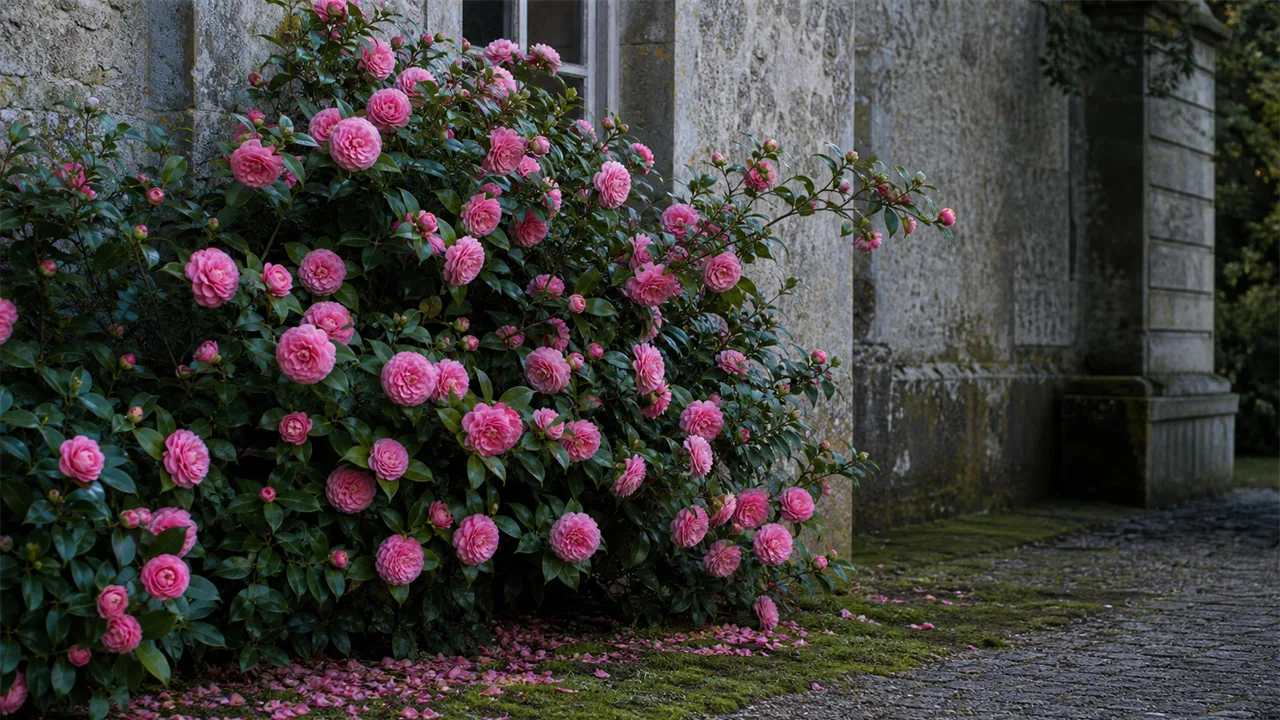
Camellia care makes sense once each job is tied to the plant’s cycle: new growth follows flowering, next year’s buds form through summer, then different groups flower from autumn into spring. Bud drop in February may therefore reflect drought the previous August; yellow leaves may point to alkaline conditions or damaged, waterlogged roots rather than a simple shortage of feed. Camellias form a mat of fibrous roots concentrated near the surface, which is why regular watering and mulchA layer of material (bark, straw…) laid on soil to retain moisture and limit weeds. do more good than feeding alone, and why hoeing close to the base easily damages the roots.
In our climate On the French Riviera, camellias are no easy win: our soils often tend to lime, and the Mediterranean summer quickly dries a shallow rootballThe block of soil left around a plant's roots when it is planted or moved.. We keep them to a sheltered spot, acidified and monitored soil, and top-up watering in summer — the same reflexes our citrus taught us against iron chlorosisYellowing of the foliage caused by poor iron uptake, often linked to chalky soil..
In the UK, camellias are rated hardy (RHS H5, H4 for Camellia sasanqua) and cope well with the British climate — the real risk is hard tap water in chalky regions, which can push the soil toward alkaline and trigger the same iron chlorosis as on the Riviera; the RHS recommends rainwater where mains water is hard.
For a layered part-shade border, compare its needs with hydrangea and, for a brighter flowering position, with rose. Browse all live species in the plant encyclopedia.
Reliable facts before choosing a camellia
Where should a camellia be planted?
Choose filtered light or gentle morning sun, away from cold drying air. An exposed east-facing position can thaw frozen flowers too fast, while reflected afternoon heat scorches leaves and dries the root zoneThe area of soil occupied by a plant's roots, where water and nutrients matter most.. Autumn-flowering sasanquas need more light and warmth than most japonicas, but are generally less hardy.
The ideal soil stores moisture without becoming airless. Improve structure with mature organic matter where necessary and mulch without banking material against the stem. On chalk, use a generously drained container with peat-free ericaceous compost rather than an isolated pocket of acid mix that surrounding soil and water will gradually neutralise.
When to plant, check water, feed and prune
This calendar is for a temperate UK garden. Shift it for the actual flowering group, local frost and soil condition; never plant into frozen, saturated or drought-stressed ground.
| Jan | Feb | Mar | Apr | May | Jun | Jul | Aug | Sep | Oct | Nov | Dec | |
|---|---|---|---|---|---|---|---|---|---|---|---|---|
| Plant | ||||||||||||
| Check root-zone moisture | ||||||||||||
| Feed after flowering | ||||||||||||
| Prune only if needed | ||||||||||||
| Inspect buds and blooms |
How much water does a camellia need in soil or a pot?
Planting and the first 18 months. RHS guidance calls for particular attention during establishment. In dry weather, check the soil at about 10 cm two or three times a week. If it is beginning to dry, soak the rootball and adjacent soil slowly; if it remains moist, wait. After rain, confirm how deeply water penetrated rather than subtracting a gauge reading automatically.
Established in open ground. There is no universal interval. Universeity of Florida guidance gives a warm-climate comparison of approximately 25 litres per square metre every 10–14 days during extended drought, and about 25 L/m² weekly while flowering. It is not a UK target: subtract effective rainfall, reduce or cancel it while soil at 10 cm remains moist, and reject it on heavy or poorly drained ground. As a conversion, 10 mm of water that actually infiltrates equals 10 L/m².
Summer bud formation. Do not allow the root zone to dry out completely in July and August, when next year’s flowers are being prepared. Mulch slows moisture loss. Water onto the soil with rainwater where practical; repeated use of very hard tap water gradually raises compost pH.
In a container. Test 3–5 cm down and lift the pot. When that layer starts to dry and the pot feels lighter, water slowly until it drains, let it finish and empty the saucer. A fixed volume would ignore pot size, porosity and root occupancy. Keep the compost lightly moist in winter, never saturated and never bone dry.
Which NPK should a camellia receive, and when?
Soil improvement and feeding are different jobs. Mature organic matter can improve poor soil structure; fertiliser supplies nutrients. For container plants, the RHS recommends feeding in spring with an ericaceous fertiliser and warns against feeding beyond the end of July. Do not feed a dry, waterlogged or declining rootball.
No UK authority consulted specifies one universal NPKThe three main nutrients in a fertiliser: nitrogen, phosphorus and potassium. grade. The clearest exact comparison is Universeity of Florida guidance for established landscape camellias: equal nitrogen and potassium with less phosphorus, for example 12-4-12 or 15-5-15, in spring and/or early summer. This Florida formulation is not a UK dose or a prescription for young plants and containers; its US area rate is deliberately not transferred.
Choose a locally labelled ericaceous product close to N = K with lower P, apply only its label rate to moist soil after flowering and stop by late July. One controlled-release application may be enough in a suitable border. Excess or late feed makes soft growth, risks root scorch and can contribute to bud drop. Yellow leaves do not prove iron deficiency: pH, drainage and roots must be checked first.
Four checks before adding water, feed or treatment
Name the group and stage
Record the species or cultivar, soil or pot, new or established plant, and whether flowering is over or buds are forming.
Read the root zone
Check at 10 cm in soil or 3–5 cm in compost, then note infiltrated rainfall, drainage and the last measured application.
Match at least two signs
Yellow leaves, wet soil and dark roots require a different response from yellow leaves on a dry alkaline site.
Change one variable
Correct drainage, water or exposure, date the change and watch new growth before combining fertiliser and treatment.
Choosing by season, colour and eventual size
Sizes and hardiness classes below are RHS references for UK conditions. Confirm the botanical label and local performance with a specialist nursery.
| Cultivar | Flowering and habit | Useful character | Watch for |
|---|---|---|---|
| C. japonica ‘Nuccio’s Gem’ | Upright, eventually 2.5–4 m | Large formal double white flowers; RHS AGM. | Pale flowers show rain, frost and petal blight quickly. |
| C. japonica ‘Adolphe Audusson’ | Large shrub, RHS class 4–8 m | Rich red semi-double flowers with visible stamens; AGM. | Not a permanently compact container plant. |
| C. × williamsii ‘Donation’ | Strong, upright; late winter to early spring | Large light rose-pink semi-double flowers; AGM. | Allow for its 4–8 m RHS size class. |
| C. japonica ‘Brushfield’s Yellow’ | Upright, 2.5–4 m | Creamy-white anemone flowers shading pale yellow at the centre. | The yellow is soft and central, not a uniformly yellow bloom. |
| C. sasanqua ‘Narumigata’ | 2.5–4 m; fragrant autumn flowers | Single pink-tinted white blooms and greater sun tolerance. | RHS H4: give it a very sheltered site or movable container. |
Brown flower, yellow leaf or falling bud: what is different?
One symptom is not a diagnosis. Inspect both leaf surfaces, roots in containers, soil moisture and speed of change. Any plant-protection product must be identified as suitable and legally authorised for the current UK use.
| Observed sign | Possible cause | Distinguishing clue | First action |
|---|---|---|---|
| Petals brown rapidly from within and the whole flower collapses. | Camellia petal blight Ciborinia camelliae | Fast progression through blooms in damp weather, unlike frost scorch confined to exposed edges. | Collect affected and fallen blooms, dispose of them away from compost and avoid moving contaminated debris or soil. |
| Young leaves or shoots become thick, fleshy, pale and swollen. | Camellia gall Exobasidium camelliae | A localised cream swelling rather than flat interveinal yellowing. | Remove affected tissue before the pale spore-bearing surface develops and improve air movement. |
| Sticky leaves, wipeable black coating, scales or aphids. | Scale or aphids with sooty mould | The mould grows on honeydew and wipes off; it is not internal leaf rot. | Isolate an affected pot, remove a small colony physically and reassess air, light and plant stress. |
| Notches around leaf edges; declining potted plant with chewed roots. | Vine weevil | Adults feed at night; curved pale larvae may be present in the rootball. | Inspect after dark and examine the rootball to confirm the pest before intervention. |
| Yellow tissue between green veins and weak growth. | High-pH chlorosis or inactive roots | Chalk, hard water, cold or waterlogging can mimic iron shortage. | Test pH and drainage and inspect container roots before adding a corrective product. |
| Wilting and yellowing while soil stays wet; roots turn brown and soft. | Waterlogging or Phytophthora root rot | Persistent saturation and loss of firm pale roots. | Stop watering, clear drainage and seek a diagnosis if crown or shoot dieback progresses. |
| Dry or falling buds without a clear lesion. | Physiological stress | Past summer drought, a hot dry room, frost or late/excess feed may all be involved. | Rebuild the history from July, stabilise moisture and temperature, then assess the next cycle. |
How to protect flowers without spoiling the natural habit
Camellias need little pruning. Immediately after flowering, remove dead wood and shorten a wayward branch to a lateral shoot if necessary. Later pruning removes developing buds. Clean tools between sound and suspect tissue, and keep petal-blight debris out of compost.
In most UK gardens, a suitable H5 spring cultivar in drained soil needs shelter from cold wind and morning sun more than wrapping. Protect container roots during prolonged frost. Autumn-flowering H4 forms deserve a sheltered wall or an unheated, bright protected place; water lightly on frost-free days if the rootball is drying.
Use the camellia as structure, not only as a bouquet
Dark evergreenDescribes foliage that stays on the plant all year, even in winter. foliage reads beautifully against pale stone and beside a route used in winter. Give the shrub its eventual width and keep the lower planting quiet. Once flowering ends, a well-sited camellia should still hold the composition through its outline and polished leaves.
What most often weakens a camellia
Watering by weekday ignores rainfall, soil texture and actual depth of moisture.
Digging a small ericaceous pocket in chalk is not a durable pH solution.
Feeding yellow leaves before checking roots can worsen waterlogging injury.
Stopping water after flowering leaves summer-forming buds exposed to delayed damage.
Pruning in autumn removes a share of next season’s display.
Camellia questions
How often should a camellia be watered?
Not to a fixed interval. For the first 18 months, check around 10 cm down two or three times weekly in dry weather and water only as that zone starts to dry. An established plant needs a deep soak during extended drought; a pot is watered when the top 3–5 cm begin to dry and must then drain fully.
Which NPK fertiliser is suitable?
The precise university comparison is 12-4-12 or 15-5-15 for established landscape camellias in Florida: equal nitrogen and potassium with less phosphorus. In the UK, retain the proportion rather than the foreign rate, choose a labelled ericaceous product, feed after flowering and stop by the end of July.
Why do flower buds fall before opening?
Drought during summer bud formation may appear months later. A hot dry room, frost, excess fertiliser or feeding too late can also contribute. Reconstruct the growing history before blaming a pest.
Can a camellia grow in full sun?
Most japonicas prefer bright partial shade with shelter from fierce sun and cold wind. Sasanquas need and tolerate more sun to flower well but tend to be less hardy, so cultivar and microclimate matter.
Why are the leaves turning yellow?
Alkaline soil or prolonged hard water can restrict iron uptake, but cold, saturated or diseased roots look similar. Test pH, drainage and container roots before adding iron or feed.
Botanical, cultivation and plant-health sources
- Kew Science — Camellia japonica: accepted name, family and native range.
- Royal Horticultural Society — How to grow camellias: UK site, planting, 10 cm check, establishment, containers, feeding and pruning.
- RHS — Camellia problems: bud drop, oedema, chlorosis, sooty mould and differential diagnosis.
- Universeity of Florida IFAS — Camellias at a Glance: pH, external water comparison and exact 12-4-12 or 15-5-15 formulations, explicitly bounded to Florida.
- NC State Extension — Camellia japonica: soil, exposure and establishment context.
- RHS — Camellia gall: signs and management of Exobasidium camelliae.
- Estación Fitopatolóxica Areeiro — Camellia pests, diseases and disorders: specialist health corpus, used as a declared Spanish professional source.
- RHS — Camellia selection: flowering groups, mature sizes and listed cultivars.