Panicle hydrangea
Hydrangea paniculata Siebold
Conical flower heads open cream or white and often age through pink, carried on the current season’s growth. Panicle hydrangea accepts more sun than bigleaf hydrangea, but it is not a dry-border shrub: reliable moisture, free drainage and restrained feeding matter more than a rigid care timetable.
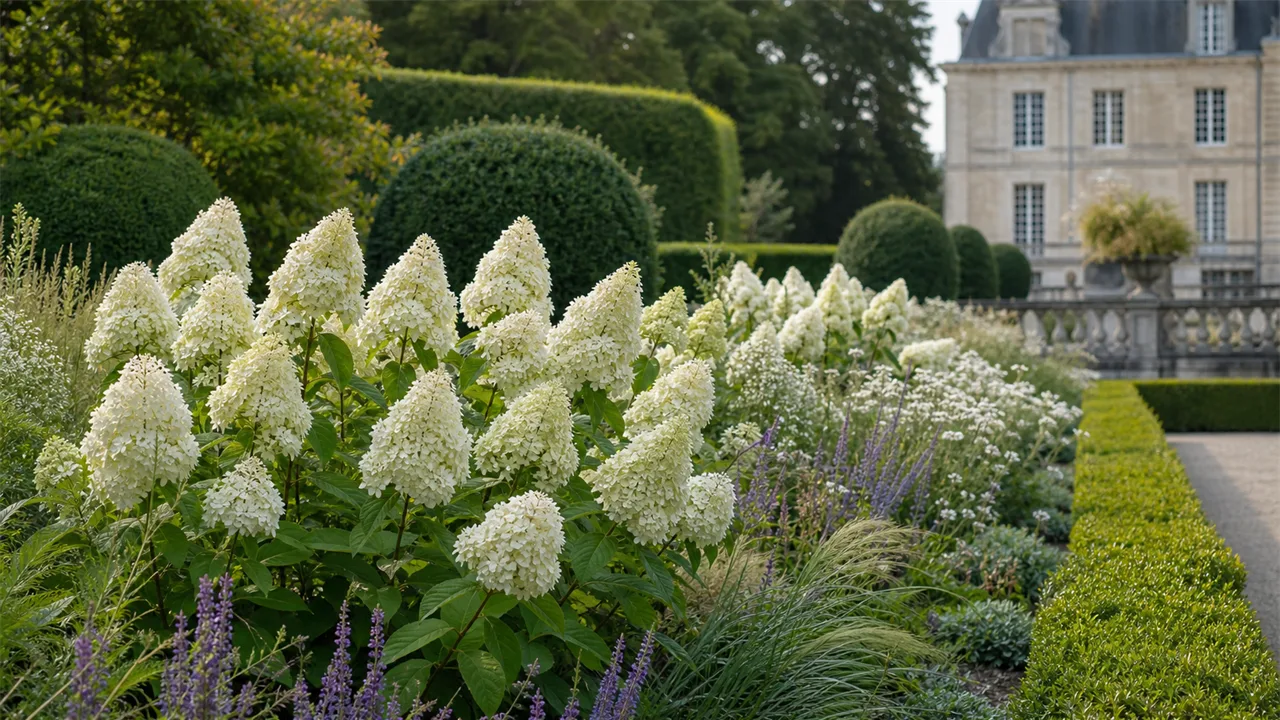
Panicle hydrangea must not be pruned by the rules used for every other hydrangea. It flowers on new wood, so late-winter pruning can shape the shrub without removing the coming season’s established flower buds. Watering calls for the same precision: midday flagging does not prove dry soil when the leaves recover overnight and the root zoneThe area of soil occupied by a plant's roots, where water and nutrients matter most. remains moist. With no taproot, panicle hydrangea spreads a fibrous root network well beyond its foliage rather than diving deep — watering a wide area around the base matters more than watering deeply.
In our climate It is the most realistic hydrangea for us: it takes sun better than the bigleaf hydrangea. On the Riviera it still remains a shrub of cool soil — we give it amended ground, a thick mulchA layer of material (bark, straw…) laid on soil to retain moisture and limit weeds. and a steady water reserve through heatwaves.
In the UK, Hydrangea paniculata is RHS-rated H5-H6 and suits most gardens without reservation — it’s the most forgiving hydrangea for British conditions. Watch for powdery mildewA foliage disease caused by a fungus, recognisable by its white, powdery coating. and grey mouldA fungus, also called botrytis, that affects damp flowers and leaves., and improve chalky soils with organic matter.
Compare it with bigleaf hydrangea before choosing a site. For another long-flowering shrub, see the garden rose. All completed profiles are collected in the plant encyclopedia.
Reliable facts before choosing a panicle hydrangea
Where should it grow for sturdy stems and lasting flowers?
Give it open light without immediate competition from established tree roots. Full sun suits many UK gardens where moisture is dependable; a hot south-facing wall or shallow rain-shadowed bed is less forgiving. Dense shade stretches the growth and reduces flowering. Allow the mature width stated for the named cultivar rather than trying to hold an unsuitable selection in a narrow gap by severe annual pruning.
Set the root flare at soil level in a hole wider than the rootballThe block of soil left around a plant's roots when it is planted or moved.. Loosen circling roots, backfill mainly with the excavated soil and water to settle it. Mulch the surface while leaving stems and crown clear. A permanently wet site needs a different planting position, not gravel hidden at the bottom of a water-holding pit.
When should you plant, check water, feed and prune?
This is a UK temperate guide. Shift each task for local frost, rainfall, soil temperature and actual growth; never work frozen, saturated or heat-stressed ground.
| Jan | Feb | Mar | Apr | May | Jun | Jul | Aug | Sep | Oct | Nov | Dec | |
|---|---|---|---|---|---|---|---|---|---|---|---|---|
| Plant | ||||||||||||
| Check moisture | ||||||||||||
| Feed if needed | ||||||||||||
| Prune | ||||||||||||
| Inspect leaves and flowers |
How do you water without confusing heat, drought and waterlogging?
New planting. During the first two growing seasons, inspect the root zone two or three times a week in dry weather. Move the mulch and test about 8–10 cm down. Water slowly across the rootball and its edge when that layer begins to lose moisture; wait if it remains moist. A brief shower can wet only the surface.
Established shrub. Do not water by weekday. Check after sustained warm, dry weather and soak the root area only when the deeper soil is drying. In its bigleaf-hydrangea section, Maryland Extension documents overnight recovery while the soil is not dry as a sign of heat stress. For H. paniculata, use that sign only as a clue to confirm at the root zone, not as species-specific proof. Continually adding water to cool, wet soil removes air from the roots.
Container. Check the top 3–5 cm and lift or tilt the pot to learn its moist weight. When it starts to dry and feels lighter, water in stages until excess drains, then empty the saucer. Wind, a small dark pot and a warm wall increase the checking frequency; they do not justify an automatic daily dose.
Keep an open organic mulch clear of the stems and water the ground in the morning. Avoid routine overhead watering: prolonged wetness and splash favour Botrytis and leaf spots.
Which NPK suits panicle hydrangea, and when?
Establish the need first. The RHS five-year trial adjusted nutrients from annual soil analysis, rather than treating every plant to the same schedule. A healthy, flowering shrub in decent soil may need only a modest compost mulch. Excess nitrogen can produce soft, long growth and reduce flowering.
The clearest exact number found is a slow-release NPKThe three main nutrients in a fertiliser: nitrogen, phosphorus and potassium. 5-10-10, applied in late spring and midsummer but not after 15 August, in Universeity of Connecticut guidance for the Hydrangea genus. It is a US genus-level comparator, not a UK dose or a formula proven specifically for H. paniculata. The American amount, a newly damaged root system and a container must not be inferred from it.
In practice, top-dress with mature compost in spring where organic matter is low. If growth, foliage or a soil test justifies fertiliser, choose a locally sold hydrangea or flowering-shrub product with a declared analysis; use 5-10-10 only as the transparent comparison and follow the UK label on already moist soil. One spring slow-release application is often enough. Consider a second feed before midsummer only where both the label and observed need support it, then stop nitrogenous feeding so growth can mature.
Four checks before adding water, feed or treatment
Name the stage and setting
Record cultivar, ground or pot, planting date, aspect and mulch.
Read the root zone
Check 8–10 cm in soil or 3–5 cm in a pot; note effective rain, drainage and the last watering.
Compare midday with morning
Recovery overnight in moist soil suggests heat; lasting wilt with brown roots suggests oxygen loss or rot.
Change one variable
Correct water, drainage or shade, date the action and assess new growth before combining feed and pesticide.
Hard or light pruning: what changes?
The RHS trial found a useful trade-off: hard pruning produced tight, dense plants and larger but fewer flower heads; light pruning retained more, smaller panicles. Prune in late winter or early spring before strong extension growth.
| Aim | Action | Likely result | Watch for |
|---|---|---|---|
| Natural large shrub | Remove dead, crossing wood and old flowers. | Many flowers and a relaxed outline. | Thin the centre gradually if congested. |
| Compact framework | Shorten last year’s shoots to sound buds. | Stronger shoots and larger panicles. | A level haircut can look rigid. |
| Renew an old plant | Remove a few oldest stems at the base over several years. | Steady replacement growth. | Do not empty the framework in one season. |
| Maintain a standard | Shape the crown without cutting into the formed trunk. | Retains a small-tree outline. | Remove basal shoots and support overloaded branches. |
Spotted, sticky or wilted leaves: what should you distinguish?
RHS lists aphids, capsid bug, hydrangea scale and vine weevil, with leaf spot, powdery mildew, Botrytis and occasional honey fungus. Many cases are cosmetic. Identify the organism and check current UK authorisation before any plant-protection product.
| Sign | Possible cause | Useful distinction | First response |
|---|---|---|---|
| Sticky, distorted young growth. | Aphids | Colonies and honeydew, sometimes wipeable sooty mould. | Tolerate predators or dislodge a small colony; avoid high nitrogen. |
| Brown scales or white cottony masses. | Hydrangea scale | Fixed insects on stems or leaf undersides with honeydew. | Remove small colonies and improve air movement. |
| Notched leaves; root decline in pots. | Vine weevil | Nocturnal adults and pale C-shaped larvae in compost. | Inspect at night and check the rootball before acting. |
| Small sunken brown marks and later holes. | Capsid or plant bug | Feeding injury on expanding leaves, often limited. | Monitor; control is commonly unnecessary. |
| Brown or purple leaf spots. | Fungal leaf spot | Often starts low and spreads with splash. | Water below foliage and clear affected fallen leaves. |
| White powdery coating. | Powdery mildew | Worse in crowded, humid canopies. | Improve spacing and remove badly affected debris. |
| Brown flowers or tissue with grey mould. | Botrytis | Cool, damp conditions and flowers staying wet. | Remove affected material and stop overhead watering. |
| Persistent wilt in wet soil, brown roots. | Waterlogging or root rot | No overnight recovery and slow drainage. | Stop watering, clear outlets and seek diagnosis if decline spreads. |
Use pale panicles as part of the garden’s structure
Place a generous cultivar against dark foliage or weathered stone, where late flowers catch low light. Allow the base and mature width to remain visible. Compact forms often look more convincing repeated through a border than stranded in undersized pots. Cultivars with an open proportion of fertile flowers also offer more to visiting insects than heads composed almost entirely of sterile florets.
What most often weakens a panicle hydrangea?
Treating it as a deep-shade shrub reduces compact growth and flower.
Watering every midday wilt can saturate soil that is already moist.
Using high-nitrogen feed encourages soft stems and foliage.
Copying a foreign 5-10-10 dose ignores local soil, label, stage and root volume.
Hard-pruning every plant by default sacrifices flower number for size whether or not that effect is wanted.
Questions about panicle hydrangea
How often should I water a panicle hydrangea?
Not by a fixed interval. For the first two growing seasons, check 8–10 cm down two or three times a week in dry weather and water when that layer begins to dry. Check established plants during sustained drought; test pots at 3–5 cm and by weight.
Which NPK should I use?
The exact university comparator is slow-release 5-10-10 in late spring and, if needed, midsummer, with no application after 15 August, for the Hydrangea genus in Connecticut. In the UK, use the number as a declared comparison, not a dose: follow a local product label on moist soil only when soil or growth justifies feeding.
Does it prefer sun or shade?
It flowers best in good light. Sun is suitable where soil stays reliably moist; give afternoon shade on hot, dry sites. Dense shade reduces flowering and stretches stems.
When should it be pruned?
Prune in late winter or early spring because it flowers on the current year’s growth. Hard pruning generally means larger but fewer panicles; light pruning keeps a more natural plant and more flower heads.
Why does it wilt in moist soil?
Temporary midday flagging that corrects overnight can be heat stress. Persistent wilt with wet soil and brown roots points to oxygen loss or root disease. Check depth and drainage before adding water.
Botanical, cultivation and plant-health sources
- Kew Science — Hydrangea paniculata: accepted name, family and native range.
- Royal Horticultural Society — Hydrangea paniculata: UK site, soil, size, hardiness, pests and diseases.
- RHS five-year panicle hydrangea trial: pruning comparisons and nutrient management based on testing.
- French National Horticultural Society — panicle hydrangea: water, compost and cultivation, used as a declared European source.
- Universeity of Connecticut — Hydrangea: exact 5-10-10 comparator and timing, bounded to US genus-level guidance.
- Universeity of Maryland Extension — Hydrangea problems: bigleaf-hydrangea heat clue, excessive nitrogen and diagnostic method, with the cross-species limit stated.
- Universeity of Connecticut — Hydrangea diseases and pests: symptom distinctions and pest biology.