Ornamental allium
Allium L. — bulbous species and hybrids grown for flowers
Clean flower globes depend less on constant care than on sun, free drainage, water only when the bulbA rounded underground organ that stores a plant's reserves during dormancy. zone dries, and restrained feeding.
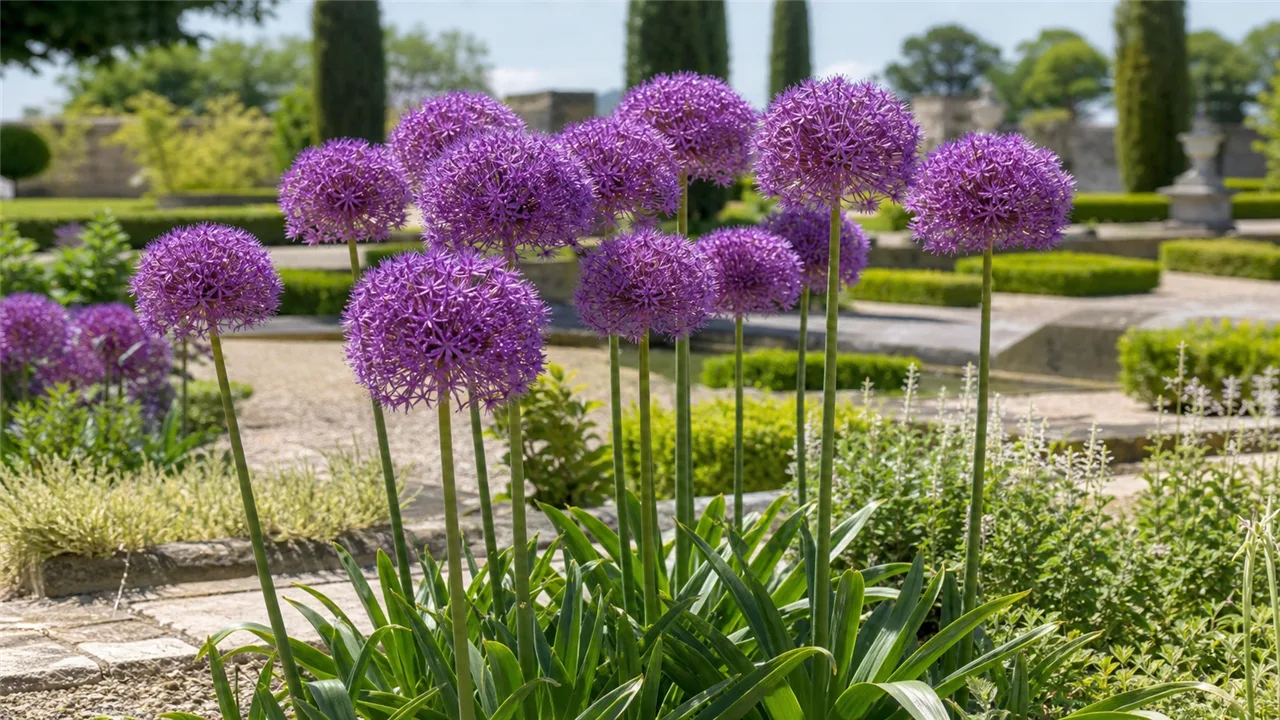
Ornamental alliums are often sold as maintenance-free bulbs. They come close once established, provided normal summer dieback is not mistaken for thirst and damp soil is not mistaken for useful moisture. Those distinctions translate into observable decisions. Contractile roots gradually adjust the bulb’s depth over the seasons, but the feeder roots stay shallow and cannot forage lower down — which is why well-structured topsoil matters more than deep digging.
In our climate The ornamental allium sits well with our Mediterranean climate: the dry Riviera summer matches its rest, when the bulb actually prefers ground that dries out. We give it sun and sharp drainage, and stop watering as soon as summer senescence begins rather than mistaking its normal yellowing for thirst.
In the UK, ornamental alliums are generally trouble-free in borders, sharing the pests of edible onions — white rot, downy mildew, onion fly — but rarely causing serious losses. The RHS is still researching allium rust, since cultivarA variety produced through selection or cultivation, distinct from the wild original plant. resistance varies and isn’t yet well understood.
For a balanced border, compare the position with the hydrangea’s requirements and the garden rose’s requirements, then browse the full plant encyclopedia.
Which ornamental alliums are covered here?
Scope guardrail. Allium also contains onions, garlic, leeks and rhizomatous perennials. Vegetable yield schedules and advice for clump-formers such as “Millenium” are not transferred to the autumn-planted ornamental bulbs covered here.
Where, when and how should the bulbs be planted?
Plant in early to mid-autumn in an open, sunny place where water clears after heavy rain. On heavy ground, improve drainage across the bed or raise the planting level; a small pocket of loose material inside saturated clay can simply collect water.
The RHS gives a planting depth of about four times the bulb diameter. Measure from the base, keep the point upwards and let a species-specific label override this group rule. Give tall alliums more space than compact ones and avoid freshly manured, over-rich ground.
Water once after planting only when soil is dry, to settle it around the bulb. Let autumn rain take over when it has genuinely reached planting depth.
A stage-led care calendar
| Stage | Decision |
|---|---|
| Autumn | Plant firm bulbs, correct drainage and water only if soil remains dry at bulb depth. |
| Late winter – spring | Watch emergence, slugs, mines and actual soil moisture before adding anything. |
| Flowering | Keep living foliage intact; support only tall stems exposed to wind. |
| After flowering | Let leaves replenish the bulb; where a need is established, 5-10-5 remains a US university comparator for spring-flowering bulbs, never a universal Allium formula or dose. Choose one window: here or at emergence, never both. |
| Summer dormancy | Stop routine irrigation, especially on heavy soil; divide crowded bulbs only after dieback. |
When should ornamental alliums be watered?
After planting. Push a finger or narrow probe beside the bulb to discover how far moisture has travelled. A dry surface may cover moist soil, while a short shower may wet only the top. Water only when the planting zone is dry and no useful rain is due.
During rooting and first growth. Check sandy soil, slopes, exposed sites and new plantings more often. If dry, apply water slowly enough to reach the root zoneThe area of soil occupied by a plant's roots, where water and nutrients matter most., then allow air back into the pores. Wait while clay is still sticky or glossy.
Established bulbs in open ground. RHS guidance says watering is not usually needed. During a prolonged dry spring, inspect at bulb depth while leaves remain green and water only if that zone is dry. Count rainfall only when it has infiltrated this far.
Containers. Their smaller reserve dries faster. Check below the surface, water to drainage when the active compost is dry, and empty any saucer. The mix must never remain saturated.
Stop signal. As leaves yellow naturally and the bulb rests, reduce and then stop routine watering. A soft bulb, rotten smell or persistently wet mix calls for drainage and diagnosis, not more water.
Which NPK should be used, and when?
The default is no routine feed. The RHS states that ornamental alliums do not need regular feeding. A flowering planting in properly prepared soil does not benefit from annual compost plus several fertiliser applications.
Where a need is established, the exact reference is NPKThe three main nutrients in a fertiliser: nitrogen, phosphorus and potassium. 5-10-5. Iowa State Extension documents it for established spring-flowering bulbs either as growth emerges or after flowers fade, not both. This is a bulb comparator, not a cultivar-specific prescription: use a product authorised for the intended use and its UK label rate. The US source does not supply a transferable dose.
Universeity of Missouri Extension also gives 5-10-5 after flowering and links excessive nitrogen with bulb rot. Reserve feeding for declining flowering after light, crowding, drainage and bulb health have been checked. Never feed a soft bulb in saturated soil.
Soil amendment is not fertiliser. Mature compost can gradually improve poor soil structure; 5-10-5 supplies nutrients in a known ratio. Avoid fresh manure and do not routinely stack compost, planting feed and an after-flowering application.
Four checks before adding water or feed
Name the stage
Record planting, green growth, flowering, yellowing or dormancy. The same soil does not justify the same action at every stage.
Cross-check depth and symptoms
Inspect moisture at bulb depth, infiltrated rain, drainage and at least two matching signs before deciding that drought or disease is responsible.
Change one variable
Act first on the best-supported cause: water, drainage, crowding, light or nutrition. Avoid a stack of contradictory interventions.
Record and contain
Date rain, watering and feeding. Remove a rotten bulb without moving its soil elsewhere and clean tools before using them in another bed.
Normal dieback, rot, downy mildew or a pest?
These signs are a triage tool, not a laboratory diagnosis. Lift one badly affected plant to inspect bulb and roots instead of watering the whole bed blindly.
| What you see | Possible cause | Useful differential | First action |
|---|---|---|---|
| Leaves yellow fairly evenly during or just after flowering; bulb remains firm. | Normal senescence | Timing matches the species and there is no soft base or fungal growth. | Let leaves finish dying back, then remove them and reduce water. |
| Limp leaves, soft base, rotten smell or brown bulb in wet soil. | Waterlogging or bulb rot | Saturation and softness separate this from a dry dormant bulb. | Stop watering, remove the affected bulb and correct drainage. |
| Yellowing and wilt; decayed roots and bulb base with white fluff, then tiny black grains. | Onion white rot Stromatinia cepivora | Black sclerotia embedded in white growth are strongly characteristic. | Remove bulb and attached soil; seek local advice before replanting any Allium. |
| Tip-down yellowing followed by white to purple growth in mild, humid weather. | Allium downy mildew Peronospora destructor | Humid fungal growth differs from an even end-of-cycle fade. | Remove badly affected tissue, improve airflow and keep foliage dry. |
| Lines of white dots or mines, twisted leaves; pale larvae or brown pupae in tissue. | Allium leaf miner | Cold-related distortion has no mines, larvae or pupae. | Remove infested material and do not carry debris to another bed. |
| Young shoots rasped or holed, with slime trails. | Slugs or snails | Damage is external and often nocturnal, with no tunnelling in the bulb. | Inspect at dusk and protect emerging shoots mechanically. |
| Plant collapses and larvae are present in roots or bulb. | Possible onion fly | Internal larvae and bulb damage distinguish it from ordinary leaf dieback. | Isolate and discard the bulb; confirm the pest before taking further action. |
Why have established alliums stopped flowering?
Start with light and drainage. Increasing shade, a wet pocket or unsuitable planting depth matters more than an assumed lack of fertiliser. Then check for overcrowding and whether foliage was removed before it yellowed.
Soft leafy growth after high-nitrogen feed does not promise large umbels. If the site is sound but flowers are diminishing, divide after dormancy or use the single, bounded 5-10-5 option described above.
How to display the globes while hiding fading foliage
Repeat tall alliums in small drifts among perennials whose leaves rise as the allium foliage declines. Fine grasses, hardy geraniums or catmint screen the base without hiding the outline. Use compact species near an edge or rock garden and keep tall stems out of a wind corridor.
Leave some dry heads when they remain crisp; they extend structure without requiring irrigation. Remove them when self-seeding is unwanted or conserving bulb reserves matters more.
The mistakes that cost the most bulbs
Watering every week by default. The surface says nothing about infiltrated rain or moisture at bulb depth.
Treating yellow leaves as drought. Many tall alliums normally lose foliage as they flower.
Planting in an enriched sump. A wet pocket around the bulb encourages oxygen stress and rot.
Stacking amendment and fertiliser. Excess richness, particularly nitrogen, upsets growth and increases risk.
Copying garlic-crop recipes. These are ornamental border bulbs, not a food crop.
Frequently asked questions about ornamental alliums
Should bulbs be watered after planting?
Yes when soil is dry at planting depth. Give one settling application, then count rainfall only when it penetrates that far.
Which NPK is appropriate?
The documented spring-bulb reference is 5-10-5, at emergence or after flowering, never both. It is conditional and the amount comes only from the local product label.
Why do leaves yellow during flowering?
This is common and often normal in tall alliums. Look for a soft base, smell, fungal growth or mines before assuming drought.
Can ornamental alliums grow in pots?
Yes, in a deep, freely draining pot. Check below the surface, water during growth only when the mix dries, and shelter dormant pots from persistent rain.
When should heads and leaves be cut?
A dry seedhead may stay for structure. Keep leaves while green and remove them once fully yellow and loose.
Checked sources and transfer limits
- Kew — Plants of the World Online — taxonomy: Allium, Amaryllidaceae.
- Royal Horticultural Society — allium guide — UK planting, drainage, water, feeding and ornamental-allium problems.
- Iowa State Extension — bulbs after bloom — 5-10-5 ratio and alternative timing; US comparator, not a UK dose.
- Universeity of Missouri Extension — spring bulbs — post-flowering 5-10-5 and excess-nitrogen risk; comparator only.
- RHS — onion white rot — diagnostic signs and soil persistence.
- RHS — allium downy mildew — tip-down dieback and fungal growth in humid conditions.
- RHS — allium leaf miner — feeding dots, mines, distortion, larvae and pupae.
- Iowa State Extension — ornamental onions — ornamental scope, forms and flowering season.