Okitsu Wase satsuma
Citrus unshiu ‘Okitsu Wase’ — “Wase” denotes an early selection
An early satsuma with slightly flattened, easy-peeling fruit that is usually seedless. In Britain, its useful advantage is a head start on ripening, paired with dependable container culture and bright frost-free winter shelter.
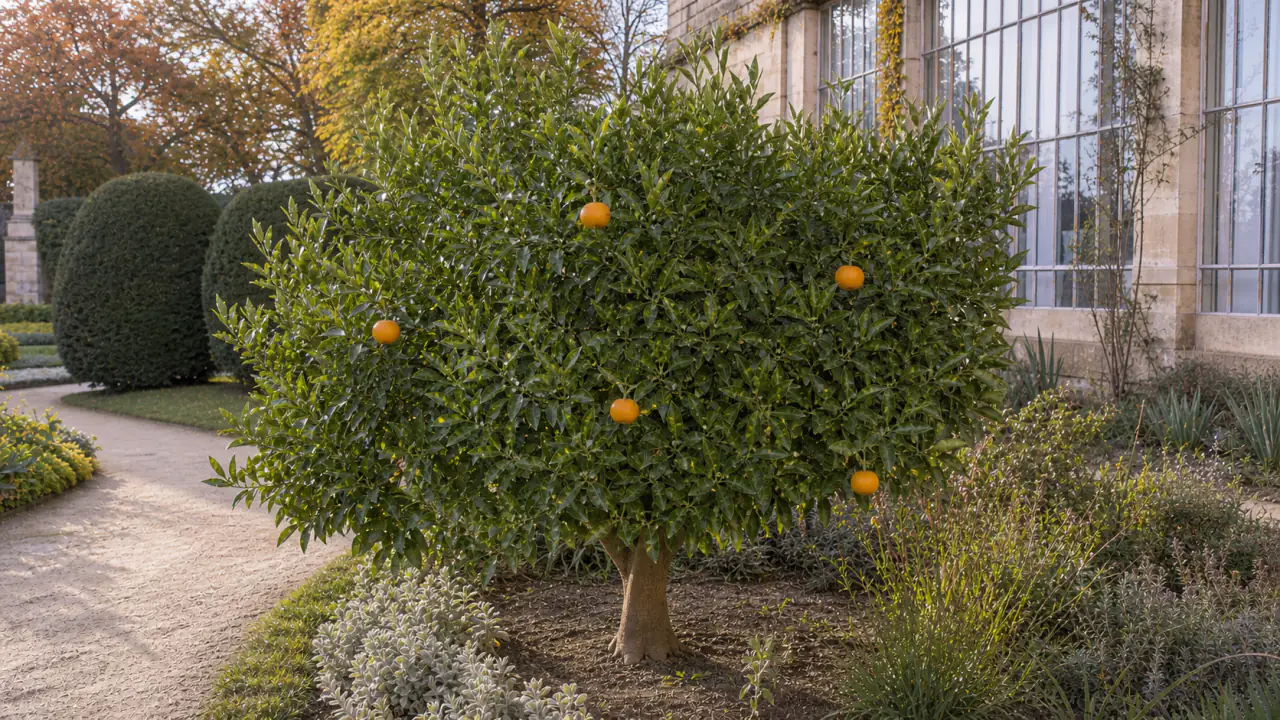
Okitsu Wase was selected in Japan from a nucellar seedling of ‘Miyagawa Wase’ produced after controlled pollination with trifoliate orange. Because nucellar growth is maternally derived, that history does not make Okitsu a genetic Miyagawa × Poncirus hybrid. In the comparison reported by UCR, it had more oblate fruit, higher sugar and maturity about a week before Miyagawa, with relatively greater vigour. Those are source-specific comparisons, not fixed British dates. The fruit is tender, juicy, easy to peel and usually seedless; no polliniser is required, although an occasional pip remains possible.
Compare it with the Owari satsuma, another relatively cold-tolerant selection. Okitsu’s distinction is its comparative earliness, not a universal frost threshold or a guaranteed UK harvest month.
Reliable points to check before buying
In Britain, earliness still needs protected cultivation
Okitsu’s practical appeal is its comparatively early ripening: a fruit that starts maturing sooner has a better chance of finishing before winter conditions become limiting. That does not turn Californian or Japanese calendars into a British picking promise. Light, accumulated warmth, rootstock and winter shelter all shift the season. Keep the tree in a manageable container, give it a sunny sheltered summer position, and taste a representative fruit before picking the crop; peel colour can advance ahead of the flavour.
Like other satsumas, Okitsu combines parthenocarpic fruit set with fruit that is generally, not invariably, seedless. A polliniser is not needed for cropping. Ask for the named cultivarA variety produced through selection or cultivation, distinct from the wild original plant. and the rootstock, then match both to your compost and water. Trifoliate orange suits non-calcareous conditions where restrained vigour and cold adaptation matter; it cannot make the scion hardy throughout Britain.
| According to your aim | Rootstock(s) | Why — and the trade-off |
|---|---|---|
| Container, restrained vigour, cold priority | Trifoliate orange (Citrus trifoliata) | Can restrain vigour and supports acclimation. ⚠️ unsuitable for lime-rich compost or water; relatively slow growth. |
| Relatively high pH | Forner-Alcaide 5 (FA5), if available | Selected for relative tolerance of calcareous conditions. ⚠️ not a guarantee against chlorosisYellowing of the foliage caused by poor iron uptake, often linked to chalky soil. or cold damage. |
| Production in suitable conditions | C35 or Carrizo, where offered | Established citrus rootstocks. ⚠️ check final vigour and response to high pH with the supplier. |
| Before ordering | Cultivar × rootstock label | Buy a grafted, named ‘Okitsu Wase’ and record the rootstock; an unlabelled “satsuma” is not equivalent. |
The Okitsu year in a British container
Use this as a management rhythm, not a harvest guarantee. A sunny sheltered summer and bright frost-free winter quarters are the dependable British pattern; flowering and ripening move with light and temperature.
| Jan | Feb | Mar | Apr | May | Jun | Jul | Aug | Sep | Oct | Nov | Dec | |
|---|---|---|---|---|---|---|---|---|---|---|---|---|
| Inspect roots (repot in spring) | ||||||||||||
| Bright frost-free shelter / fleece during transitions | ||||||||||||
| Flowering (conditions dependent) | ||||||||||||
| Taste and pick (early, but variable) | ||||||||||||
| Citrus feed during active growth |
Ripen an early satsuma without forcing the calendar
Measure the two growing places
Check summer sun and shelter, then winter light, minimum temperature and draughts before buying the tree.
Separate colour from flavour
Peel colour is only one clue. Taste one fruit and judge sweetness, acidity and juice before deciding that the crop is ready.
Protect light and drainage
Move the pot to bright frost-free shelter before damaging cold, and let excess water drain instead of following a fixed watering timetable.
Record the real season
Note flowering, first colour and the first balanced-tasting fruit each year; your own record is more useful than a borrowed harvest month.
Read the symptom, find the cause, correct it and prevent a repeat
In a British container, winter light, root moisture and sheltered pests usually deserve attention before any headline claim about cold tolerance.
| Symptom observed | Likely cause | Correct | Prevent |
|---|---|---|---|
| Blackened shoot tips after cold weather | Frost or a cold draught; relative tolerance is not immunity | Return the tree to frost-free shelter; remove dead wood only after regrowth shows the boundary | Monitor the winter quarters and move the tree before frost |
| Yellow leaves with greener veins | Iron chlorosis associated with high pH or waterlogged roots | Check drainage and water quality; use an appropriate iron treatment only as directed | Match rootstock and compost, and never leave the pot standing in water |
| Cottony patches or scales on stems and leaf undersides | Mealybugs or scale insects favoured by sheltered quarters | Remove by hand and use only a product authorised for the crop, following its label | Inspect before housing and ventilate the winter quarters |
| Sticky black coating on foliage | Sooty mould growing on insect honeydew | Control the honeydew-producing pest first, then clean the foliage | Monitor scale insects and aphids early |
| Silvery winding mines in young leaves | Citrus leaf miner | Remove only badly affected soft shoots; avoid unnecessary treatment | Avoid excessive nitrogen that drives vulnerable soft growth |
Keep treatment proportionate and follow the current UK label for any plant-protection product. For a regulated plant-health concern, use official guidance rather than a generic citrus remedy.
An easy-peeling satsuma for the early season
Okitsu is best enjoyed fresh: the thin, loose peel comes away readily and the tender segments provide sweet, generous juice. The fruit is usually seedless, although an occasional pip is botanically possible. It also presses into a mild juice, works in marmalade, and untreated peel or segments can be dried. Its earliness opens the satsuma season, but the flavour—not a calendar—decides when a home-grown fruit is ready.
Commercial figures need their market and context
Great Britain applies a Specific Marketing Standard for citrus fruit; its figures concern fresh produce sold commercially, not a ripeness target for one tree in a pot.
- GB satsuma commercial reference: diameter at least 45 mm, juice content at least 33%, and a sugar-to-acid ratio of at least 6.5:1.
- Home-grown maturity: taste first; skin colour, fruit size and a foreign harvest month cannot establish flavour on their own.
UCR’s accession data vary by site, date and rootstock. In one ten-fruit Lindcove sample on 10 October 2007, mean width was 63.4 mm, mean weight 107.97 g and juice 50.84%. These are contextual observations, not an Okitsu specification or a British yield promise.
What British growers most often ask
Is Okitsu earlier than Owari?
Okitsu is classed as an early satsuma, and trials in warmer regions have placed it ahead of Owari. Treat that as a cultivar comparison, not a guaranteed British harvest date.
Does Okitsu need another citrus for pollination?
No. Satsumas can set fruit parthenocarpically, so a polliniser is not required. Fruit is usually seedless, but compatible pollen nearby can occasionally result in pips.
Can Okitsu stay outdoors all year in Britain?
Do not assume so. The responsible default is a grafted container tree with a sunny sheltered summer position and bright frost-free winter quarters.
When should I pick an Okitsu satsuma?
Taste a representative fruit. Peel colour can develop ahead of the desired sugar-acid balance, while light and winter protection shift the season from year to year.
Sources and checks
Latest scientific and market check: 2026-08-01. Cultivar comparisons, British container care and commercial standards are kept in their own contexts.
- Royal Horticultural Society — Grow your own citrus fruit: British container culture, summer acclimatisation and bright frost-free winter shelter for Citrus.
- UC Riverside Citrus Variety Collection — Okitsu Wase satsuma: origin, comparative earliness, fruit characters and accession measurements.