Nagami kumquat tree
Citrus japonica ‘Nagami’ — syn. Fortunella margarita, the oval kumquat
The citrus fruit to eat whole: a thin, sweet and fragrant peel wrapped around sharply tart flesh. Its appeal lies in that contrast, while the compact tree is best treated as container citrus in Britain.
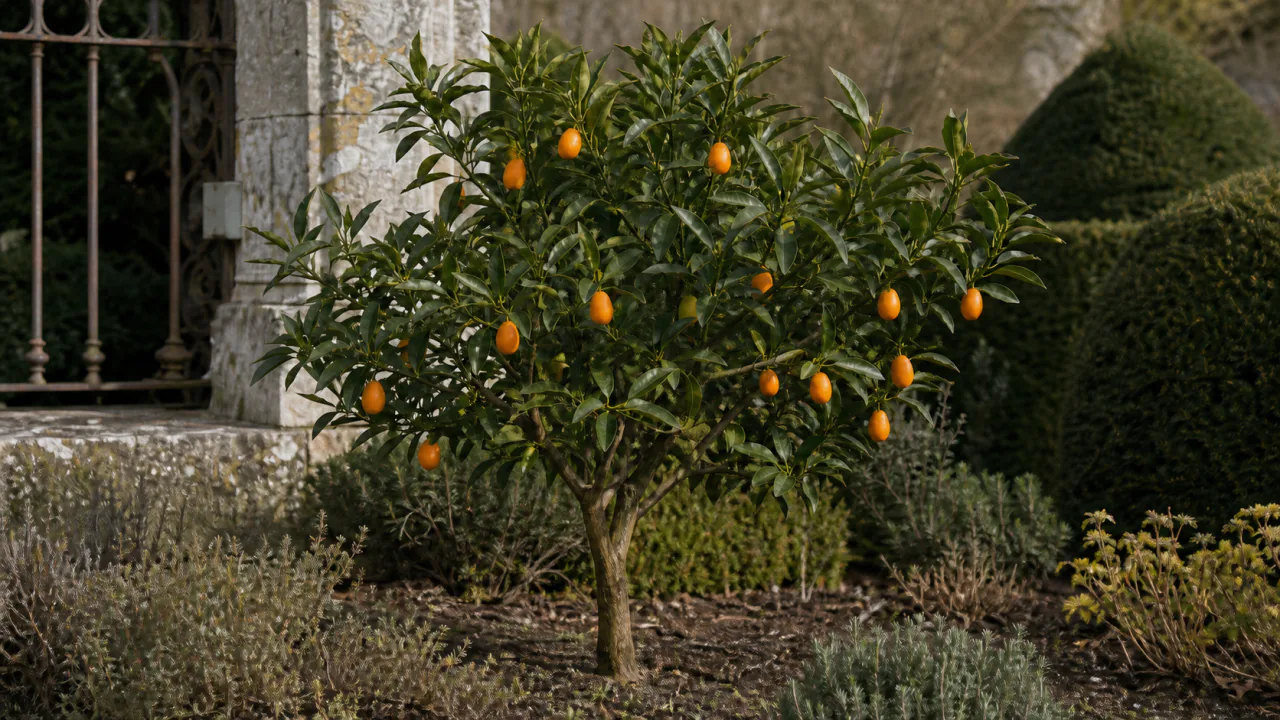
A Nagami kumquat is not peeled: it is eaten whole. Its thin rind is sweet, aromatic and edible, while the flesh is distinctly tart; one bite combines both sides. The fruit is small and oval, the quickest visual distinction from rounder kumquats, and it commonly contains several pips. UCR’s Nagami accession records late-winter maturity at Riverside and typical fruit around 32 × 19 mm; those measurements describe that collection, not a British grading promise.
Do not confuse it with the Meiwa kumquat, which is rounder and usually sweeter, or the calamondin, a very tart ornamental citrus hybrid.
Reliable checks before you buy
A fruit built on contrast: sweet peel, tart flesh
Choose Nagami to eat the fruit whole, without peeling it. The thin rind supplies fragrance and sweetness; the flesh supplies the bright acidity. Rolling the fruit gently between your fingers before eating helps release the peel’s oils, but ripeness still matters: taste one before harvesting the crop.
Nagami is more cold-tolerant than many familiar citrus, yet that biological comparison is not a British outdoor-hardinessA plant's ability to survive winter cold without protection. guarantee. RHS guidance makes a movable container and bright frost-free winter shelter the dependable baseline. Frost does not reliably improve flavour. Ask the nursery to identify the grafted cultivarA variety produced through selection or cultivation, distinct from the wild original plant. and rootstockThe root and base onto which a variety is grafted to give it vigour or resistance., then match the pot, compost and watering to that combination.
| Your situation | What to ask about | Reason — and trade-off |
|---|---|---|
| Container and restricted space | Trifoliate orange or Flying Dragon | Often chosen to restrain vigour. ⚠ Suitability depends on graft compatibility, compost chemistry and nursery experience. |
| Hard or alkaline irrigation water | Rootstock named by the nursery | High pH can aggravate iron chlorosisYellowing of the foliage caused by poor iron uptake, often linked to chalky soil.. ⚠ Do not assume one rootstock solves every container-water problem. |
| More vigour wanted | Citrange options | A more vigorous combination may fill a larger shelter. ⚠ It can also outgrow a pot and remains site-dependent. |
| Keep this rule | No universal ban or winner | Buy a traceable grafted tree and confirm the exact cultivar–rootstock combination with the supplying nursery. |
The Nagami year in a British container
Keep the tree mobile: a sheltered, sunny summer outdoors and a bright, cool, frost-free winter under cover. Treat the months as observation windows, because local frost dates and shelter temperatures vary.
| Jan | Feb | Mar | Apr | May | Jun | Jul | Aug | Sep | Oct | Nov | Dec | |
|---|---|---|---|---|---|---|---|---|---|---|---|---|
| Plant or repot under protection | ||||||||||||
| Keep bright, cool and frost-free | ||||||||||||
| Move outdoors after frost | ||||||||||||
| Watch for summer flowering | ||||||||||||
| Taste ripe fruit | ||||||||||||
| Feed container citrus |
A fragrant, well-balanced Nagami crop
Shelter, compost, rootstock, stage
Read these four variables before acting. Their combination explains growth, water use and fruit flavour; change one variable at a time.
Overly tart flesh or bland peel
Fruit can taste one-dimensionally sour when picked too early or eaten without enough peel. Weak fragrance may also follow poor light. Judge colour, peel aroma and the combined bite.
Let it mature, improve the light
Leave sound fruit on the tree longer and give the canopy the brightest suitable position. Taste at intervals to find the balance rather than relying on one calendar date.
Protect it; do not rely on frost
Bring the pot under cover before frost, keep the winter position bright and cool, and water enough to prevent complete drying without leaving the roots waterlogged.
Read the symptom, trace the cause, correct, prevent
Container-grown Nagami shares the usual indoor citrus problems. Check the plant carefully before it comes under cover and keep air moving around the canopy.
| What you see | Likely cause | Correct | Prevent |
|---|---|---|---|
| Yellow leaves with greener veins | Possible iron chlorosis, high pH, hard water or wet roots | Check drainage, water quality and root condition before feeding | Use free-draining compost and monitor irrigation water |
| Cottony clusters or fixed scales on stems | Mealybugs or scale insects | Isolate, remove by hand and confirm the pest | Inspect before overwintering and maintain ventilation |
| Sticky leaves with a black coating | Sooty mould growing on insect honeydew | Find and control the sap-feeding insect first | Check young shoots and leaf undersides early |
| Silvery winding mines in young leaves | Citrus leafminer | Remove only badly damaged soft growth; protect beneficial insects | Avoid forcing repeated lush growth with excess nitrogen |
| Flowers or young fruit dropping | Fluctuating water, temperature or nutrition | Restore steady moisture and reduce abrupt environmental changes | Water consistently in summer and repot before roots become congested |
Start with hygiene, ventilation and correct watering. For a suspected regulated pest, follow the UK Plant Health Portal; before using any product, check its current authorisation and label for the exact use.
The whole fruit is the point
Nagami is a whole-fruit citrus: one bite combines sweet aromatic rind with tart flesh. Its peel also suits candying and marmalade, where it supplies fragrance, texture and pectin, while the fruit’s acidity works in salt-preserving or fermentation. The juice is better used as a sharp seasoning than as a drink. If you want a naturally sweeter fresh-eating kumquat, compare the Meiwa.
What the standards do — and do not — tell you
Nagami kumquats fall outside the named orange, mandarin, lemon, lime, grapefruit and pomelo groups in the GB citrus marketing standard, so do not borrow those fruit-size codes.
- Commercial classification: no Nagami-specific size scale is being applied here; whole-fruit flavour balance and sound, traceable fruit matter more than an orange or lemon diameter.
- Ripeness check: full orange colour, fragrant peel and a balanced whole-fruit taste — not one fixed British date.
Crop size changes with rootstock, shelter, container volume, tree age and season; record the performance of your own plant.
What growers ask most often
Do you really eat the peel?
Yes. Nagami’s edible rind is sweet and fragrant while the flesh is tart. Eat the clean fruit whole so the two tastes balance.
Why is my kumquat so sour?
It may have been picked too early, or eaten without enough peel. Let sound fruit mature, then taste the whole fruit; choose Meiwa if you prefer a naturally sweeter kumquat.
Can it survive a British winter outdoors?
Do not rely on that. Although kumquats are relatively cold-tolerant, RHS guidance treats bright, cool and frost-free shelter as the dependable British winter baseline.
Container or open ground?
A movable container is the reliable British choice. Permanent planting outdoors is an exceptional, site-specific experiment for a very mild, sheltered position, not a general recommendation.
Sources and verification
Last local-language evidence check: 2026-08-03. UCR accession measurements remain bound to Riverside; British culture follows RHS guidance.
- Royal Horticultural Society — Citrus japonica ‘Nagami’: British identity of Citrus japonica / Fortunella margarita, habit, whole-fruit use and protected cultivation.
- UC Riverside Citrus Variety Collection — Nagami kumquat CRC 3877: accession-bound fruit shape, size, rind–pulp contrast, seeds and Riverside season.