Meiwa kumquat tree
Citrus japonica ‘Meiwa’ — syn. Fortunella crassifolia, the rounder, sweeter kumquat
A kumquat selected for fresh eating: the fruit is round to oval, with a thick, sweet edible rind around a small acidic centre. Taken whole, it generally tastes gentler than the longer Nagami.
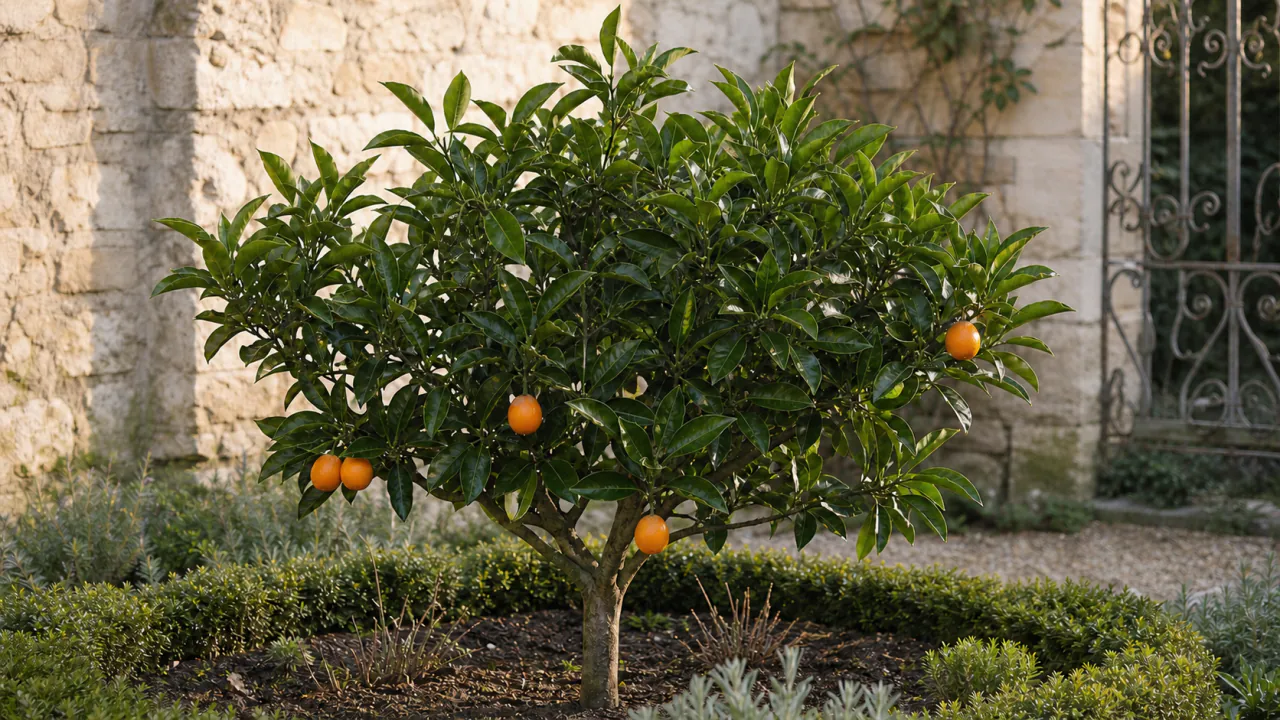
Measured against Nagami, Meiwa is the kumquat of gentler whole-fruit flavour. It is a fresh-eating cultivarA variety produced through selection or cultivation, distinct from the wild original plant.: round to oval, with a thick sweet edible rind around a small acidic centre, generally few pips and a high rind-to-flesh ratio. Seeded fruit still occurs, so a seedless crop is never guaranteed.
Choose Meiwa when fresh, whole-fruit eating comes first. Choose the more elongated Nagami for a sharper peel-and-pulp contrast, and do not confuse either with the much tarter calamondin.
Reliable checks before you buy
The kumquat for a gentler whole-fruit bite
Choose Meiwa primarily for fresh eating. Its sweet, substantial rind occupies more of each bite, while the smaller acidic centre keeps the fruit lively. Taste it whole and clean rather than judging the flesh on its own. Compared with Nagami, it is usually the easier introduction to kumquats; for a sharper marmalade or preserve, Nagami may supply more contrast.
Do not transfer a rootstockThe root and base onto which a variety is grafted to give it vigour or resistance. recommendation from Nagami automatically. UCR’s Meiwa accessions themselves show that cultivar–rootstock compatibility needs checking. Ask the supplying nursery for the named cultivar, named rootstock and a combination it has actually propagated successfully; then match the container, compost and irrigation water to that traced graft.
| Your situation | What to verify | Reason — and trade-off |
|---|---|---|
| Buying a grafted Meiwa | Cultivar and rootstock on the label | Meiwa does not necessarily behave like Nagami on every stock. ⚠ A generic “kumquat” label is not enough. |
| Container and restricted space | Expected vigour of the exact graft | A compact combination is easier to move and shelter. ⚠ Excess restriction can reduce resilience if roots are neglected. |
| Hard or alkaline irrigation water | Nursery record for that water and compost | High pH can aggravate iron chlorosisYellowing of the foliage caused by poor iron uptake, often linked to chalky soil.. ⚠ No rootstock fixes poor drainage or unsuitable water by itself. |
| Keep this rule | A proven, traceable combination | There is no universal winner here: confirm the exact Meiwa–rootstock pairing with the supplying nursery. |
The Meiwa year in a British container
Keep the tree mobile: a sunny, sheltered summer outdoors and a bright, cool, frost-free winter under cover. These are observation windows, not fixed cultivar dates; flowering and ripening move with heat, light and the shelter used.
| Jan | Feb | Mar | Apr | May | Jun | Jul | Aug | Sep | Oct | Nov | Dec | |
|---|---|---|---|---|---|---|---|---|---|---|---|---|
| Plant or repot under protection | ||||||||||||
| Keep bright, cool and frost-free | ||||||||||||
| Move outdoors after frost | ||||||||||||
| Watch for later flowering | ||||||||||||
| Taste coloured fruit | ||||||||||||
| Feed container citrus |
A fragrant, balanced Meiwa crop
Light, root zone, graft, fruit stage
Read these four variables before acting. Together they explain growth, water use and how the whole fruit tastes; change one variable at a time.
A harsh or flat whole-fruit taste
Fruit may be immature, the canopy may lack light, or irregular watering may have checked growth. Judge rind colour and aroma, then taste rind and flesh together.
Let sound fruit mature in good light
Keep the canopy in the brightest suitable position and leave sound fruit to develop. Taste at intervals instead of harvesting every fruit on one calendar date.
Keep water and winter conditions steady
Water thoroughly without waterlogging, avoid a hot dark winter room, and move the plant under bright frost-free cover before damaging weather arrives.
Read the symptom, trace the cause, correct, prevent
Container-grown Meiwa shares the usual protected-citrus problems. Inspect stems and leaf undersides before bringing the tree indoors, and keep air moving around the canopy.
| What you see | Likely cause | Correct | Prevent |
|---|---|---|---|
| Yellow leaves with greener veins | Possible iron chlorosis, high pH, hard water or wet roots | Check drainage, root condition and water quality before feeding | Use free-draining compost and monitor irrigation water |
| Cottony clusters or fixed scales on stems | Mealybugs or scale insects | Isolate the plant, remove insects by hand and confirm the pest | Inspect before overwintering and maintain ventilation |
| Sticky leaves with a black coating | Sooty mould growing on insect honeydew | Find and control the sap-feeding insect first | Check young shoots and leaf undersides early |
| Silvery winding mines in young leaves | Citrus leafminer | Remove only badly damaged soft growth; protect beneficial insects | Avoid forcing repeated lush growth with excess nitrogen |
| Flowers or young fruit dropping | Fluctuating water, temperature or nutrition | Restore steady moisture and reduce abrupt environmental changes | Water consistently in summer and repot before roots become congested |
Start with hygiene, ventilation and correct watering. For a suspected regulated pest, follow the UK Plant Health Portal; before using any plant-protection product, check its current authorisation and label for the exact use.
The fresh-eating kumquat
Meiwa is best understood as a whole-fruit citrus. Its thick, sweet aromatic rind surrounds a small tart centre, so eating both together gives the intended balance. It can still be candied or made into marmalade, but the result is generally gentler than with Nagami. The small amount of acidic flesh makes juice secondary, while fresh eating remains its strength. For a more incisive preserve or savoury contrast, compare the Nagami kumquat.
What the standards do — and do not — tell you
Meiwa kumquats fall outside the named orange, mandarin, lemon, lime, grapefruit and pomelo groups in the GB citrus marketing standard, so those groups’ size, juice or sugar thresholds are not transferred here.
- Commercial classification: no Meiwa-specific size scale is being applied; sound fruit, cultivar traceability and balanced whole-fruit taste matter more than an orange or lemon diameter.
- Ripeness check: developed orange colour, fragrant rind and a pleasing rind-and-flesh balance — not one fixed British harvest date.
Crop size changes with the exact graft, shelter, container volume, tree age and season; record the performance of your own plant.
What growers ask most often
How does Meiwa differ from Nagami?
Meiwa is rounder and has a thicker sweet rind around less acidic flesh, so the whole fruit generally tastes sweeter. Nagami is longer and gives a sharper sweet-rind–tart-pulp contrast.
Do you eat the rind?
Yes. Wash the fruit and eat it whole: the sweet edible rind is central to Meiwa’s flavour, while the small acidic centre supplies freshness.
Can it survive a British winter outdoors?
Do not rely on that. Kumquats may tolerate more cold than many familiar citrus, but RHS guidance makes a bright, cool and frost-free shelter the dependable British baseline.
Which rootstock should I choose?
Ask for the exact named rootstock and a Meiwa combination the nursery has propagated successfully. Compatibility cannot be inferred simply from what is used for Nagami.
Sources and verification
Last local-language evidence check: 2026-08-04. UCR and UC ANR observations remain tied to their accessions and Riverside conditions; British cultivation follows RHS guidance.
- Royal Horticultural Society — How to grow citrus fruit: British container citrus practice, summer position and bright, cool, frost-free overwintering.
- UC Riverside Citrus Variety Collection — Meiwa kumquat CRC 3818: accession-bound fruit shape, thick sweet rind, acidic flesh, seeds and the caution over rootstock compatibility.