Calamondin
Citrus × microcarpa — calamansi, calamondin orange
The potted « little orange »: compact, free-flowering, covered in tart miniature fruit. An ornamental and useful citrus, provided you accept the one rule that matters: it needs a great deal of light.
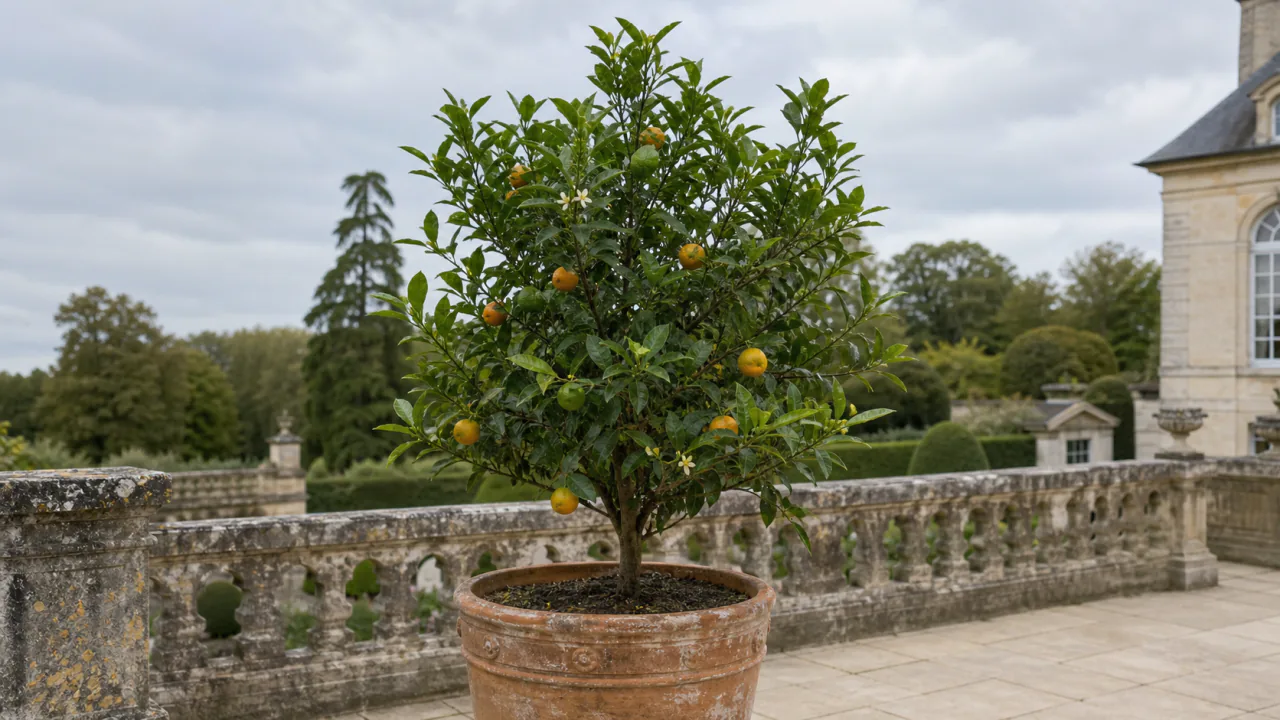
The calamondin is sold as a houseplant, and that is where the disappointment begins: it is not a plant for a dark room. Compact, dense, dotted with small fragrant white flowers then miniature orange fruit, it is superb and productive, but only if it gets plenty of light. In a dim living room it loses its leaves and stops fruiting. Well placed (a conservatory, a very bright sill, outdoors in summer), it is on the other hand one of the most generous potted citrus, whose fruit is eaten whole, thin skin included.
Close to the kumquats in cultivation (small fruit, compact plant); see also the Citrus & Orchard section. « Calamansi » is its name in the Philippines, where it is essential in cooking.
The reliable facts before you buy
The tree and the fruit
The calamondin forms a small, dense and compact tree, very free-flowering, with small fragrant white flowers that, in good conditions, give a spread-out crop. The fruit is a small round orange citrus, with a thin, edible skin (slightly sweet) enclosing a very acidic pulp with variable seeds. It is that contrast — sweet skin, acidic flesh — that makes its charm and its use: you bite it whole or you press it.
Light before everything else
No other factor weighs as much: the calamondin flowers and fruits in proportion to the light it receives. A plant set at the back of a room yellows, grows spindly and no longer sets fruit. Good management fits in one phrase: the brightest spot possible all year, and a move outdoors as soon as the nights are mild. On the root side, favour a rootstock that contains the size — there is no point boosting the vigour of a plant you want compact.
| Depending on your goal | Rootstock(s) | Why — and the trade-off |
|---|---|---|
| Contained size, pot (priority) | Trifoliate (Citrus trifoliata), Flying Dragon | Keep the plant compact and free-flowering. ⚠️ reserve for non-calcareous composts; sensitive to active lime. |
| Calcareous soil | Forner-Alcaide 5 (FA5) | Tolerance to lime-induced chlorosisYellowing of the foliage caused by poor iron uptake, often linked to chalky soil.. ⚠️ depends on the soil and the plant. |
| Vigour, mild climate | Volkameriana, Citrus macrophylla | Vigour in mild-zone ground. ⚠️ too vigorous for a small pot space. |
| To avoid / verify | A very vigorous rootstock in a pot | Counterproductive for a plant meant to stay compact. Insist on a proven combination. |
The calamondin’s rhythm: the pot, the light
Excellent in a pot, to be moved out as soon as the nights are mild and overwintered in the brightest spot. Under good light, flowers and fruit follow almost all year; in a dark winter, it pauses.
| Jan | Feb | Mar | Apr | May | Jun | Jul | Aug | Sep | Oct | Nov | Dec | |
|---|---|---|---|---|---|---|---|---|---|---|---|---|
| Overwinter (brightest spot, cool-temperate) | ||||||||||||
| Move the pot outside | ||||||||||||
| Flowering (fragrant) | ||||||||||||
| Harvest (spread out) | ||||||||||||
| Feed (citrus) |
A calamondin covered in fruit
Measure the light
First of all, judge the real brightness of the spot. If shade settles in the afternoon, the calamondin will pay for it in flowering.
Leaf drop = light or water
A calamondin going bare almost always signals a lack of light or a watering error (dry/waterlogged), rarely anything else.
Bright, drained, fed
The brightest spot, free-draining compost, citrus feed in season. Correct the light first, the rest afterwards.
Summer outing, bright overwintering
Outdoors in summer to rebuild its reserves, bright and not-too-warm overwintering: that is the rhythm that keeps it flowering.
Read the sign, trace the cause, correct, prevent
Often grown indoors, the calamondin is very exposed to the pests of warm, dry overwintering; a lack of light remains its first cause of failure.
| Sign observed | Probable cause | Correct | Prevent |
|---|---|---|---|
| Leaves yellowing and dropping, plant growing spindly | Lack of light (cause no. 1) | A far brighter spot, move out as soon as possible | The most light all year |
| Cottony masses or shells on stems and undersides | Scale insects (mealybugs or armoured scale) | Clean off, white oil or soft soap, isolate | Ventilate overwintering, inspect when bringing in |
| Fine webbing, leaves stippled yellow, dry air | Red spider mites (mites) | Mist the foliage, humidify the air | Avoid hot dry air in the overwintering space |
| Sticky black deposit on the foliage | Sooty mould, on the honeydew of scale or aphids | Treat the honeydew-producing insect first | Watch scale and aphids early |
| Yellow leaves with veins staying green | Iron chlorosis (high pH, lime, waterlogging) | Iron chelate; review watering | Free-draining compost, low-lime water |
Stay sparing with treatments: clean foliage, airy and bright overwintering, balanced nutrition. If a notifiable citrus disease is suspected, follow the official instructions in force.
A small, very acidic fruit, whole
The calamondin is used whole: its thin, slightly sweet skin and its very acidic pulp make it an excellent condiment. Pressed, it sharpens drinks and sauces (the calamansi of Philippine cooking); cooked, it gives excellent marmalades and lends itself to candying; you can even preserve or ferment it. Few fruits for so many uses: it is a precious back-up citrus within arm’s reach.
Off the usual scales
A miniature fruit, the calamondin is off the sizing scale of lemons and oranges. No commercial size code is applied to it.
No generic yield can be published: its « productivity » depends above all on light and is judged by eye, by the cover of fruit under good exposureThe amount of sunlight a spot in the garden receives (full sun, part shade, shade).. Describe what you observe, without a universal figure, and be wary of promises of « fruit all year indoors ».
What people most often ask
Is the calamondin a houseplant?
Only in a very bright spot. In a dark room it loses its leaves and does not fruit. It does far better outdoors in summer and in a bright conservatory in winter.
Can you eat its fruit?
Yes, whole: the thin skin is slightly sweet, the pulp very acidic. You press them (juice/calamansi), make marmalade or candy them.
Why does it lose its leaves?
Almost always from lack of light or irregular watering. Place it in the brightest spot and water regularly without waterlogging.
Does it fruit all year?
Under very good light, flowers and fruit follow for a long time. But in a dark winter it pauses: the promise of « continuous fruit » does not hold in a dimly lit apartment.
Sources and control
Last scientific check: 2026-07-18. Fruit measurements and rootstock trials to be completed.
- UC Riverside — Citrus Variety Collection: characters of Citrus × microcarpa.
- Calamansi — Wikipedia (EN): hybrid, cultivation and uses.