Lunario « Four Seasons » Lemon
Citrus × limon ‘Lunario’ — sold as the « four seasons » or « everbearing » lemon
The famous « four seasons » lemon. Its appeal is real — repeated flowering, a spread-out crop — but the name oversells: neither a continuous harvest, nor any guarantee about the variety actually in the pot.
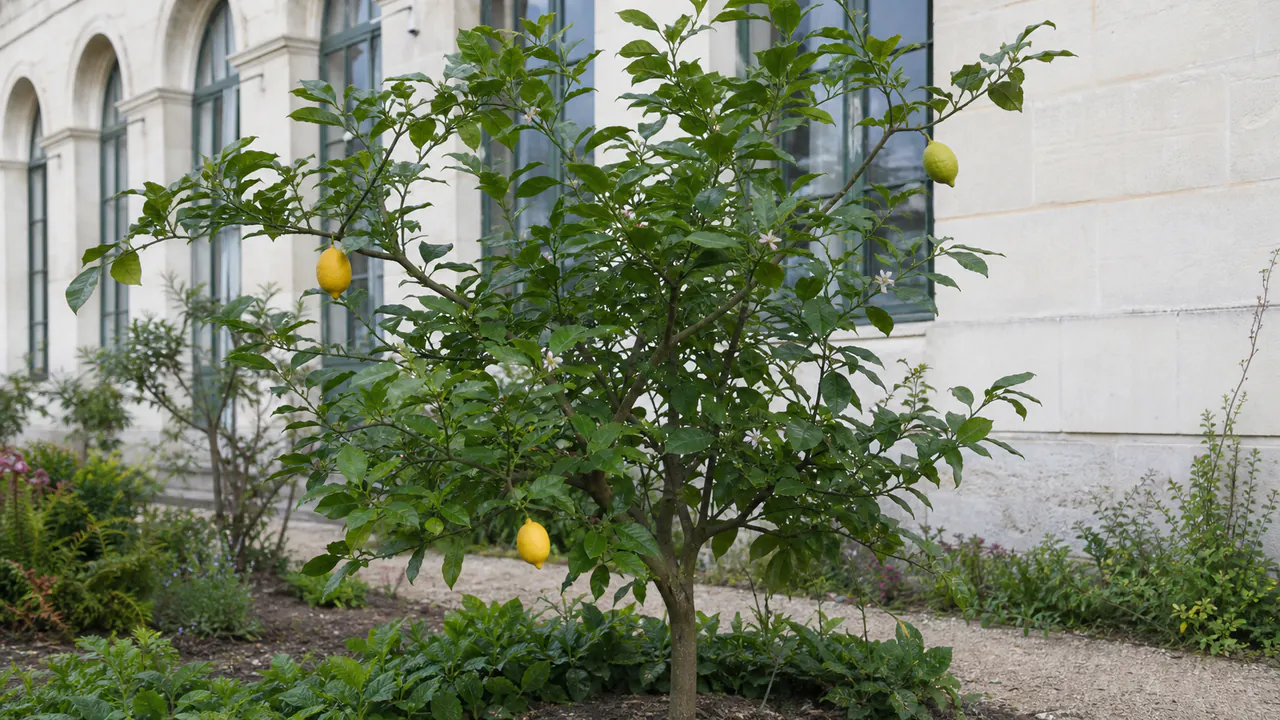
« Four seasons » is a promise, not a variety. The true Lunario is an Italian lemon cultivarA variety produced through selection or cultivation, distinct from the wild original plant. notable for its successive flowering: it is not unusual to see flowers and fruit at different stages on the same tree. But two honest qualifications apply. First, « repeated flowering » does not mean « continuous harvest »: under a dark or cold winter the tree pauses. Second, the « four seasons » label is a trade name, and may cover clones other than the true Lunario. Buying one well means, first of all, checking what you are buying.
Compare with the Eureka, the other everbearing lemon, but they are two distinct varieties, not to be confused. For container culture, see the Citrus & Orchard section.
The reliable facts before you buy
« Four seasons »: check what you are buying
Here is the real trap of this lemon: the « four seasons » name is not protected. It describes a behaviour — repeated flowering — more than a precise variety, and some plants sold under it are not the true Lunario. Before buying, ask the nursery for the exact botanical name (Citrus × limon ‘Lunario’) and the rootstock; be wary of a label that only says « four seasons lemon ».
Second point to grasp: the repeat flowering is nothing magical. It happens when light, warmth and feeding are sufficient. A tree overwintered in a dark room, or starved, stops — that is normal, not a fault of the variety. The « fruit all year round » promised on sales pages holds only under a warm, bright glasshouse, not on a windowsill in January.
The root decides vigour and soil tolerance
As with all lemon trees, the rootstock counts as much as the clone: ask for it when buying. You are not looking for a single « winner » but for the option that matches your soil and climate.
| For your goal | Rootstock(s) | Why — and the trade-off |
|---|---|---|
| Contained vigour, pot | Trifoliate (Citrus trifoliata), Flying Dragon (dwarf) | Compact tree, concentrated fruit, better cold tolerance — ideal to limit vigour in a container. ⚠️ very lime-sensitive, slow. |
| Productivity, warm soil | Volkameriana, Citrus macrophylla | Vigour and yield in a mild area. ⚠️ cold-tender, variable quality. |
| Calcareous or saline soil | Forner-Alcaide 5 (FA5), compared with C35 | Documented tolerance to lime-induced chlorosisYellowing of the foliage caused by poor iron uptake, often linked to chalky soil.. ⚠️ not « universal »; variable response. |
| To verify | Exact combination | No incompatibility to assert without a source for Lunario: insist on a scion–rootstock combination already proven in a comparable region. |
The Lunario’s rhythm: open ground or container
In mild areas the Lunario can go in the ground and be protected on cold nights; elsewhere it is grown in a container moved into a bright, frost-free space — the key condition for repeat flowering. Its flowering is staggered, but the harvest stays concentrated over an extended growing season.
| Jan | Feb | Mar | Apr | May | Jun | Jul | Aug | Sep | Oct | Nov | Dec | |
|---|---|---|---|---|---|---|---|---|---|---|---|---|
| Plant (open ground, mild area) | ||||||||||||
| Protect from cold (pot brought in / fleece outdoors) | ||||||||||||
| Move the pot back outdoors | ||||||||||||
| Successive flowering | ||||||||||||
| Harvest (spread out) | ||||||||||||
| Feed (citrus fertiliser) |
Actually getting several flushes of fruit
Light above all
A Lunario only reflowers if it gets enough light and warmth. Look hard at the real brightness of your overwintering spot: that is the factor that decides the repeat.
One variable at a time
If the tree stalls, do not change everything at once. Check light first, then water, then feeding, then rootstock. Correcting all together prevents understanding.
Fuel the repeat
Free-draining medium, citrus feed in season, steady watering: repeated flowering exhausts the tree if it is not supported.
A bright overwintering
Bring it in frost-free but above all into the light: a dark winter stops the repeat and drops the developing fruit.
Read the sign, trace the cause, correct, prevent
Like all lemon trees, the Lunario is watched first on its foliage. The same method — observe, diagnose, correct, prevent — applies to its commonest troubles, often tied to overwintering: scale, red spider mites and fruit drop from lack of light.
| Sign observed | Likely cause | Correct | Prevent |
|---|---|---|---|
| Yellow leaves with veins staying green | Iron chlorosis (high pH, lime, overwatering) | Iron chelate; review watering; in time, a lime-tolerant rootstock | Free-draining medium, low-lime water, suitable rootstock |
| Cottony masses or small shells on stems and leaf undersides | Scale insects (mealybugs or armoured scale) | Clean off, white oil or soft soap, isolate the plant | Ventilate overwintering, inspect when bringing indoors |
| Sticky black coating on the foliage | Sooty mould, on the honeydew of scale or aphids | Treat the honeydew-producing insect first | Watch for scale and aphids early |
| Fine webbing, leaves stippled yellow, dry air | Red spider mites | Mist the foliage, raise humidity | Avoid hot, dry air in winter quarters |
| Drop of flowers and young fruit | Dark overwintering, watering swings or a cold snap | Bright space, steady watering, cold protection | Bright, early overwintering, consistent feeding |
Keep treatments minimal: clean foliage, airy and bright overwintering and balanced feeding prevent most problems. Where a notifiable citrus disease is suspected, follow the official guidance in force.
What one more acidic lemon does for you
Like the other true lemons, the Lunario gives a juicy, acidic fruit: its juice sharpens, its zest flavours, its rind takes to salting (preserved lemons). Its advantage is not in taste but in practicality: the repeat flowering can supply a few fresh lemons out of season, when the tree is well managed — enough never to be short of half a lemon for a sauce or a drink.
What the standards say
The Lunario belongs to the lemons class of the EU/UK marketing standard. Size is set by the equatorial diameter, never by variety alone.
- Commercial minimum (lemons class): diameter ≥ 45 mm, juice content ≥ 20%.
- Size codes: 0 (79–90 mm) to 7 (45–52 mm).
No consolidated numeric yield exists for this cultivar in our reference: the clonal description and fruit measurements remain to be established on identified plants. Publish no yield promise — measure your own crop.
What people most often ask
Does the « four seasons » lemon really give lemons all year?
No, not in a cool-temperate climate. It flowers several times a year, which spreads the harvest, but it pauses in a dark winter. A continuous crop only exists under a warm, bright glasshouse.
How can I be sure I’m buying a true Lunario?
Ask for the exact botanical name (Citrus × limon ‘Lunario’) and the rootstock. A label that only says « four seasons lemon » does not guarantee the variety.
What is the difference from the Eureka?
They are two distinct lemon varieties, both everbearing. The Lunario is known for its successive flowering; the Eureka for its productivity and open, nearly thornless habit.
Why does it stop flowering in winter?
Almost always for lack of light and warmth during overwintering, sometimes a deficiency. A bright space and suitable feeding restart the repeat.
Sources and checking
Last scientific check: 2026-07-18. Clonal description to be consolidated on identified plants.
- UC Riverside — Citrus Variety Collection: reference for comparing lemon clones and cultivars.
- RHS — Growing citrus: container culture and bright frost-free overwintering.