‘Marisol’ clementine
Citrus × clementina ‘Marisol’ — the early, parthenocarpic clementine
An early, juicy clementine whose seedlessness rests on a precise mechanism: parthenocarpy. Understanding it explains why fruit can set without fertilisation.
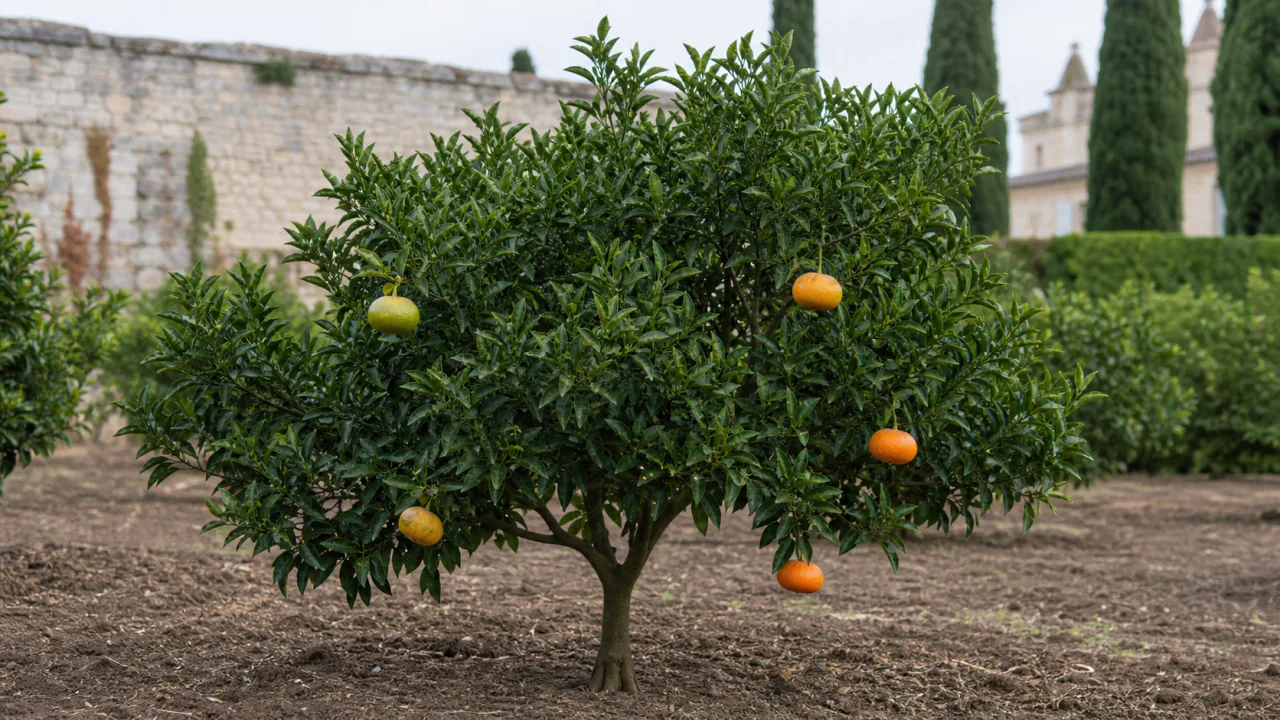
Marisol is an early Spanish clementine, juicy and easy to peel, but its most instructive trait is parthenocarpy. This allows fruit to develop without fertilisation and therefore without seeds. Marisol has a strong parthenocarpic capacity compared with Clemenules: in the cited study, its seedless fruit set was independent of self-pollination. “Seedless” does not mean “self-fertile”; it means that fruit can develop without the ovules being fertilised.
Place it within the clementine season alongside early Oroval, mid-season Clemenules, the main comparator, and the common clementine, where “seedless” and “self-fertile” are also carefully distinguished.
Reliable points to check before buying
Parthenocarpy: how Marisol sets seedless fruit
Two ideas explain Marisol fruit set:
- Self-incompatibility: its own pollen does not fertilise its ovules, so the tree does not fertilise itself.
- Parthenocarpy: fruit develops without fertilisation and is consequently seedless. Marisol’s capacity is strong and, in the cited study, independent of self-pollination.
An isolated tree can therefore crop without seeds, although a compatible polliniser nearby may introduce pips through cross-pollination. Because the tree is productive, monitor crop load and thin if necessary: overcropping reduces fruit size. Match the rootstock to the soil and confirm the exact scion–rootstock combination with the nursery.
In Mesejo et al.’s controlled comparison of unpollinated flowers, Marisol showed 21% higher ovule abortion, 44% higher fruit set and 50% higher fruit weight than Clemenules. These are comparative experimental findings, not universal orchard or garden guarantees.
Marisol through the year: in the ground or in a pot
Plant outdoors only in a mild climate; elsewhere, overwinter it in a container under cover (F3). Its early crop mainly calls for careful crop-load checks.
| Jan | Feb | Mar | Apr | May | Jun | Jul | Aug | Sep | Oct | Nov | Dec | |
|---|---|---|---|---|---|---|---|---|---|---|---|---|
| Plant outdoors (mild districts) | ||||||||||||
| Protect from cold (pot under cover / fleece) | ||||||||||||
| Move the pot outdoors | ||||||||||||
| Flowering; watch fruit set and crop load | ||||||||||||
| Harvest (early; judge by taste) | ||||||||||||
| Feed with a citrus fertiliser |
Seedless Marisol clementines of a worthwhile size
The crop load
Count the young fruit on this productive tree. An excessive set points to smaller clementines and lower eating quality.
Small fruit or unexpected pips
Small fruit suggests overcropping; pips indicate cross-pollination by a compatible cultivarA variety produced through selection or cultivation, distinct from the wild original plant.. They have different causes and remedies.
Thin or isolate
Thin an excessive crop to restore fruit size. If seedlessness matters, keep compatible pollinisers farther away.
Pick at internal maturity
As with any early clementine, taste the fruit instead of relying on peel colour alone; colour break can precede full eating quality.
Observe first; treat only after identification
The same symptom can have several causes. This grid gives a first check, not a remote diagnosis or a pesticide prescription.
| Observation | First check | Decision boundary |
|---|---|---|
| Leaves turning yellow | Check moisture, drainage, water quality and changes in young leaves | Have the cause confirmed before applying an amendment |
| Insects, cottony clusters or sticky deposits | Isolate the plant and identify the organism accurately | Use only a method or product authorised for that use, following the local label |
| Coloured fruit with disappointing flavour | Sample one fruit and check internal maturity before generalising | Rind colour alone cannot diagnose maturity or disease |
Seek professional or plant-health advice if decline is rapid, symptoms are unusual or regulatory status is uncertain.
An early clementine that is easy to use
Juicy, sweet-sharp and easy to peel, Marisol is best eaten fresh, with seedless segments that are particularly convenient for children. Fully mature fruit makes fragrant juice, while the peel can be used for marmalade. Its appeal lies in an early-season window and usually seedless flesh, provided the crop is allowed to reach internal maturity.
What the marketing standard says for clementines
Marisol falls within the clementine group in the UK marketing standard.
- Nominal marketing thresholds: diameter ≥ 35 mm, juice content ≥ 40% and sugar-to-acid ratio ≥ 7.0:1. A size tolerance limited to 10% of the lot by number or weight may include fruit below 35 mm, but never below 34 mm.
- Fruit size warning: overcropping on this productive tree reduces diameter, which is why thinning can matter.
Do not treat a generic yield as a promise. Brix, acidity and size vary with site, crop load and harvest date; measure the fruit from your own tree.
What growers most often ask
Why is a Marisol clementine seedless?
Because parthenocarpy lets the fruit develop without fertilisation. Marisol has a strong capacity and, in the cited study, its seedless fruit set was independent of self-pollination.
Can Marisol fruit still contain pips?
Yes. It is self-incompatible, but compatible pollen from another cultivar may fertilise the flowers. Greater isolation helps where seedlessness is important.
Why are the clementines small?
Overcropping is a common reason on this productive cultivar. Timely fruit thinning can restore size and eating quality.
How does Marisol differ from Clemenules?
Marisol is earlier and has a documented parthenocarpic capacity stronger than that of mid-season Clemenules in the cited comparison.
Sources and evidence
Evidence reviewed on 31 July 2026. Each source is limited to the claims stated; garden guidance remains a cautious editorial adaptation.
- Mesejo et al. — Self-pollination and parthenocarpic ability in developing ovaries of self-incompatible Clementine mandarins: controlled Marisol–Clemenules comparison in unpollinated flowers; the 21%, 44% and 50% differences remain experimental findings.
- Spanish MAPA — early clementine varieties (1996): Marisol origin, early character, crop-load and harvest context, without exporting the calendar beyond the study region.
- GOV.UK — marketing standard for citrus fruit: nominal thresholds and size tolerance for clementines; these figures describe marketed lots, not tree hardiness or yield.
- Royal Horticultural Society — grow your own citrus: UK guidance for container growing, drainage and winter protection; it does not establish cultivar-specific performance.
- IVIA — mandarin and rootstock evaluation programme: a combination is assessed against site, climate, soil and growing system; this Spanish source is used only for that experimental boundary.