Clemenules 2026: verified size and maturity figures
Citrus × clementina ‘Clemenules’ — Nules clementine
The great Spanish mid-season clementine, productive and regular — so much so that it is the textbook model. Its challenge in the garden is not to fruit, but to carry its crop well.
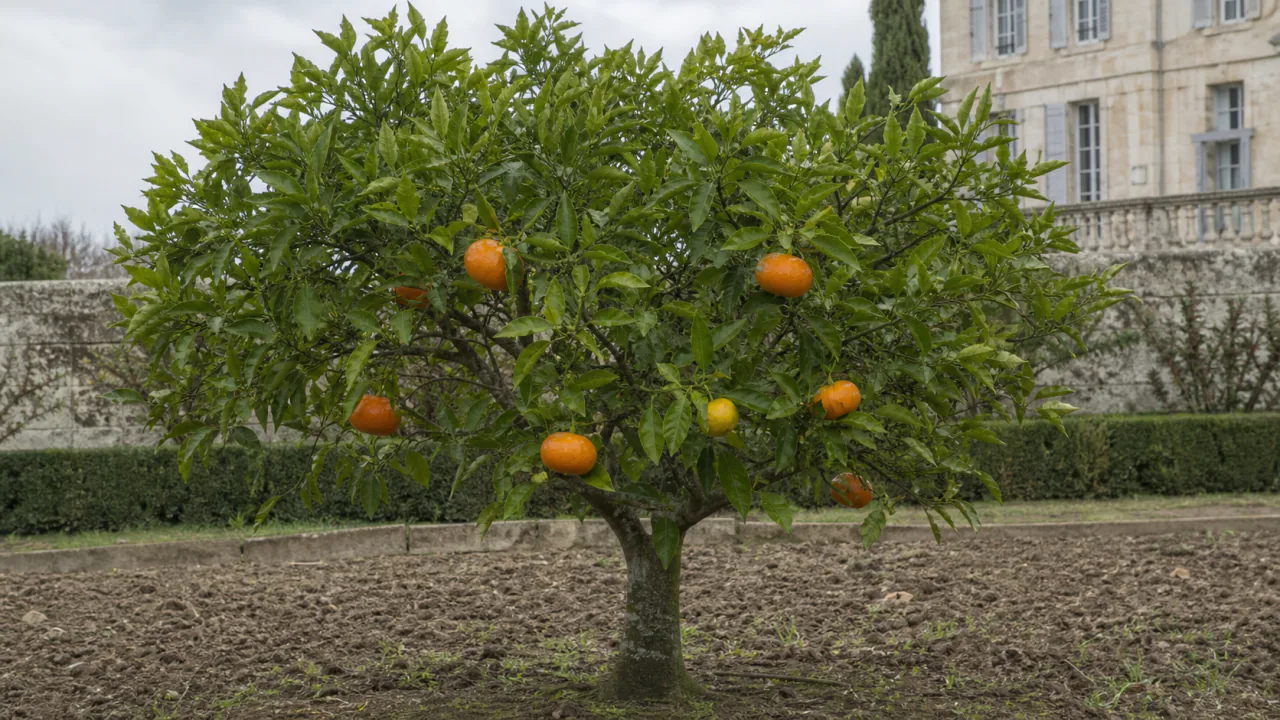
If the common clementine is the historical clementine, the Clemenules (Nules clementine) is its modern benchmark: a major Spanish selection, mid-season, productive and regular, with medium, juicy, easy-to-peel fruit. It is even the classic scientific model of self-incompatibility: like every clementine, it is seedless in the absence of compatible pollen, and sets seeds under cross-pollination. Its cultural particularity lies elsewhere: its crop load can be heavy, and it is that abundance that must be managed to keep size and regularity.
For the « seedless but not self-fertile » biology, see the common clementine fact-sheet. Not to be confused with Oroval, Marisol, Hernandina or the Nova/Fortune hybrids. See also the Citrus & Orchard section.
The reliable facts before you buy
Managing a heavy load to keep size
The Clemenules has a quality that can turn against it: it sets a lot. An excessive load gives smaller fruit and can set up alternate bearing (a full year, an empty year). The useful move is therefore to regulate the load — by reasoned thinning and steady nutrition — to obtain good-sized fruit every year, rather than an avalanche of small fruit every other year.
On the seed side, there is nothing specific to Clemenules: it is the same biology as all clementines (self-incompatible and parthenocarpic). Without compatible pollen nearby, the fruit is seedless; with it, it makes seeds. The common clementine fact-sheet details this mechanism.
According to the soil, without an absolute hierarchy
No rootstock is « the best » for the Clemenules: you choose according to the soil and the goal, and no ranking is published without a trial.
The Clemenules’ rhythm: in the ground or in a pot
A mid-season clementine: in the ground in a mild zone, in a pot elsewhere. The harvest calendar is set by region; ripeness is judged by taste, not colour.
| Jan | Feb | Mar | Apr | May | Jun | Jul | Aug | Sep | Oct | Nov | Dec | |
|---|---|---|---|---|---|---|---|---|---|---|---|---|
| Plant (in the ground, mild zone) | ||||||||||||
| Protect from cold (pot in / fleece in ground) | ||||||||||||
| Move the pot outside | ||||||||||||
| Flowering / thin if overloaded | ||||||||||||
| Harvest (mid-season) | ||||||||||||
| Feed (citrus) |
A regular crop, of good size
The fruit load
Watch the set: a very heavy load foretells small fruit and possible alternation. That is the signal to act.
Size and regularity
Too many small fruit, or an empty year after a full one, betrays a badly regulated load more than a variety problem.
Thin and feed
Reasoned thinning and steady nutrition spread the tree’s effort: fewer fruit, but finer and more regular.
Root matched to the load
Choose a rootstock whose vigour matches your maintenance capacity: very vigorous = more load to manage.
Observe first; treat only after identification
The same symptom can have several causes. This grid gives a first check, not a remote diagnosis or a pesticide prescription.
| Observation | First check | Decision boundary |
|---|---|---|
| Leaves turning yellow | Check moisture, drainage, water quality and changes in young leaves | Have the cause confirmed before applying an amendment |
| Insects, cottony clusters or sticky deposits | Isolate the plant and identify the organism accurately | Use only a method or product authorised for that use, following the local label |
| Coloured fruit with disappointing flavour | Sample one fruit and check internal maturity before generalising | Rind colour alone cannot diagnose maturity or disease |
Seek professional or plant-health advice if decline is rapid, symptoms are unusual or regulatory status is uncertain.
A generous eating clementine
Like its common cousin, the Clemenules is first of all a fresh fruit: easy skin, juicy segments, sweet-tart flavour. It presses into a mild juice and cooks into marmalade. Its asset is generosity: well managed, it gives a fine, regular mid-season crop, to be eaten as it is.
What people most often ask
What is the difference with the common clementine?
The Clemenules is a Spanish mid-season selection, very productive and regular; the common (Fine de Corse) is the historical form. Same seedless biology, slightly different calendars.
Why are my clementines small?
Most often from overload: the Clemenules sets a lot. Thinning and good nutrition bring back size and regularity.
Does it make seeds?
No in isolation (self-incompatible and parthenocarpic), yes if a compatible citrus flowers nearby and pollinates it.
How should the rootstock be chosen?
Ask for an identified combination tested in conditions close to yours. The nursery should relate its choice to soil, water, climate, available space and growing system.
Sources and evidence
Evidence is tied to the stated claims; garden guidance remains a cautious editorial adaptation.
- UC Riverside — Nules clementine, CRC 4056: accession identity, synonyms, fruit characters and the Riverside season; it does not set a universal UK harvest calendar.
- IFAPA — Clemenules rootstock trial: experimental evidence that rootstock, site and management affect vigour and cropping; no universal ranking is inferred.
- Mesejo et al. — Self-pollination and parthenocarpic ability in developing ovaries of self-incompatible Clementine mandarins: Clemenules is the physiological comparator; the study does not establish universal garden yield or management.
- GOV.UK — marketing standard for citrus fruit: nominal thresholds and size tolerance for clementines; these figures describe marketed lots, not tree hardiness or yield.
- Royal Horticultural Society — grow your own citrus: UK guidance for container growing, drainage and winter protection; it does not establish cultivarA variety produced through selection or cultivation, distinct from the wild original plant.-specific performance.
- IVIA — mandarin and rootstock evaluation programme: a combination is assessed against site, climate, soil and growing system; this Spanish source is used only for that experimental boundary.
Clemenules 2026: five verified commercial figures
This 2026 asset brings together five documentary figures for clementine lots marketed in the United Kingdom. It is a controlled extraction from the official citrus marketing standard linked by GOV.UK guidance, not a set of measurements made on Clemenules trees. The table separates nominal diameter, the lower floor allowed within tolerance, juice content, sugar-to-acid ratio and the off-size share. Readers can check each value, unit and commercial scope without confusing a packing rule with biological ripeness. The figures do not describe flavour, cold hardiness, local picking dates or the yield of a garden tree.
P1 — shared period for all five figures: underlying act dated 7 June 2011, GOV.UK guidance last updated 8 May 2024; documentary capture completed on 31 July 2026.
- P1 · Nominal minimum diameter : 35 mm — nominal threshold. GOV.UK — Marketing Standard for Citrus Fruit (543/2011).
- P1 · Absolute floor within tolerance : 34 mm — within tolerance only. GOV.UK — Marketing Standard for Citrus Fruit (543/2011).
- P1 · Minimum juice content : 40% of fruit weight. GOV.UK — Marketing Standard for Citrus Fruit (543/2011).
- P1 · Minimum sugar-to-acid ratio : 7.0:1. GOV.UK — Marketing Standard for Citrus Fruit (543/2011).
- P1 · Maximum off-size share : 10% of the lot by number or weight. GOV.UK — Marketing Standard for Citrus Fruit (543/2011).
| Indicator | Value | Scope |
|---|---|---|
| Nominal minimum diameter | 35 mm — nominal threshold | Nominal marketing requirement |
| Absolute floor within tolerance | 34 mm — within tolerance only | Tolerance within a marketed lot |
| Minimum juice content | 40% of fruit weight | Nominal marketing requirement |
| Minimum sugar-to-acid ratio | 7.0:1 | Nominal marketing requirement |
| Maximum off-size share | 10% of the lot by number or weight | Tolerance within a marketed lot |
Method and limitations
Source and version: UK Government and the European Commission, “Commission Implementing Regulation (EU) No 543/2011 — consolidated text, Annex I, Part B, Part 2: Marketing Standard for Citrus Fruit”, the PDF linked by GOV.UK fresh-produce guidance. Publication, guidance-update and collection dates are grouped in P1 so that they are not repeated.
Volume, period, scope and units: one ten-page standard and five criteria for the clementine commercial category. Diameter is in millimetres; juice is a percentage of fruit weight; the sugar-to-acid ratio is unitless; size tolerance is a percentage of the lot by number or weight.
Extraction and transformations: manual transcription of the relevant cells and clauses. No sample, mean, estimate, calculation or rounding was produced; only punctuation and wording were normalised for this English summary without changing the values.
Exclusions, uncertainty and limitations: hardiness, local harvest timing, flavour, yield and biological extrapolation to a garden tree are excluded. The residual uncertainty is legal or documentary change, not a statistical margin; the current GOV.UK guidance and controlling legislation must be checked before regulatory use.
Reuse: the summary, table and citation sentence created here are offered under CC BY 4.0 with attribution and a link to this page. The source document retains Crown and official reuse conditions; GOV.UK content is subject to the Open Government Licence unless otherwise stated.
How to cite this asset
Ready-to-quote factual sentence: “According to Les Jardins d'un Châtelain, the marketing standard checked in 2026 sets a 35 mm nominal minimum diameter for clementines; 34 mm is allowed only as the floor within a lot tolerance capped at 10%.”
Les Jardins d'un Châtelain, “Clemenules 2026: five verified commercial figures”, version 1.0, checked against the UK marketing standard for citrus fruit.
The original summary and table may be quoted or reused with attribution and a link to this page; the official standard remains the controlling reference.
Version log
Version 1.0 — asset created with a clear distinction between nominal threshold, tolerance floor and commercial scope.