Makrut Lime
Citrus hystrix — makrut, combava
The citrus grown first for its leaf. Its bilobed leaf, incomparably fragrant, matters more than its small bumpy-skinned fruit, and its juice, scarce and acidic, is only incidental.
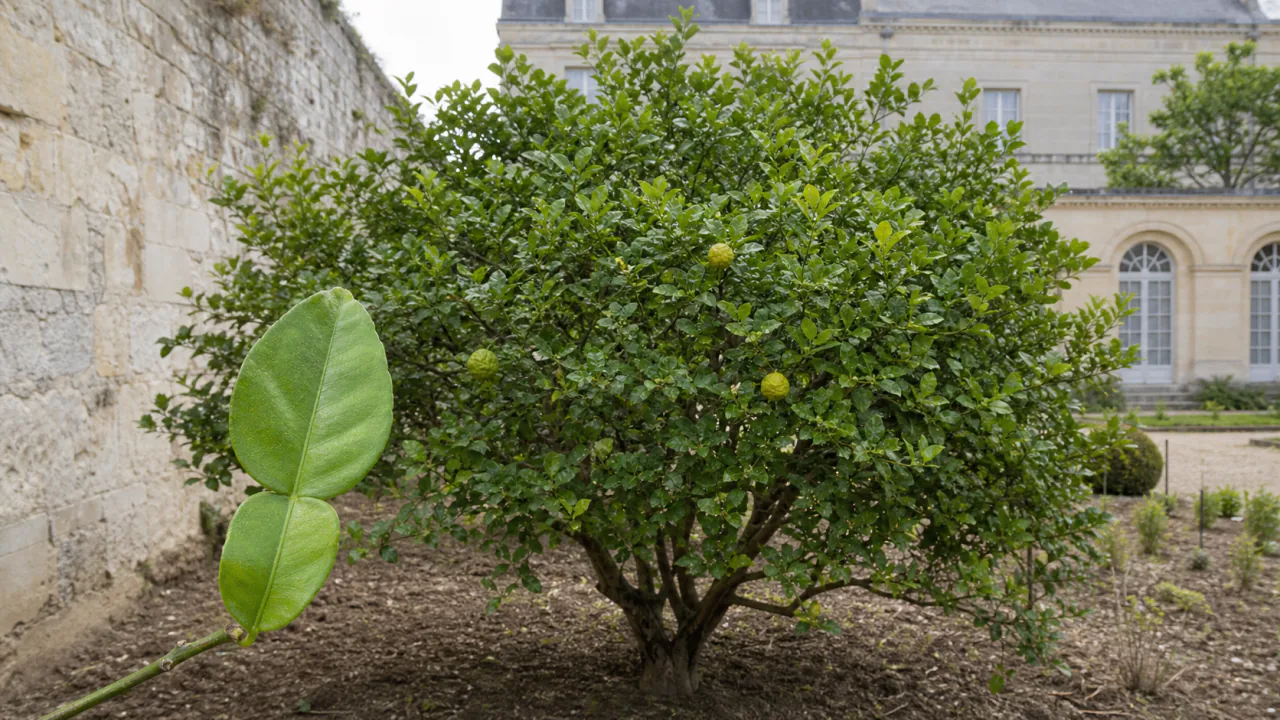
The makrut lime reverses the logic of the other citrus: it is not the fruit that is sought, but the leaf. Its bilobed leaf — two lobes in a row, the petiole being broadly winged — gives off a powerful, unique fragrance, a pillar of Southeast Asian cooking. The fruit is small, with a strongly bumpy, essential-oil-rich skin, and an acidic, low-juice, seedy pulp: it is mainly the zest that is used. In the garden, one point is non-negotiable: it is a tropical citrus, with no frost tolerance whatever, to be grown in a well-sheltered, bright pot.
We avoid the colonial term « kaffir lime »: say makrut lime or combava. To be distinguished from the true limes (juice lemons and limes). See also the Citrus & Orchard section.
The reliable facts before you buy
The tree, the leaf and the fruit
The makrut lime is a thorny shrub with leathery, glossy foliage. Its signature is the bilobed leaf: what looks like two leaves end to end is in fact a single leaf whose petiole is very broadly winged — an immediately recognisable feature. The fruit is small to medium, green then yellowing, with a very bumpy skin loaded with essential oils; its pulp is acidic, low in juice and seedy. So it is the leaf, then the zest, that make all the plant’s interest.
A tropical: winter warmth comes first
Unlike lemon trees, the makrut lime tolerates no frost: its overwintering must be bright and out of the cold, generally above 5 °C. No rootstock will change that — the root’s hardiness is not the foliage’s. The root is chosen for vigour and soil; survival, though, depends on shelter.
| Depending on your goal | Rootstock(s) | Why — and the trade-off |
|---|---|---|
| Vigour, mild climate | Citrus macrophylla, Volkameriana | Vigour in a warm zone. ⚠️ do not improve the foliage’s cold tolerance. |
| Contained size, pot | Trifoliate, Flying Dragon | Contain vigour in a tub. ⚠️ sensitive to lime; the makrut stays tropical. |
| Calcareous soil | Forner-Alcaide 5 (FA5) | A high-pH option, only if the nursery masters the combination. |
| To keep in mind / verify | Foliage hardiness | Never announce the rootstock’s hardiness as the makrut’s. Warm winter shelter is the real condition. |
The makrut’s rhythm: the pot, watched all year
In temperate Europe, grow in a tub outside an exceptional microclimate, with very bright and warm overwintering. Leaves are harvested as needed on a healthy plant; the fruit, often green, for zest.
| Jan | Feb | Mar | Apr | May | Jun | Jul | Aug | Sep | Oct | Nov | Dec | |
|---|---|---|---|---|---|---|---|---|---|---|---|---|
| Overwinter (bright, > 5 °C) | ||||||||||||
| Move the tub out (nights > 10 °C) | ||||||||||||
| Harvest the leaves | ||||||||||||
| Harvest the fruit (zest, green) | ||||||||||||
| Feed (citrus) |
Fine aromatic foliage all year
Warmth first
Give it bright, warm overwintering (generally > 5 °C): it is a tropical, cold stops it dead, well before frost.
A leaf plant
Understand that the main harvest is the leaf: you aim for healthy, dense, residue-free foliage rather than a fruit crop.
Compost and tempered water
Free-draining tub, citrus compost, watering with non-cold water in winter. Light pruning densifies the foliage to harvest.
Only treat with food-compatible products
Since the leaves are eaten, apply nothing incompatible with food use: favour manual cleaning, soft soap and white oil.
Read the sign, trace the cause, correct, prevent
Because its leaves are eaten, vigilance over treatments is paramount. The pests are those of potted citrus, accentuated by warm, dry overwintering.
| Sign observed | Probable cause | Correct | Prevent |
|---|---|---|---|
| Foliage blackening, dropping after a cold spell | Cold (F0-F1, no frost tolerated) | Bring in warm and bright, cut damaged wood | Overwintering > 5 °C, do not put out too early |
| Cottony masses or shells on stems and undersides | Scale insects (mealybugs or armoured scale) | Manual cleaning, soft soap or white oil (food-compatible) | Ventilate overwintering, inspect when bringing in |
| Fine webbing, leaves stippled yellow, dry air | Red spider mites (mites) | Mist the foliage, humidify the air | Avoid hot dry air in the overwintering space |
| Sticky black deposit on the leaves | Sooty mould, on the honeydew of scale or aphids | Treat the honeydew-producing insect, wipe the leaves | Watch pests early |
| Yellow leaves with veins staying green | Iron chlorosisYellowing of the foliage caused by poor iron uptake, often linked to chalky soil. (high pH, waterlogging, cold) | Iron chelate; review watering and warmth | Free-draining compost, tempered water |
Safety rule: as the makrut is grown for its eaten leaf, use only products compatible with food use. If a notifiable citrus disease is suspected, follow the official instructions in force.
The leaf, then the zest
The makrut leaf is the ingredient: shredded or whole, it flavours broths, curries and marinades with an incomparable green-citrus aroma, and dries or freezes very well to be kept. The fruit’s zest, oil-rich, also flavours; the acidic, scarce pulp mainly serves to sharpen in small doses. You do not press a makrut: you strip its leaves and grate it.
Off the usual scales
The makrut is off the sizing scale of commercial lemons and limes: it is not a size fruit, but a leaf plant.
No size code is applied to it and no generic yield. Its useful « production » is judged by the health and density of the available foliage, not by a tonnage of fruit. Describe what you actually harvest, without a universal figure.
What people most often ask
Is the makrut grown for its leaves or its fruit?
First for its leaves, very aromatic and used whole or shredded. The fruit mainly serves for zest; its juice, scarce and acidic, is incidental.
Does it resist cold?
No, it is a tropical citrus that tolerates no frost (F0-F1). It needs bright, warm overwintering, generally above 5 °C, and container growing almost everywhere in temperate Europe.
Why avoid the term « kaffir lime »?
It is a term with a colonial and offensive connotation. « Makrut lime » (or the French « combava ») is preferred.
Can I eat the leaves of any makrut?
Only if the plant has not been treated with products incompatible with consumption. Favour pesticide-free care for culinary use.
Sources and control
Last scientific check: 2026-07-18. Fruit measurements and rootstock trials to be completed.
- UC Riverside — Citrus Variety Collection: characters of Citrus hystrix.
- Citrus hystrix — Wikipedia (EN): botany, bilobed leaf and uses.