Satsuma ‘Iwasaki’
Citrus unshiu ‘Iwasaki’ — the very early Japanese satsuma (Iwasaki Wase)
A satsuma selected for very early maturity. Its earliness and generally seedless, flattened fruit are useful where autumn warmth is limited, although British crops still depend on shelter and light.
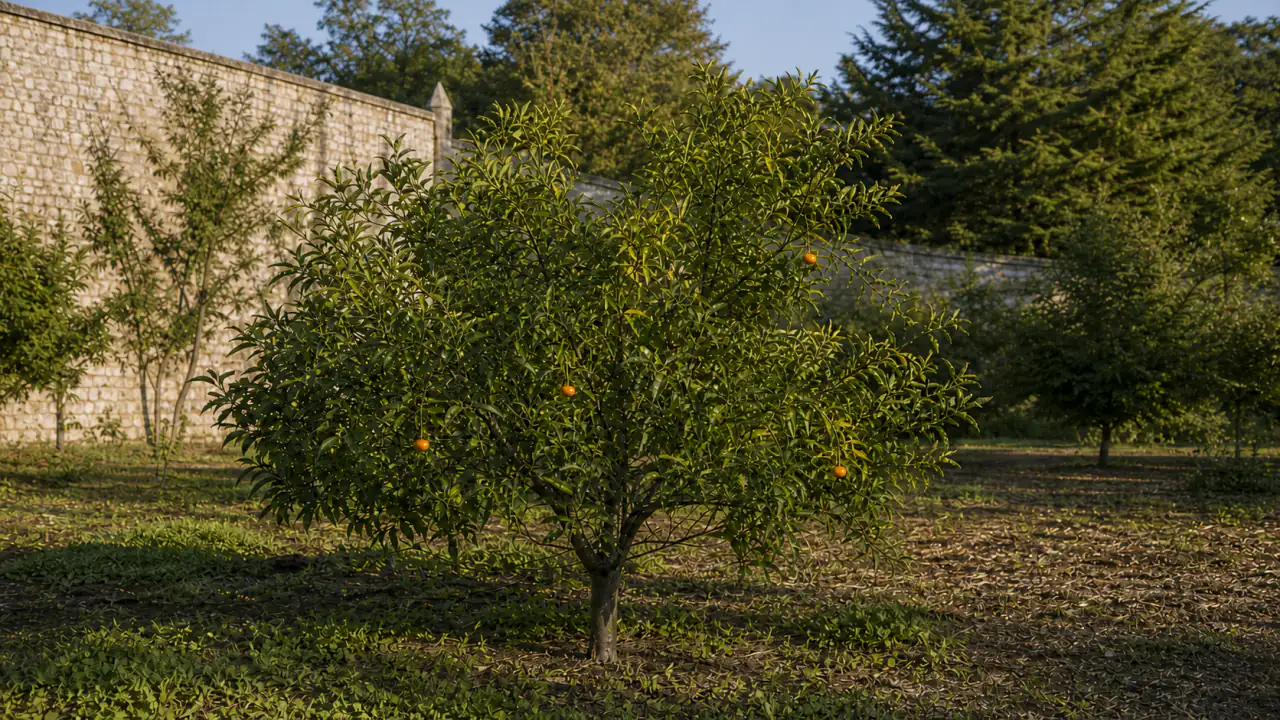
Iwasaki is a very early Japanese selection of satsuma, reaching maturity by early autumn in favourable climates. Its practical advantage is clear: finishing fruit maturation before autumn cold sets in. This makes it particularly interesting for regions with a short growing season where later mandarins fail to sweeten. Like other satsumas, it is strongly parthenocarpic, producing flattened fruit generally without seeds and without requiring a pollinator, while peeling easily by hand. Its habit can be open, spreading or gently drooping, depending on rootstockThe root and base onto which a variety is grafted to give it vigour or resistance. and culture.
Within the encyclopedia’s satsuma range, it sits alongside the reliable standard Owari and the early Okitsu Wase, pushing the boundary of early ripening further.
Reliable points to check before buying
Ripening early — and picking by taste
Gardeners choose Iwasaki to bring harvest forward. In a suitable climate, this very early satsuma can complete its development before later selections, but Spanish or Californian dates do not guarantee a British crop. Its primary benefit is earliness, not proven outdoor hardinessA plant's ability to survive winter cold without protection..
One important detail to watch: the sugar-acid balance varies with the harvest date. Picked too early, even an early variety can taste sharp; left to develop slightly longer within safe weather limits, the fruit rounds out. It sets generally seedless fruit without needing a pollinator. Select your rootstock according to the growing medium, confirming the exact combination with your nursery supplier.
Iwasaki through the year: container or sheltered garden
In Britain, container culture with bright, frost-free winter shelter is the dependable choice; open-ground growing is suited only to exceptionally mild, sheltered locations. Its early ripening window brings harvest forward into autumn.
| Jan | Feb | Mar | Apr | May | Jun | Jul | Aug | Sep | Oct | Nov | Dec | |
|---|---|---|---|---|---|---|---|---|---|---|---|---|
| Plant outdoors (exceptionally mild sites) | ||||||||||||
| Overwinter container in frost-free shelter | ||||||||||||
| Harden off and move container outdoors | ||||||||||||
| Fragrant spring flowering | ||||||||||||
| Early harvest (site-dependent) | ||||||||||||
| Citrus feed |
Indicative calendar for a favourable site: region, microclimate, rootstock, crop load and season shift the dates. Confirm internal maturity by tasting and protect the plant in line with local weather warnings.
An Iwasaki ripe on time and full of flavour
The race against winter
Monitor fruit development as autumn approaches: the objective is to harvest before early frosts within the window your climate allows.
Fruit coloured yet sharp
A satsuma that shows colour but tastes tart has been picked too soon; with Iwasaki, sugar-acid balance depends heavily on timing.
Allow ripening within the window
Wait for the flavour to mellow without risking frost damage; taste fruit regularly to find the right picking moment.
Reserve for shorter seasons
This is where it shines: in milder, longer seasons, a standard main-season satsuma may perform equally well.
Observe first; treat only after identification
The same symptom can have several causes. This grid gives a first check; it is neither a remote diagnosis nor a pesticide prescription.
| Observation | First check | Decision boundary |
|---|---|---|
| Leaves turning yellow | Check moisture, drainage, water quality and changes in young leaves | Have the cause confirmed before applying an amendment |
| Insects, cottony clusters or sticky deposits | Isolate if necessary and identify the organism accurately | Use only a method or product authorised for that use, following the local label |
| Coloured fruit with disappointing flavour | Sample one fruit and check internal maturity before generalising | Rind colour alone proves neither maturity nor disease |
Seek professional or plant-health advice if decline is rapid, symptoms are unusual or regulatory status is uncertain.
The first satsuma of the year
Flattened, generally seedless and easy to peel, Iwasaki is a satsuma for immediate enjoyment, to be eaten fresh right at the start of autumn — the first of the season. Fully ripe fruit yields a sweet juice, its unwaxed peel suits marmalade, and the segments lend themselves to drying. Its value lies not in complex culinary processing but in its earliness: providing fresh fruit sooner where the growing season is limited.
Satsuma marketing standard: figures and limits
These figures apply to marketed citrus lots under the cited official standard. They measure neither garden eating maturity, cultivarA variety produced through selection or cultivation, distinct from the wild original plant. hardiness nor cultivar yield.
- Nominal minimum diameter: 45 mm.
- Absolute floor within the size tolerance: 43 mm, only within a total tolerance capped at 10% of the lot by number or weight.
- Minimum satsuma juice content: 33%.
- Minimum sugar-to-acid ratio: 6.5:1.
- Colour: typical of the variety on at least one third of the surface within the commercial scope of the standard.
Official source — GOV.UK marketing standard for citrus fruit. No generic yield is published: observe the tree, crop load and local conditions.
What growers most often ask
What is the main advantage of Iwasaki?
Its exceptional earliness: in a suitable climate it can ripen ahead of later satsumas. The exact British picking date still depends on light, shelter and the season.
Does it contain pips?
It is generally seedless, not guaranteed pip-free. Satsumas can set fruit parthenocarpically without a pollinator, while UCR observations of Iwasaki include occasional small seed counts.
Why is my satsuma tasting tart?
Often because it was picked too early. With Iwasaki, the sugar-acid balance depends strongly on timing. Allow it to mature within the autumn window before picking.
Is it hardy?
It shares the relative cold tolerance of satsumas, but in Britain it requires container culture with frost-free winter shelter or an exceptionally mild sheltered spot.
Sources, scope and checks
Foreign evidence is retained only for identity and cultivar traits; no foreign harvest date, climate performance, dose, yield or legal rule is transferred to the United Kingdom.
- UC Riverside Citrus Variety Collection — Iwasaki Satsuma mandarin : bounded cultivar identity and traits; the foreign observation is neither a UK calendar nor UK performance evidence.
- Universeity of Georgia Extension — Comparing Early-Maturing Satsumas to Owari in Southern Georgia : a result from a defined study or site, retained with its protocol, region and period.
- Universeity of Florida IFAS — The Satsuma Mandarin : a general satsuma-group principle; it does not guarantee every fruit of this cultivar.
- Royal Horticultural Society — Grow your own citrus fruit : general growing guidance for the target market; no cultivar-specific performance is inferred.
- Todolí Citrus Fundació — Iwasaki : bounded cultivar identity and traits; the foreign observation is neither a UK calendar nor UK performance evidence.
- MAPA — Pliego Cítricos Valencianos 2025 : bounded cultivar identity and traits; the foreign observation is neither a UK calendar nor UK performance evidence.
- GOV.UK — Marketing standards for citrus fruits : requirements for a marketed lot; neither cultivar measurement nor a garden-ripeness test.
- IVIA — mandarin and rootstock evaluation programme : evidence that the combination must be assessed by site, climate, soil and system; no universal ranking.