Eremolemon
Citrus glauca × Meyer lemon — desert lime crossed with a lemon
A desert-citrus hybrid reported from Australian desert lime and Meyer lemon. It belongs in a collection or breeding record and must be described as an accession, not a uniform commercial variety.
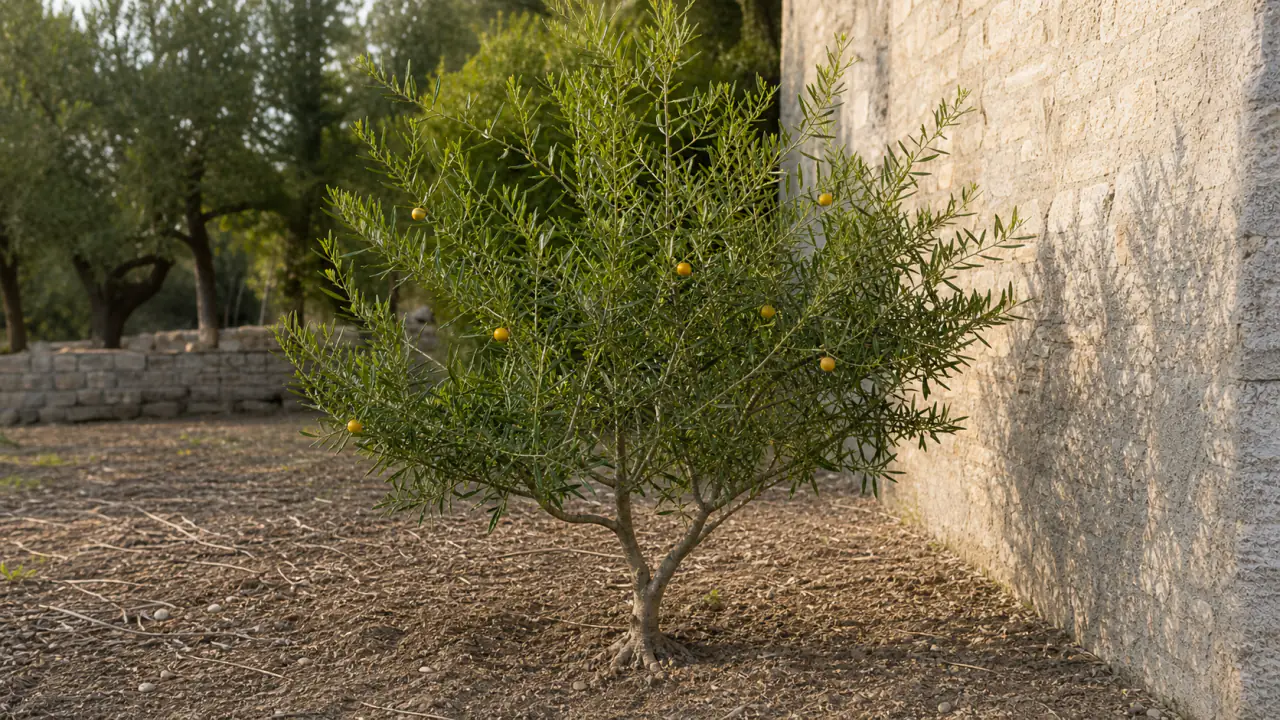
Eremolemon is a desert-citrus hybrid: material reported in the United States from Australian desert lime (Eremocitrus glauca, here treated as Citrus glauca) and Meyer lemon. Its most relevant inherited trait is drought tolerance, the desert lime’s principal horticultural interest. The fruit is small, subglobose to flattened, yellow and lemon-like, with little fresh-eating value. Its real role is collection and breeding rather than an orchard crop. Crucially, it is not a uniform commercial variety but material that must be recorded as a precise accession.
Compare it with its desert-lime relative Eremorange and with the reported parent Meyer lemon. Intermediate single leaves reflect its mixed ancestry.
Reliable pointers — by accession
A desert accession — not a nursery variety
Understand Eremolemon as an accession: a particular plant documented by a collection, not a commercial variety expected to be identical everywhere. Its two interests are drought tolerance from desert lime, useful to research and breeding, and its value as a collection plant for rare-citrus growers. The small lemon-like fruit has no serious table-fruit role.
Its characters are therefore presented as accession observations for UCR CRC 2439, not universal specifications. Cold tolerance remains unverified and must be tested. If grafted, the rootstockThe root and base onto which a variety is grafted to give it vigour or resistance. should follow soil and water only after the exact combination has been confirmed by the nursery.
| Your aim | Choice | Reason — and trade-off |
|---|---|---|
| Collection / dry conditions | Own roots or documented graft in free-draining soil | Displays the drought-adapted character. ⚠ Fruit has little fresh use. |
| Alkaline soil | A locally proven tolerant rootstock if grafted | May reduce chlorosisYellowing of the foliage caused by poor iron uptake, often linked to chalky soil. risk. ⚠ Do not prescribe a stock without evidence for the exact graft. |
| Breeding / research | Accession-identified material | Record the accession number, not merely a variety name. ⚠ Other material may differ. |
| Keep in mind | Accession, not variety | Verify identity and local response; never generalise CRC 2439 data. |
An Eremolemon year: drought-adapted, evidence-protected
Provide full light and sharply drained soil, but keep the exact plant protected from frost until tested. UCR’s April–November harvest belongs to CRC 2439 at Riverside, California; it is shown only as an accession record.
| Jan | Feb | Mar | Apr | May | Jun | Jul | Aug | Sep | Oct | Nov | Dec | |
|---|---|---|---|---|---|---|---|---|---|---|---|---|
| Plant in free-draining conditions | ||||||||||||
| Protect pending local hardiness evidence | ||||||||||||
| Possible flowering | ||||||||||||
| CRC 2439 Riverside harvest record only | ||||||||||||
| Feed lightly while actively growing |
Document Eremolemon rigorously
The accession, not “the variety”
Record the exact accession: its traits belong to documented material, not to a supposedly uniform commercial variety.
A “disappointing” fruit
A small fruit with little fresh-eating value is not a defect here. The hybrid’s botanical and breeding value lies elsewhere.
Use its dry-site character correctly
Choose sharp drainage and measured irrigation in full light; drought tolerance still requires establishment and does not mean withholding all water.
Test hardiness rather than repeating a number
Keep it protected until the exact accession has credible local observations.
Read the symptom, trace the cause, correct and prevent
Eremolemon is a low-input collection citrus; accession fruit characters are observations, not disorders.
| What you see | Likely cause | Correct | Prevent |
|---|---|---|---|
| Small fruit with little fresh appeal | Normal desert-hybrid accession character | Reserve for collection, breeding or occasional zest | Understand the accession before expecting a crop |
| Yellow leaves with greener veins | Iron chlorosis promoted by high pH or wet roots | Correct irrigation and drainage; use suitable chelate only after diagnosis | Keep soil open and avoid chronic saturation |
| Cottony deposits or fixed scales on stems and leaf backs | Mealybugs or scale insects | Isolate, remove by hand and use a labelled treatment if needed | Inspect regularly, especially under cover |
| Foliage damaged after cold | The accession’s cold limit was exceeded | Protect and remove dead wood only after spring growth shows | Establish cold response locally; do not rely on a generic class |
| Silvery winding mines in young leaves | Citrus leafminer | Remove only badly distorted shoots and preserve beneficial insects | Avoid nitrogen-driven flushes late in the season |
Keep treatment proportionate: clean foliage and moderate nutrition come first. For an uncertain or regulated citrus pest, follow current UK plant-health guidance.
A collection citrus, not a fruit-bowl choice
Eremolemon is not a table fruit: its small lemon-like fruit has little fresh appeal. At most, its juice and zest may occasionally acidify or scent a preparation, while peel could enter small experimental marmalades, salt cures or dried seasonings. Its primary value is botanical: drought-adapted material for breeding and a documented collection accession. Grow it for what it represents, not a promised crop.
What standards do — and do not — say
Eremolemon falls outside a market-size scale: it is not a mainstream eating fruit, and the available numbers are accession data.
- Market category: outside the cited grades; value is botanical, collecting and breeding.
- Accession data (UCR CRC 2439): historical descriptions report fruit 18–25 mm wide, with five to six segments and one to three seeds. These are accession observations, not universal specifications.
No generic yield should be published: this plant is not evaluated as a commercial fruit crop.
What British growers most often ask
What is Eremolemon?
Reported Citrus glauca × Meyer lemon material combining Australian desert-lime ancestry with a lemon. It is of collection and breeding interest, not a uniform commercial variety.
Can the fruit be eaten?
It has little fresh-eating value. The plant is grown mainly for drought-adapted germplasm and botanical interest.
What do the published measurements mean?
UCR describes CRC 2439 fruit as 18–25 mm, with five to six segments and one to three seeds. Those figures belong to that accession, not every plant sold under the name.
Is it hardy?
No generic British rating is justified. Its better-supported interest is drought adaptation; protect the exact material until locally tested.
Accession evidence and scope control
Evidence checked 4 August 2026. Measurements and dates remain explicitly tied to CRC 2439 at Riverside.
- UC Riverside — Eremolemon CRC 2439: accession identity, reported parentage, Riverside phenology and historical fruit measurements.
- Royal Horticultural Society — Citrus glauca × Meyer: accepted search-facing hybrid name and British horticultural context.