English lavender
Lavandula angustifolia Mill. — common or true lavender
A sun-loving Mediterranean subshrub that is hardy across much of the UK when its roots stay well drained. Establish it carefully, then avoid routine feeding.
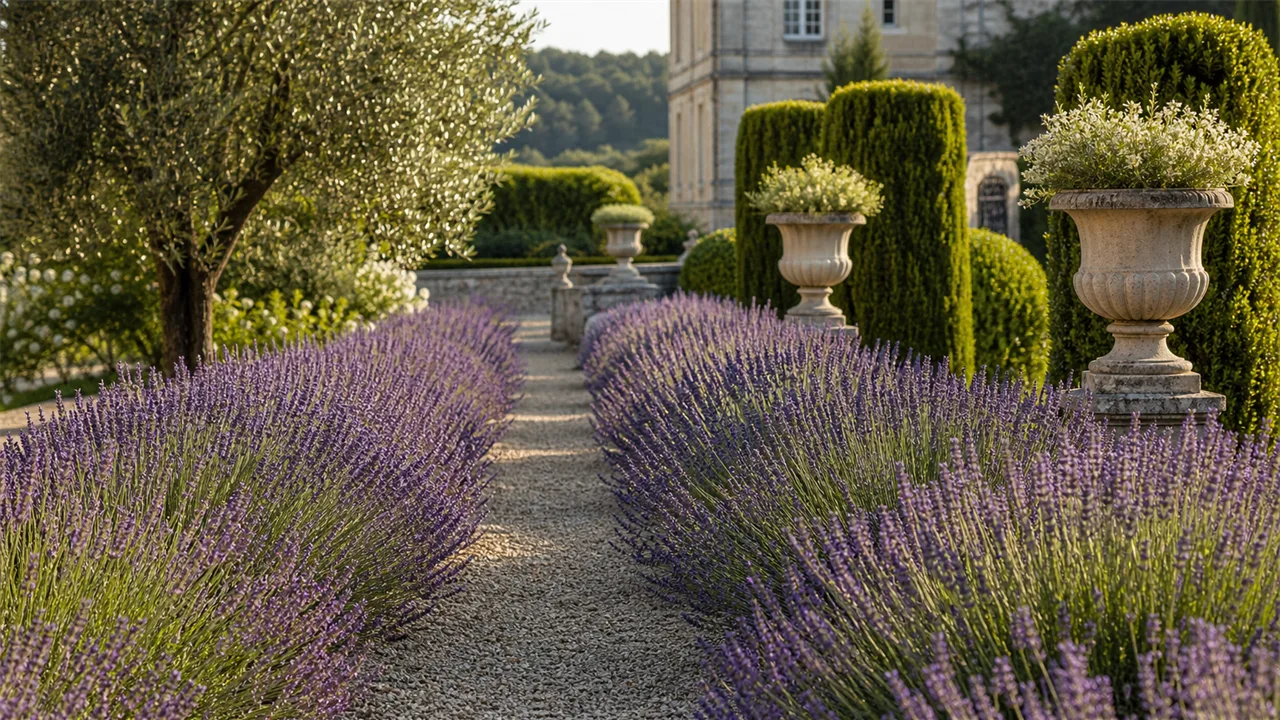
English lavender needs full sun, moving air and soil that releases water quickly. Once rooted, it copes with dry spells and normally flowers without regular feed. Its vulnerable point in Britain is not simply winter cold, but cold combined with wet compost or waterlogged soil. Good care therefore changes with the stage and setting: a new plant needs attention through its first summer, an established border plant needs very little, a container dries faster, and every plant should be kept comparatively dry in winter.
Despite its common name, English lavender is native to south-western Europe rather than Britain. Do not confuse it with lavandin, Lavandula × intermedia, a generally larger hybrid with branching flower stems. English lavender is usually more compact, notably hardy and well suited to low hedges and edging.
Continue through the plant encyclopedia; compare agapanthus, a sunny-border plant that needs more moisture while actively growing, and hydrangea, whose preference for cooler, moister soil provides a useful contrast.
Reliable markers before planting
Where should English lavender be planted in a British garden?
Choose the sunniest open position available. A south- or west-facing gravel garden, raised bed, bank or the top of a low wall is safer than the lowest point of a border. Avoid roof runoff, heavy irrigation from a lawn and pockets where winter rain sits. On clay, planting high on a broad mound or in a raised bed is generally safer than digging a deep hole and filling it with rich compost, which can behave like a sump.
Set the crown at the same level as it grew in the nursery pot. Keep the base open to light and air, with coarse grit or gravel at the surface rather than wet organic mulchA layer of material (bark, straw…) laid on soil to retain moisture and limit weeds. pressed against the stems. For containers, choose generous drainage holes and a peat-free loam-based compost opened with plenty of coarse grit. Never allow the pot to stand in water.
Plant in April or May as the soil warms, and avoid winter planting when cold, wet soil exposes young roots to rot. After planting, water regularly through the first summer, with the interval adjusted to rain and drainage.
When to plant, water, flower and prune English lavender
The watering row applies mainly to new plants and containers. An established lavender in open ground is not watered on a calendar. In cooler or wetter districts, wait for spring rather than planting into saturated autumn soil.
| Jan | Feb | Mar | Apr | May | Jun | Jul | Aug | Sep | Oct | Nov | Dec | |
|---|---|---|---|---|---|---|---|---|---|---|---|---|
| Plant | ||||||||||||
| New plants | ||||||||||||
| Flowering | ||||||||||||
| Trim after flowering | ||||||||||||
| Feed only if justified |
How should English lavender be watered, and what NPK feed does it need?
During establishment: water regularly through the first summer, then adjust the next watering to rainfall and drainage rather than a fixed calendar.
Rainfall tracking: record it weekly in millimetres; the German Weather Service explains in English that 1 mm equals 1 L/m².
A deliberately bounded numerical benchmark: for hot regions and optimal productivity, Utah State Universeity gives about 1 US gallon, or 3.8 L per plant each week after transplanting until establishment. Use this foreign benchmark only to check the order of magnitude, not as an automatic British dose regardless of rain, drainage and soil condition.
Check before adding water: UC Agriculture and Natural Resources advises allowing the top 3–4 inches, about 7.5–10 cm, of soil to dry before watering. If that layer is still moist, delay watering; a newly planted lavender needs somewhat more attention in its first year.
For an established plant in open ground: the RHS advises that watering is rarely needed except in severe drought.
In a container: water regularly in summer because the roots have only a limited volume of compost. Large drainage holes are essential; weather, pot volume and plant condition still affect the interval.
In winter: keep containers fairly dry and protect them from excessive rain. In open ground, fast drainage remains the priority.
Routine feeding is not required. English lavender is adapted to lean soil. Correct shade, wet compost and poor drainage before considering feed.
If an established plant is still developing slowly after checking light, water, roots and health, only one external NPKThe three main nutrients in a fertiliser: nitrogen, phosphorus and potassium. exception applies. UC Marin Master Gardeners states that established plants may receive 10-10-10 NPK as a spring side-dress before flowers appear. Follow the local product label; this US reference is not a standard annual British programme.
How to decide before watering or feeding
Read the site before the plant
Note the sun, slope, soil texture, downpipes and neighbouring irrigation. No fertiliser can compensate for a lavender sitting in a winter sump.
Identify the situation
Separate the first summer, an established border plant, a container and winter. Count rain and confirm drainage before adding water.
Do not mistake root stress for hunger
Yellowing in wet compost should prompt a drainage and root check before nutrient deficiency is considered.
Trim young and keep the crown dry
Regularly trimming green growth maintains a dense mound. Keep wet mulch away from the crown, water at soil level and protect containers from persistent winter rain.
When and how should English lavender be pruned?
Give the main trim in late summer, just after flowering. Remove the spent flower stems and about 2.5 cm of leafy growth, shaping the plant into a low dome. Every cut should remain above visible leaves or young shoots. In spring, remove only genuinely dead or frost-damaged tips and neaten uneven growth once new buds make living wood clear.
Do not cut an old lavender down to bare brown wood in the hope of rejuvenating it. Lavandula angustifolia does not reliably break from leafless stems. A plant left untrimmed for several years opens in the middle and becomes difficult to reshape, so start with light annual trimming after its first flowering.
Pests, diseases and lookalike symptoms in the UK
Symptoms overlap. Check soil moisture, the crown, accessible roots and recent weather before naming a disease. Seek a professional diagnosis for rapid or spreading dieback, and treat Xylella as a biosecurity question rather than a home diagnosis.
| Observed symptom | Possible causes | Favouring factors or clues | First cautious action |
|---|---|---|---|
| Dull, yellow or wilted foliage while the soil is wet; brown decaying roots | Waterlogging or root and crown rot, including Phytophthora, Fusarium or Pythium | Compact compost, standing water or excess irrigation | Root rot cannot be confirmed from foliage colour alone. While the compost remains wet, withhold water and correct the drainage. |
| Young shoots turn chlorotic and wilt from May onwards | Phoma is one possibility in commercial guidance | Frost, root damage and other fungi can look similar | Compare affected and unaffected shoots and record whether the symptoms spread from May onwards; that pattern supports a hypothesis but does not confirm the agent. |
| Soft decay with fuzzy grey-brown mould on leaves, flowers or stems | Grey mouldA fungus, also called botrytis, that affects damp flowers and leaves., Botrytis cinerea | Humidity, damaged tissue, crowding and wet foliage | Persistent humidity, crowding and wet foliage strengthen the grey-mould hypothesis; compare its extent again after a dry interval. |
| Leaves reduced to grey-brown stumps; metallic purple-and-green beetles or grey larvae | Rosemary beetle, Chrysolina americana | Active mainly from late summer to spring; healthy plants usually tolerate it | Hand-pick adults and larvae or shake them onto paper if damage becomes conspicuous. |
| White frothy blobs on stems from May to July | Cuckoo spit made by froghopper nymphs | Growth is usually unaffected | Leave them as part of garden biodiversity. They do not justify routine insecticide treatment. |
| Leaf scorch, wilt and dieback on a recently imported plant | Ordinary stress or, more rarely, Xylella fastidiosa | Lavender is a high-risk host, but the bacterium has not been detected in the UK according to current RHS guidance | Do not diagnose from appearance or move suspect material. Prefer UK-grown stock and contact the relevant plant-health authority where import history and symptoms create a credible concern. |
Which English lavender suits the space?
Two taxa that should not be confused; use the plant label for a named cultivar.
| Form or cultivar | Main value | Good use |
|---|---|---|
| Lavandula angustifolia | English lavender, the species described here | Apply the guidance only after checking botanical identity |
| Lavandula × intermedia | Lavandin hybrid, distinct from English lavender | Do not automatically transfer this page’s dimensions or calendar |
Why does English lavender turn yellow, flop or stop flowering?
Watering every lavender on the same schedule confuses the first summer, an established border plant and a container. An established plant in open ground rarely needs water outside severe drought, while a container needs regular summer watering.
Do not turn feeding into a yearly ritual. The 10-10-10 NPK reference remains a conditional spring side-dress before flowering for an established plant.
Cutting into bare old wood can leave a framework that never shoots again. Trim within leafy growth every year. If an old plant is completely hollow and woody, replacement or cuttings from healthy young shoots are more reliable than severe renovation pruning.
Assuming every wilted plant is dry leads to watering roots that may already be suffocating. Lavender wilting in wet compost, especially with a dark crown or brown roots, needs inspection before any more water or feed.
English lavender succeeds when a British garden gives it a small Mediterranean island: sun, stone, air and a root zoneThe area of soil occupied by a plant's roots, where water and nutrients matter most. that can dry between useful waterings. A dense mound comes from keeping the crown dry and trimming leafy growth without wounding the old wood.
Frequently asked questions about English lavender
How often should English lavender be watered?
There is no interval that works in every garden. Water regularly through the first summer and count rainfall. An established plant in open ground normally needs water only in severe drought; containers need regular summer watering.
What NPK fertiliser should I use for lavender?
A healthy mature lavender normally needs none. For an established plant, one external exception applies: UC Marin Master Gardeners states that established plants may receive balanced 10-10-10 NPK in spring before flowers appear. Follow the local label and do not turn it into an annual routine.
When should English lavender be pruned?
Trim just after flowering in late summer, removing spent stems and about 2.5 cm of leafy growth. Keep visible leaves below every cut. In spring, remove only dead or frost-damaged tips once new growth shows what is alive.
Why is my lavender yellow even though I water it?
Yellowing in wet soil suggests excess water, oxygen-starved roots or root rot more readily than drought. Compare drainage, the crown and accessible roots; foliage alone does not confirm the cause.
Can English lavender stay outside in a pot over winter?
Yes, but keep the container fairly dry and protect it from excessive winter rain. Free-draining compost and large drainage holes remain essential.
Sources and editorial control
- Royal Horticultural Society — How to grow lavender: UK planting, container compost, first-summer and established watering, winter rain protection, feeding limits and pruning.
- Royal Horticultural Society — English lavender plant profile: accepted identity, hardiness, soil, high-nitrogen risk, rosemary beetle, froghoppers and diseases.
- Business Wales Farming Connect — Growing Lavender: wet-climate production context, drainage, watering, Phoma, root rots and other crop health risks; no isolation, laboratory or tool-disinfection protocol is transferred.
- Royal Horticultural Society — Rosemary beetle: identification, season, damage and proportionate non-chemical management.
- Royal Horticultural Society — Cuckoo spit: symptoms, low impact and the distinction from Xylella disease.
- Royal Horticultural Society — Xylella fastidiosa: current UK status, non-specific symptoms, high-risk hosts and biosecurity context.
- German Weather Service — Precipitation: English-language official definition equating 1 mm of precipitation with 1 L/m², used for the weekly rainfall record.
- Utah State Universeity Extension — How to Grow English Lavender in Your Garden: peer-reviewed US fact sheet used only as a bounded numerical comparison for establishment in hot-region productivity conditions, not as a standard UK dose.
- UC Agriculture and Natural Resources — Growing Lavender: US exception limited to the 3–4 inch soil-drying check and the slightly greater first-year water need.
- UC Marin Master Gardeners — Lavender: US university exception for a 10-10-10 spring side-dress before flowers appear on an established plant, and no fertiliser for mature lavender.
- Kew Science, Plants of the World Online — Lavandula angustifolia: accepted name, family and native range.