Brugmansia
Brugmansia Pers. — angel’s trumpet; a separate genus from Datura, with which it is still commonly confused
The shrub with huge hanging flowers that scent the evening air. Spectacular, easy to grow, and toxic in every part — the ornamental plant that demands the most judgement about where you put it.
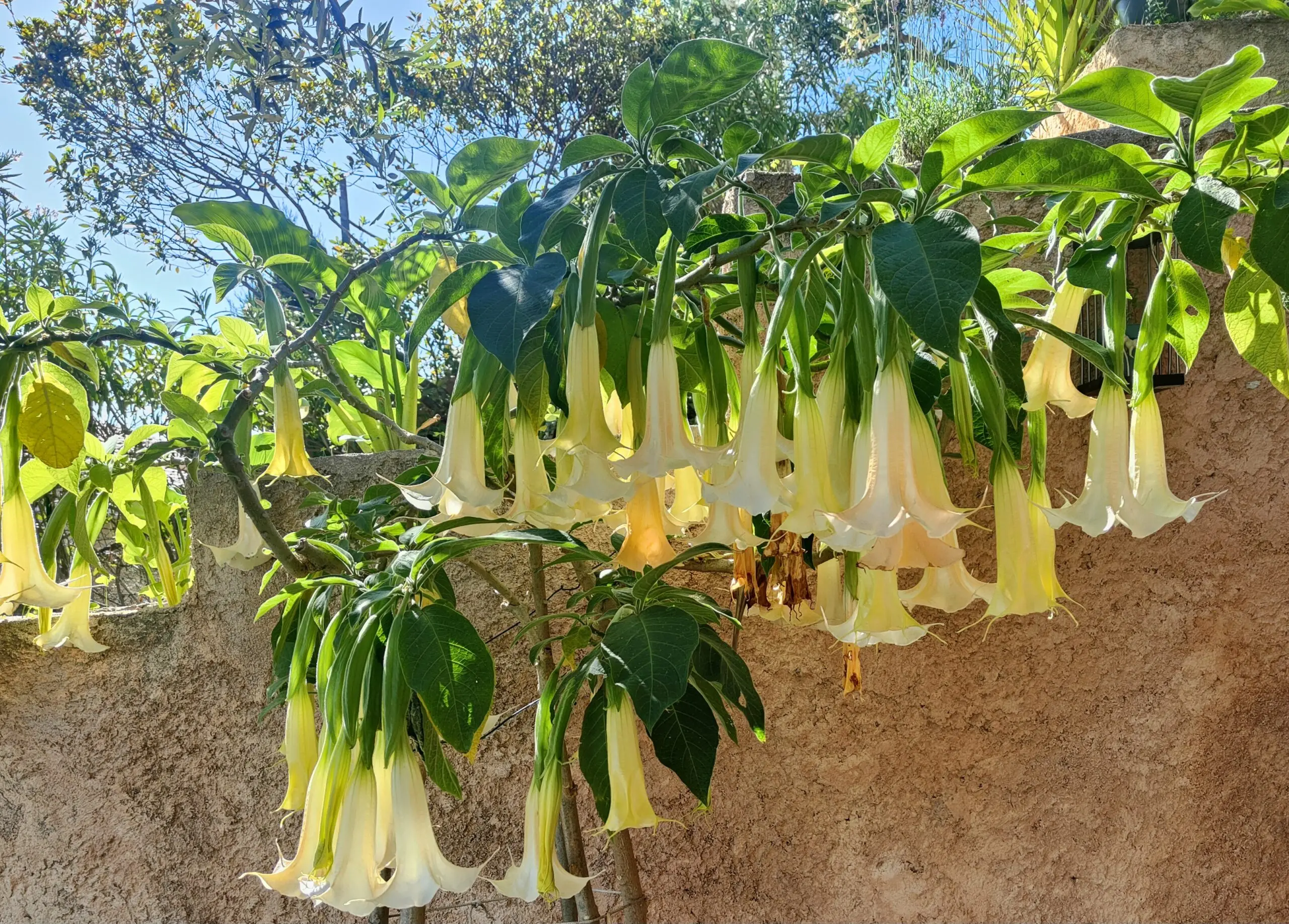
Angel’s trumpet is a soft-wooded shrub in the nightshade family, grown for its very large hanging trumpet flowers, often scented in the evening. Fast-growing, over 2 m without pruning and up to 4-5 m in favourable conditions. No hardinessA plant's ability to survive winter cold without protection. to speak of: it must be kept above 7-10 °C. Every part is highly toxic and the sap can irritate skin.
It is very often called « datura » out of habit, even in garden centres. That’s a mix-up: they are two distinct genera, and the difference is visible to the naked eye (see below).
Reliable figures before you plant
Brugmansia or datura: three characters that settle it
The confusion is a historical one — brugmansia was long classified within the genus Datura before being split off — and it lingers in everyday speech. In the garden, though, three characters are enough to decide, no microscope required:
- Habit: brugmansia is a shrub or small tree with soft but persistent wood, which builds a framework over several years. Datura is a herbaceous plant, with no woody structure.
- Flower orientation: brugmansia flowers hang down, like suspended trumpets. Datura flowers stand upright.
- The fruit: brugmansia’s seed capsule is smooth, spineless. Datura’s is spiny — hence the name « thorn apple » given to some species.
Any doubt about a plant sold under a « datura » label is settled simply by checking whether the flower hangs and whether the stem is woody.
Brugmansia asks a question that few ornamentals ask as bluntly: where to put it. Its toxicity runs through every part, and its spectacular flowering draws exactly the attention that is the problem — that of visitors, children, animals. The right instinct isn’t to give it up, but to treat it as a backdrop feature: away from through-routes, out of reach of young children, never beside a path or near a play area or animal enclosure. Growing it in a container also makes it possible to move and bring indoors for winter, which settles the frost question at the same time. It is an exceptional plant, on the condition that you decide its position before buying it, not after.
Behaviour, mechanism and limits
It is a vigorous, fast-growing plant: a well-fed, well-watered specimen produces a considerable mass of foliage in a single season, and flowers for a long stretch of summer. That vigour is also its main constraint — left unpruned it soon tops 2 m and becomes hard to bring indoors. Pruning is done in autumn to rebalance the framework, cutting the current year’s growth back to a few centimetres from the old wood.
The decisive point of management is overwintering. Brugmansia will not tolerate frost and must stay above 7-10 °C. Two paths exist: keep it in growth in a conservatory or by a large, very bright window, or rest it in a frost-free space — garage, cellar — with watering cut right back. RHS guidance is blunt about the UK specifically: there is essentially nowhere in the country, bar a handful of the mildest coastal pockets, where it survives unprotected outdoors — most gardens, including much of the south, will need a heated space to keep it frost-free. The second, dormant option needs less light but means accepting a leafless plant for several months.
The honest limit is toxicity, and it isn’t negotiable: every part contains powerful tropane alkaloids, and the sap can irritate skin. Wearing gloves while pruning is a basic precaution, as is washing hands afterwards. It should also be kept away from horses and livestock, for which it is listed as toxic. If any part is swallowed, even a small amount, contact a poisons information service or emergency care without delay.
Growing brugmansia safely
Choose the position first
Away from through-routes, children and animals, before you even buy it. A container makes this choice easier.
Foliage wilting in summer
Almost always a lack of water: in a pot, moisture needs checking daily during hot spells.
Prune in autumn, gloved
Cut the current year’s growth back near the old wood to keep a balanced framework. Gloves mandatory.
Bring indoors before the cold
Never below 7-10 °C. A bright conservatory in growth, or a frost-free space at rest with minimal watering.
Read the sign, trace the cause, correct, prevent
Most trouble occurs during overwintering, when the plant moves from an airy outdoor spot to a warm, dry indoor one.
| What you see | Likely cause | Correct | Prevent |
|---|---|---|---|
| Speckled leaves, fine webbing, warm dry air | Spider mites | Mist the foliage, raise humidity | Avoid confined warm, dry air while wintering |
| Clouds of small white insects underneath leaves, sticky residue | Whitefly | Ventilate, sticky traps, encourage natural predators | Inspect systematically before bringing the plant indoors |
| White cottony masses at leaf joints and on stems | Mealybug | Clean spot by spot, isolate the affected plant | Check when bringing indoors, ventilate the winter space |
| Foliage wilting in full heat | Lack of water, very common in containers | Water generously and regularly in summer | Check pot moisture daily during hot spells |
| Plant losing leaves after a cold snap | Temperatures dropped below the tolerated threshold | Move to shelter, cut watering, wait for regrowth | Bring indoors before the first cold spell: frost is fatal |
Wear gloves for every task. Keep the plant and its prunings out of reach of children and animals; never compost them anywhere accessible.
Species and hybrids worth knowing
Cultivated brugmansias are heavily hybridised and identifying the exact species requires examining the calyx and corolla. The pointers below help place a plant, not settle a specific case.
| Taxon | Useful characters | Note |
|---|---|---|
| Brugmansia suaveolens | Scented white flowers; leaves becoming hairless; the narrow part of the corolla visible above the calyx | One of the most widely grown species |
| Brugmansia × candida | Fully hanging flowers, the calyx covering the narrowest part of the corolla | Hybrid, very common in garden centres |
| Brugmansia arborea, B. aurea, B. insignis | Other species in the genus, variable habit and colouring | Often involved in garden hybrids |
A wall doing all the work
On our estate, in the mild microclimate of the Nice hills, a specimen planted in open ground against a sheltered wall has spent winter outdoors for more than five years, never once brought in: the wall holds enough warmth that it keeps its leaves and barely slows down, flowering repeatedly through the year rather than just once. We measure our own temperatures, at the coldest point of the night and early morning, and have never recorded below 1 °C since we settled here — a climate that explains a great deal here, including this unusual winter performance. We prune it every year to keep its vigour in check, since it pushes past 2 m. This success comes down to the wall, the aspect and this measured climate, not a general rule — it is not proof that the 7-10 °C threshold doesn’t matter, only that a sheltered spot and a mild enough winter can move it. Its position, on the other hand, was not chosen with the safety logic described above in mind — it was already there. For any new planting, we apply the rule: away from through-routes, out of reach of children and animals. For readers gardening anywhere colder than a genuinely frost-free coastal pocket, none of this changes the RHS advice above: bring it indoors.
What people ask most
Are brugmansia and datura the same plant?
No. They are two distinct genera, long confused. Brugmansia is woody with hanging flowers and smooth capsules; datura is herbaceous, with upright flowers and spiny capsules.
Is brugmansia dangerous?
Yes: every part is highly toxic and the sap can irritate skin. Wear gloves, wash your hands, and keep it away from children and animals. If any part is swallowed, contact a poisons information service immediately.
Can it be left outside over winter?
Not in the UK, except perhaps in the very mildest frost-free coastal spots. It must stay above 7-10 °C: a bright conservatory in growth, or a frost-free space at rest with minimal watering.
When and how should it be pruned?
In autumn, cutting the current year’s growth back to a few centimetres from the old wood to keep a balanced framework. Always wear gloves.
Can it be propagated easily?
Yes, and more simply than often assumed: on our estate, we just cut a branch about 20 cm long and plant it straight into the ground to get a new rooted cutting, no special treatment needed — no need for the 10-15 cm semi-ripe cuttings usually recommended. Sowing seed at around 16 °C remains another, slower option.
Sources and verification
Last checked: 27 August 2026. Written at genus level: identifying the exact species requires examining the calyx and corolla.
- RHS — Brugmansia growing guide: position, temperature thresholds, overwintering, pruning, cuttings, toxicity.
- Hardy Tropicals UK — overwintering Brugmansia: practical UK growers’ consensus on outdoor survival limits.
- Kew Science — Plants of the World Online, Brugmansia × candida: taxonomic check.