Roller or Impact Garden Shredder: Match Your Prunings
Choose a shredder from the material your garden actually produces and what you will do with the output. Impact or blade machines often suit finer, leafy pruning when their manual accepts it; roller or quiet shredders generally favour woody material and coarser shreddings. A once-a-year heap may justify hire or sharing rather than ownership. Measure representative branches, record green and dry fractions, volume and frequency, then check each candidate manual, never a universal diameter table. This guide belongs to Garden Tools.
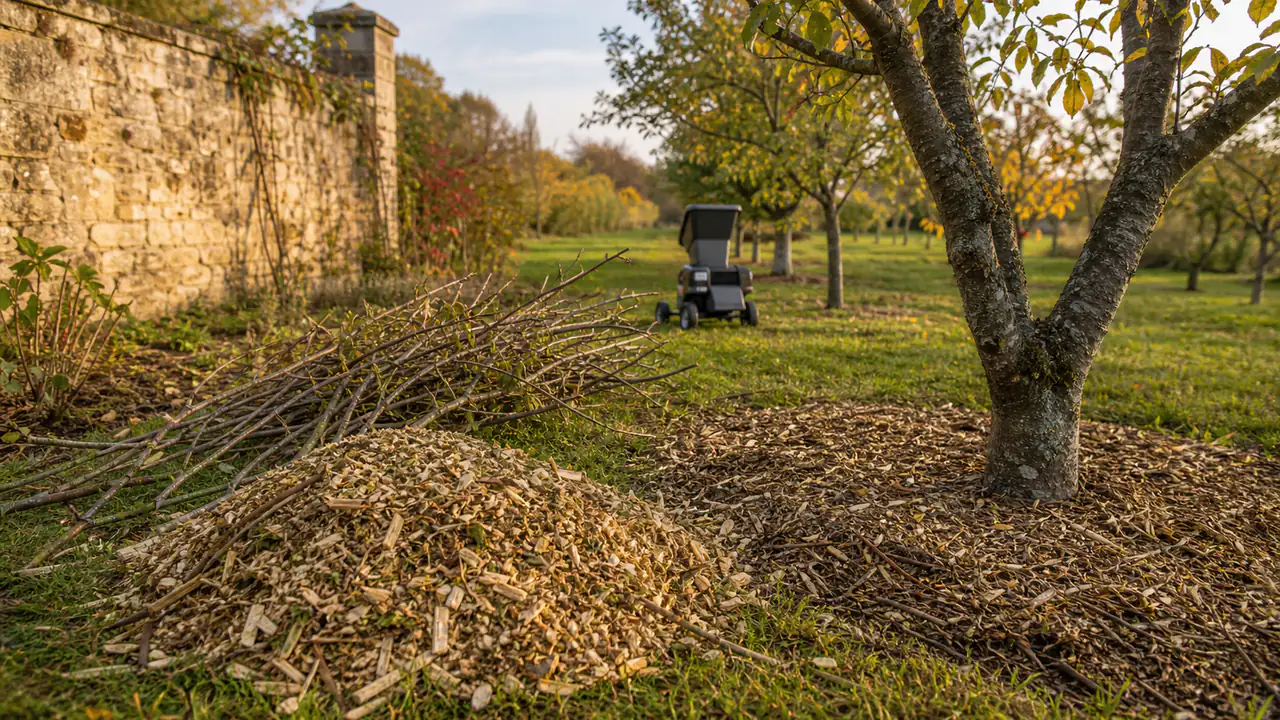
The hero image is illustrative rather than product-test evidence. It shows branches, fresh shreddings and a surface mulch beneath a fruit tree, with a garden shredder set behind the work area.
Inventory one real pruning session before choosing a mechanism
Do not begin with motor power or the largest number on a product page. Begin with the waste stream from a real hedge cut, fruit-tree prune or border clear-up. A useful inventory can be made without pretending to conduct a machine test.
Spread the material on a clear surface and record:
- soft or woody: leaves, flexible stems and hedge tips separated from lignified branches;
- green or dry: freshly cut wood distinguished from seasoned, harder material;
- measured diameter: use callipers or a rule at the thickest section you intend to feed, including forks and swollen nodes;
- shape: straight, branched, thorny, curved or root-contaminated;
- volume: count equal garden trugs, crates or a consistently filled tarp area rather than calling every pile “large”;
- frequency: one annual pruning, seasonal batches or a regular weekly stream;
- contamination: soil, stones, wire, plant labels, nails, treated timber or diseased material;
- intended destination: surface mulch, compost ingredient, path material, municipal collection, firewood or disposal under local rules.
Measure a spread of typical branches, not only the single largest stick. A machine that accepts one straight maximum-size branch under specified conditions may still be a poor match for a heap dominated by forked, dry or leafy material. Keep larger clean wood for sawing or another use rather than forcing it because the inlet looks wide.
This inventory pairs naturally with a bypass, anvil or electric-pruner decision: pruning method determines the shapes and sizes later presented to the shredder.
Use a matrix, not a universal branch-diameter rule
| Dominant garden material | First route to assess | Decisive manual check | Likely output character |
|---|---|---|---|
| Fine, fresh hedge trimmings and leafy twigs | Impact/blade shredder or direct composting | Exact accepted material, feed rate and wet-material restrictions | Finer, more cut material when the machine handles it well. |
| Predominantly straight woody prunings | Roller/quiet shredder | Model-specific diameter, pressure-plate setting, reverse function and dry-wood limits | Coarser, crushed or fibrous shreddings. |
| Mixed soft and woody batch | Sort first; compare hybrid approach or separate processing | Whether the model genuinely accepts both fractions without repeated blockage | Mixed output whose destination must be chosen after inspection. |
| One large annual pile | Hire, community scheme or shared machine | Availability, transport, induction, cleaning and responsibility for wear | Access to a suitable machine without year-round storage. |
| Frequent, uniform orchard or hedge stream | Ownership may be justified | Parts, blades/plate, collection box, cable or fuel routine and storage | Repeatable output if the material remains within the instructions. |
| Thick, forked, contaminated or treated material | Do not feed by default | Specific prohibition and alternative disposal route | Keep separate; not garden mulch. |
The labels “impact”, “blade”, “roller” and “quiet” describe mechanisms or marketing families, not identical performance. Some models use discs, multiple knives, a cutting drum or a pressure plate. Read the diagram and parts list. If the seller does not provide the current manual, accepted material and replacement-part references, the comparison is incomplete.
BBC Gardeners’ World’s UK test guide is useful because it treats handling, storage, jams, maintenance and replacement parts as part of the choice, rather than judging machines only by a headline capacity. Its tested results remain attached to the models and conditions in that guide; they are not category laws.
Decide whether buying, hiring or sharing fits the frequency
RHS guidance on woody waste explicitly includes hiring as an option. That matters because a shredder occupies storage, requires cleaning and has wear parts even when idle. Ownership makes most sense when the recorded material recurs often enough to support a maintained workflow.
Compare four annual burdens:
- number and size of actual pruning sessions;
- time and transport required to hire or collect a shared machine;
- storage, cleaning, cable or fuel management and maintenance for ownership;
- destination capacity—beds, compost bays and paths can only use so much suitable output.
If one machine is shared, document who checks blades or the roller plate, who removes contamination, how it is transported and whether every user receives the instructions. Sharing a poorly maintained unit merely spreads the blockage and safety problem between gardens.
A heavy machine also has to reach the pile and return to storage. Map gate width, steps, gradient and ground just as you would for a powered wheelbarrow on a slope. Do not drag a top-heavy shredder across a route its instructions exclude.
Define the output before calling it mulch or compost
The material leaving the chute is shreddings. It becomes mulch only when a suitable, clean fraction is deliberately applied as a surface layer for a suitable planting. It becomes a compost ingredient only when combined and managed within a composting process. The names describe use and provenance, not merely the fact that a branch has passed through a machine.
Use these distinctions:
- Fresh clean woody shreddings: may be considered for surface mulch beneath established woody plants when species, health and local practice make that appropriate.
- Coarse dry woody shreddings: may contribute structure to a balanced compost or serve another documented use, but decomposition and water behaviour differ from fresh material.
- Fine wet leafy shreddings: can mat or compact; mix and monitor rather than spreading a dense wet layer automatically.
- Diseased plant material: keep separate until the disease-specific disposal recommendation is known.
- Painted, preserved, glued or otherwise treated wood: do not treat as ordinary garden prunings or spread around food and ornamental plants.
- Thorny or sharp output: assess where it can be used without creating a handling or footpath hazard.
The French term BRF—bois raméal fragmenté—does not mean every pile of garden shredder output. It refers to a defined ramial-wood approach involving suitable young branch material and a particular soil use. In this English page, “shreddings” remains the honest generic word unless the origin and method actually meet that framework. A batch containing old dry timber, conifer trunks, wet leaves and hedge wire is not transformed into BRF by relabelling it.
Before spreading anything, inspect smell, contamination, plant health and particle form. Keep a small note of source tree or hedge, cutting date, material condition and destination. This creates traceability if the material later mats, sprouts, carries thorns or proves unsuitable for the chosen bed.
Match maintenance to blades or pressure plate
An impact or blade machine depends on sharp, correctly fitted cutting parts. A roller design may depend on roller condition and a correctly adjusted pressure plate. These are not interchangeable maintenance tasks.
Before purchase, locate:
- exact blade, drum or roller reference;
- pressure-plate reference and adjustment procedure where present;
- fasteners, tools and replacement interval described by the manufacturer;
- reverse or jam-release sequence;
- collection-box interlock and other safety switches;
- authorised repair path and availability of diagrams;
- cable specification, plug or engine-service requirements for the chosen power source.
Do not buy generic blades or improvise a plate because dimensions look similar. A cutting component is a safety-critical part. If replacement references cannot be confirmed, the apparent bargain may become a machine that cannot be maintained after one damaged edge.
Maintenance condition also affects the output. A dull or badly adjusted mechanism may bruise, tear, stall or produce inconsistent material. That observation does not justify diagnosing every jam as a blade problem; feed shape, moisture, contamination and rate must be checked too.
Prevent jams without bypassing safety systems
Sort material before starting. Remove soil, stones, wire, supports and labels. Cut off awkward forks only with an appropriate tool and stable setup. Work from a stable position and keep the discharge area clear so that output cannot build back into the chute.
Follow the current manual for eye, hearing and other personal protective equipment. Use only the supplied or approved pusher, never a hand or improvised stick in the feed opening. Branches can whip while being taken in, so keep bystanders, children and animals outside the exclusion area specified by the manufacturer.
At a blockage:
- stop feeding immediately;
- use reverse only as the instructions permit;
- switch off and isolate the energy source before opening or touching any guarded area;
- wait for all moving parts to stop;
- follow the prescribed access and clearing sequence;
- identify whether wet material, a fork, contamination, excessive feed or worn parts caused it before restarting.
Never defeat an interlock or hold a switch to make a machine run with a cover open. If blockage recurs on material the manual claims to accept, stop the session and inspect adjustment or obtain service rather than increasing force.
Treat noise as a use constraint, not a label
“Quiet shredder” is a relative product description. Compare the declared sound information for the exact model, then plan timing, duration, hearing protection and distance from neighbours. A roller mechanism may be perceived as less harsh than an impact blade, but motor, casing, material and load all contribute.
Noise affects whether the machine will actually be used. A technically capable shredder that can only be tolerated at inconvenient times may not fit a residential garden. Hiring a suitable unit for a planned session or sharing at a managed location can be the more realistic decision.
No article can establish compliance with a local nuisance rule for every UK address. Check current local requirements and the product instructions rather than assuming a national “allowed hour” copied from another council.
The narrow GOV.UK waste boundary
The GOV.UK T6 guidance in our source list concerns an exemption for specified treatment of waste wood and plant matter by chipping, shredding, cutting or pulverising. It is not a domestic buying guide, not a quality standard for garden mulch and not blanket permission to process any timber.
For routine reuse of clean prunings within a private garden, follow current local waste and plant-health guidance. If material is accepted from others, processed as part of a business, moved between sites or treated as waste, check whether registration, quantity, storage and material conditions apply. Treated timber and contaminated loads require separate handling. The government source is included only to mark this regulatory boundary.
The Chatelain Method and the refusal gate
- Observe one real pruning stream: soft/woody, green/dry, representative measured diameters, shape, contamination, volume and frequency.
- Diagnose the intended destination and whether impact/blade, roller/quiet, hire, sharing or no shredding best serves it.
- Correct through model-specific instructions, safe feed preparation, traceable output and confirmed blades or pressure plate.
- Prevent jams, unsafe clearing, neighbour conflict and unusable surplus through sorting, maintenance, noise planning and a refusal rule.
Refuse the purchase when the manual is unavailable, the real material falls outside documented acceptance, replacement cutting parts cannot be identified, the machine cannot safely reach or fit the work area, or there is no legitimate destination for the expected output. Refuse a batch when it contains treated wood, hard contamination or plant-health material whose disposal route is unresolved.
Documentary selection: three searches to compare
These sponsored searches are not a ranking. Check the current manual, accepted material, declared noise, interlocks, reverse procedure, parts and storage. No price is reproduced.
Evidence, method and limits
Our contribution. The article replaces a generic mechanism comparison with a reproducible pruning inventory, destination map, buy/hire/share decision, parts audit, output vocabulary and refusal gate.
Provenance. Woody-waste reuse, composting, shredding and the option to hire were checked against the Royal Horticultural Society. Mechanism, handling, storage, testing and maintenance criteria were checked against BBC Gardeners’ World’s UK shredder guide. The T6 boundary was checked against current GOV.UK guidance and is used only for waste-treatment context. The three English UK-market sources were consulted for the F14 review on 11 July 2026.
Method. We classified material by softness, woodiness, freshness, representative measured diameter, shape, contamination, volume, frequency and intended destination. Machines are compared only against their own manuals, wear parts, noise information and safe-clearing procedure.
Limits. This is documentary comparison, not our machine test, noise measurement or waste-law opinion. We give no universal branch diameter, throughput, sound level or maintenance interval. RHS and BBC guidance does not replace a product manual; GOV.UK T6 does not automatically apply to private reuse. Local rules, plant-health advice and the exact current instructions remain decisive.
Can all garden-shredder output be used as mulch?
No. “Shreddings” only describes processed material. Suitable clean woody shreddings may become a surface mulch after species, health, contamination and particle form are checked. Fine wet material may mat; diseased growth, treated timber, thorns or contaminated loads need another route. Nor should every mixed output be called BRF: that French method depends on the origin and use of suitable young ramial wood.
Sources consulted
- Woody waste: shredding and composting — Royal Horticultural Society
- Best garden shredders — BBC Gardeners’ World
- T6: treating waste wood and plant matter — GOV.UK
Read next
- Garden Tools
- Bypass, anvil or electric pruners
- Electric wheelbarrow on a slope
- Garden Care & Permaculture
Written and verified by Les Jardins d’un Châtelain, Organization author.
Editorial status — documentary comparison / editorial selection. This guide compares uses based on manuals, horticultural guidance and mechanical criteria; we have not carried out laboratory product testing or ranked brands.