Winterise a Garden Pond: Protect Fish and Plants From Frost
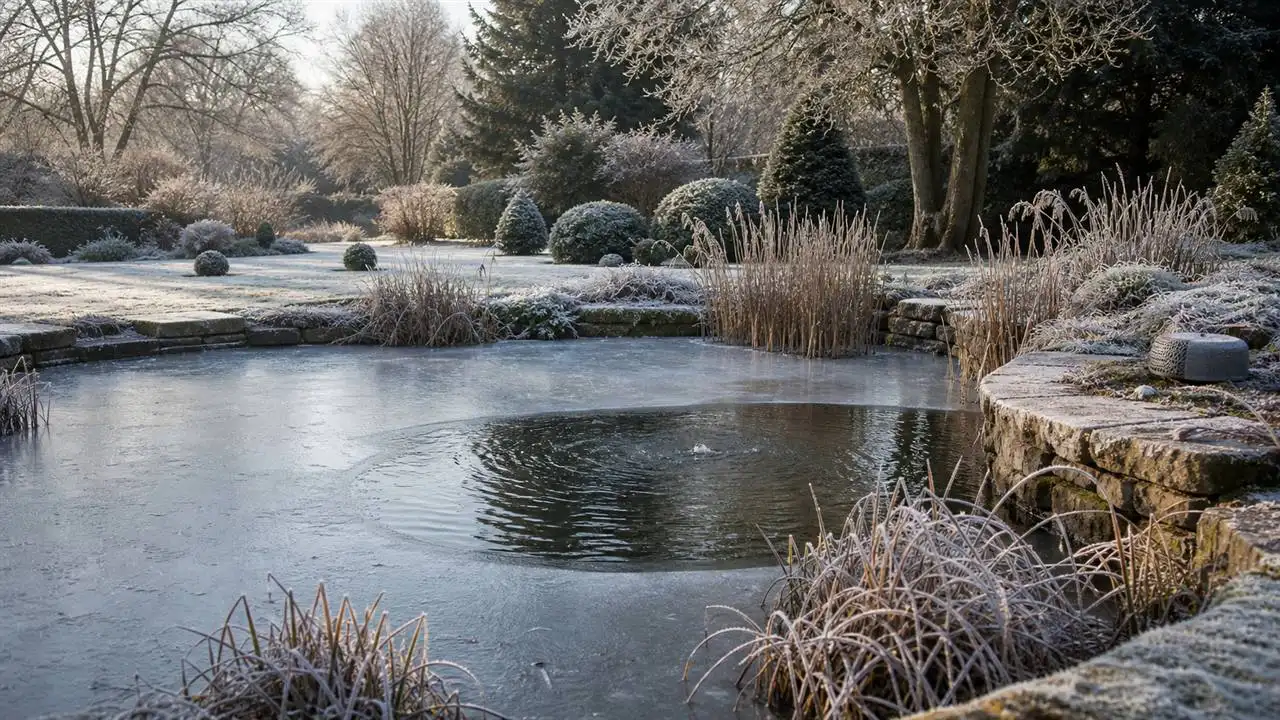
To winterise a garden pond, you never drain it: clear leaves in autumn, cut back frost-tender plants, stop feeding fish once the water drops below 10°C, and stop the surface from freezing over completely with a floating de-icer or air pump. The deep zone protects life under the ice.
The Chatelain Method for pond winterising
You observe depth and fish stock; you diagnose what is at risk from frost; you correct with the right autumn work; you prevent oxygen starvation under the ice by keeping a gas-exchange gap open.
The winterising calendar
| Period | Task |
|---|---|
| Early autumn | Remove dead leaves, fit a leaf net |
| Autumn | Cut back frost-tender plants, lower baskets |
| Below 10°C | Stop feeding (digestion slows right down) |
| First frosts | Fit a floating de-icer or air pump |
| Winter | Never smash the ice; keep an air gap open |
The Chatelain note. A fully frozen surface traps decomposition gases that are toxic to fish. The priority is not heating the pond but keeping a gap open in the ice — a de-icer or air pump does this reliably.
Fish and plants: what actually needs protecting?
Hardy fish (goldfish, orfe, koi) overwinter at the bottom as long as the deep zone does not freeze solid. Frost-tender marginal plants get cut back; non-hardy floating plants come indoors.
Why breaking the ice is risky
Never use a hammer or chisel to break a hole in the ice: the shockwaves can stress or kill dormant fish, and can damage the pond liner too. Hold a pan of hot water on the surface until it melts through instead — a far gentler method.
FAQ
Do fish need to come out of the pond in winter?
No, as long as the deep zone does not freeze solid. Hardy fish overwinter dormant at the bottom.
Why should I never break the ice?
The shock can stress or kill fish, and the liner can be damaged. Melting a hole gently is the safer method.
When should I stop feeding?
As soon as the water drops below 10°C: digestion shuts down, and undigested food only pollutes the pond.