Pondside Wedding: Use the Water as Scenery Without Making It a Hazard
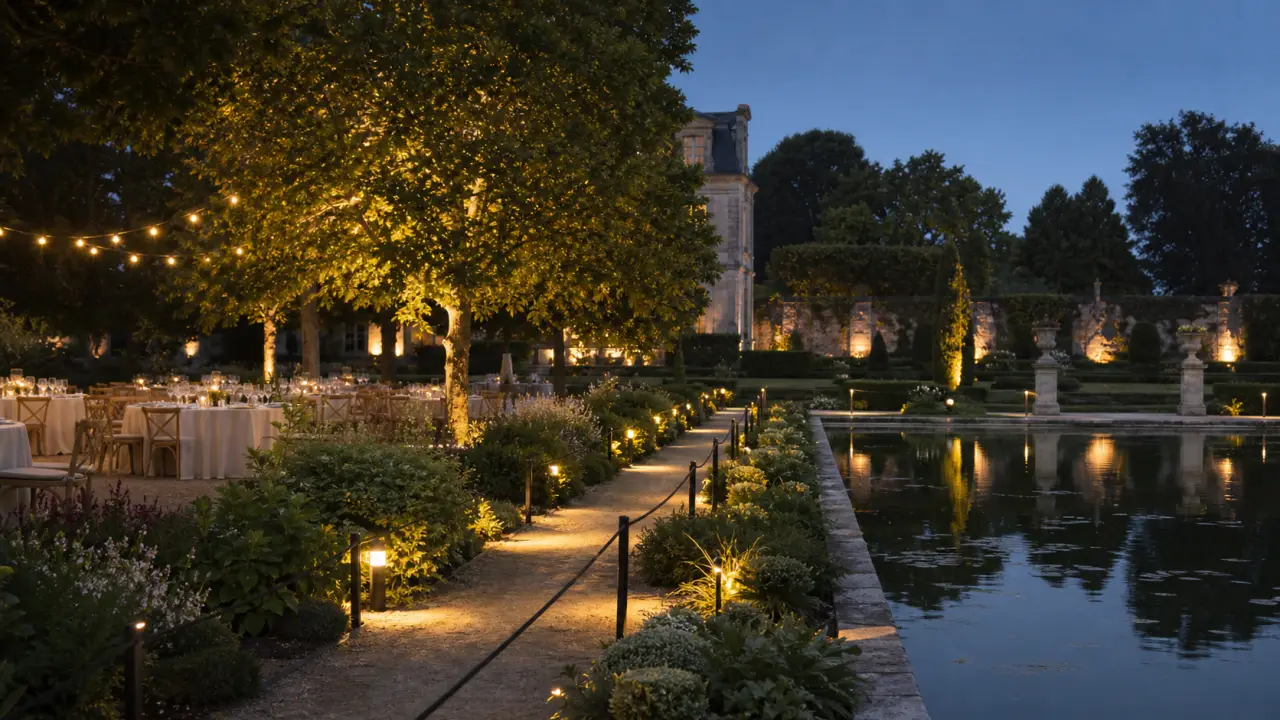
For a pondside wedding, place the ceremony and social areas on dependable ground set back from the water, then compose the view towards the pond. A workable plan provides an obvious dry route, an effective restricted area, named adults for child supervision and someone with authority to close the waterside space. It lights feet and changes of level before it lights the water.
There is no single safe setback for a formal reflecting pool, a wildlife pond, a steep-sided ornamental pond and a lake. Edge construction, water depth, ground condition, the audience, weather, venue status and local requirements all change the decision. A dimension copied from another site cannot approve this one.
Les Jardins d’un Châtelain is a horticultural editorial publication. We do not hire wedding venues or certify barriers, temporary electrics, structures or capacities. This guide helps a couple ask for evidence; the venue, organiser and competent contractors remain responsible for the real event.
Treat the pond as a site feature, not a wedding prop
Begin by asking what the water actually is. A lined wildlife pond may have a planted shelf hidden by foliage. A masonry pool may have a crisp but slippery edge. A lake can rise after rain and soften its bank. A natural swimming pond has an intended use and controls unlike those of an ornamental pond. Do not merge these categories simply because all of them reflect the sky.
Walk the full perimeter with the landowner or venue manager. Record water-level changes, steep or undercut banks, algae, moss, wet timber, polished stone, loose edging, low vegetation, service access, pumps and electrical supplies. Revisit at the hour guests will use the garden. A pale edge visible at noon can disappear into glare at dusk; dew can change a boardwalk that felt sound during a viewing.
Draw four distinct layers on the site plan:
- water and habitat, with no guest use, cable or decorative deposit;
- controlled margin, defined from the actual hazard and the protection selected for this site;
- authorised route, continuous from arrival to ceremony, toilets, indoor refuge and exit;
- event area, far enough back that a queue, a chair being pushed out or a group photograph does not spill into the margin.
The pond can remain visually central from a stable terrace or lawn. It does not need floating candles, a temporary bridge or a drinks station on the bank to contribute to the wedding.
Use the Chatelain Method for the waterside decision
The Chatelain Method moves through Observe, Diagnose, Correct and Prevent.
Observe. Photograph each edge segment when dry and after ordinary wetting. Note slope, surface, drops, visibility, planting, foot traffic and nearby services. Check the view from a child’s height, from a seated guest and from the direction people will walk after dark.
Diagnose. Describe the route to harm. It might be a direct fall into water, a slip that carries someone towards the edge, a cable ramp that diverts feet, a bar queue that forms beside the pond, or a bright fitting whose reflection conceals the bank. “The pond is fenced” is not a diagnosis if a gate is left open for caterers.
Correct. Remove the exposure before adding decoration. Move the reception, close a shortcut or take photographs from a sound surface. Where a physical safeguard is needed, have the venue select and assess a system appropriate to the edge, audience, ground and applicable rules. Plant pots, bunting and a rope line are visual cues, not automatically protective barriers.
Prevent. Our editorial register suggests recording the venue’s contacts for inspection, acceptance and closure. Rain, lighting failure, a change in the attending children or a moved safeguard are examples of changed conditions to reassess, not an official or exhaustive UK event checklist.
Complete an edge-segment register
The HSE’s event guidance for Great Britain asks organisers within its scope to consider existing features, topography, ground, access, services and clearly assigned responsibilities. Use that logic to make a proportionate register, while checking which legal duties apply to your event. One row should cover one consistent section of edge, not “the pond” as a whole.
| Segment | Dry and wet condition | Foreseeable movement | Intended use | Agreed control | Evidence | Owner | Close if |
|---|---|---|---|---|---|---|---|
| Ceremony-facing bank | Surface, slope, visible edge and water level | Guest steps back or loses balance | View only | Controlled margin and access prevention accepted by venue | Photograph from aisle and dusk visibility check | Venue manager | Ground wets, boundary moves or control is absent |
| Route to toilets | Width, changes of level, splash and drainage | Two-way flow, wheelchair turn or stumble | Main guest route | Stable alternative route and task lighting | Full walk in both directions | Wedding coordinator | Puddle, cable, congestion or failed light |
| Catering route | Trolley load, bank proximity, service timing | Trolley deviates or blocks escape | Staff only | Timed one-way route and separate storage | Contractor briefing recorded | Catering lead | Delivery changes or wheels mark the ground |
| Existing jetty or bridge | Structure, rails, surface and inspection history | Side fall, crowding or entrapment | Closed or controlled use only | Written venue decision; no improvised loading | Inspection record or competent confirmation | Landowner | Movement, wet surface, defect or crowd forms |
| Electrical compound | Intakes, pumps, connectors and isolation | Contact, trip or unauthorised access | No public access | Secure enclosure and known isolation | Electrical handover | Electrical contractor | Water ingress, damage, open enclosure or trip |
Add date, time and plan version. A photograph without a location, observation and decision does not prove a control was accepted. Record the action that has actually been completed, not merely “barrier needed”.
Plan child safety for a distracted social setting
RoSPA stresses close supervision of young children near ponds and recommends practical safeguards that are secure enough for the individual pond. A wedding makes attention unusually fragile: adults greet people, take photographs, collect drinks and assume somebody else is watching. “Parents are responsible” is not a workable handover unless responsibility is explicit and continuous.
Confirm which children will attend and their ages. Ask the venue what fixed protection exists, when it was last checked, how gates are controlled and what changes when event equipment is installed. If an additional safeguard is required, it must be selected for the actual edge and assessed by the competent people involved. A flimsy cover, low planter, decorative rope or line of lanterns can create false reassurance.
Name supervising adults and a relief arrangement. The adult should not simultaneously be serving, photographing, coordinating suppliers or drinking in a way that impairs attention. Older siblings are guests, not the control measure. Physical separation and active adult supervision are complementary layers; neither justifies placing the children’s activity beside the water.
If the venue cannot demonstrate a suitable arrangement for the invited audience, put the pond outside the event boundary. The water can still be seen from a safer part of the garden.
Make the safe route more legible than the reflection
Map the journey guests must actually make after sunset: parking or drop-off, entrance, ceremony, reception, toilets, quieter space, indoor weather refuge and final exit. Keep it away from the bank wherever practicable. Avoid service cross-flows and attractions that cause people to stop beside the edge. Consider guests using mobility aids, children, older people and formal footwear rather than testing only with an able-bodied planner in daylight.
Rehearse with furniture, doors and lighting in their event positions. Walk both ways and pass another person. Look for a point where water glare pulls the eye away from a step, where a fitting shines directly into faces or where a cable protector narrows the route. Correct the direction and shielding of light instead of merely increasing output.
After rain, check moss, saturated soil, puddles, muddy transitions, wet timber and loose edging. If the authorised route no longer matches the accepted evidence, use the alternative or close the waterside sequence. The wider outdoor wedding weather plan should make that switch possible without inventing a new route on the day.
Keep temporary electrics separate from water and guests
The pond pump, filtration and permanent lighting are one system. Wedding sound, catering, festoons and temporary path lighting are another. Do not borrow a convenient socket, open a pump housing or combine circuits on assumption. Ask for a temporary electrical plan showing supply, demand, cable routes, connections, environmental protection, isolation and the person responsible.
HSE guidance says event electrical equipment within its scope must be properly selected, installed and maintained, with cables routed to reduce trips and mechanical damage. That requires a competent contractor to interpret the site, current standards and the event. A product marked “outdoor” or “low voltage” does not validate the whole arrangement beside water.
Keep intakes, generators, distribution and connections segregated from the public and protected for the forecast conditions. Do not route cables along a bank, through water, under a damp rug or across a path in a way that sends guests round the protector towards the pond. Treat every cable crossing as part of route design.
The electrical lead should hand over the isolation procedure to the venue. Decorative failure must not remove the light needed for movement or emergency arrangements. If a connector is wetted, a cable is damaged or an enclosure is opened, close access and call the responsible person; nobody should improvise a reset for the sake of photographs.
Light feet and edges while preserving a dark pond
The RHS recommends concentrating necessary garden light on steps and paths, keeping it low and directed, and avoiding illumination of ponds where possible because of wildlife impacts. Begin with walking and changes of level. Only then test whether a modest landscape accent is useful. View it from tables, the route and seated eye level, including reflections from water, pale paving, glass and wet leaves.
Do not float candles, flowers or illuminated objects. They invite people to approach, can become litter and interfere with the habitat. Leave a dark, quiet section of water and planting; limit duration, shield upward spill and switch the decorative layer off when the relevant part of the evening ends. The water often looks better reflecting a restrained garden than glowing from an added underwater display.
Protect the pond from confetti, smoke effects, colourants, flower waste, drinks and insect-control products. Speakers, bars and smoking areas belong elsewhere. A wildlife pond remains living infrastructure during a wedding, not an empty bowl available for styling.
Open, monitor and hand back the area
Before guests arrive, our editorial register proposes a visual walk of the route and a repeat lighting check after dusk. Any rule about moving furniture, ballast, stores or cables must come from the venue-approved plan and the relevant contractors; this article does not create an approval mechanism or contractual authority.
Prepare a closure message with the affected area, observed reason, alternative route, decision owner and review time. Rain, an unplanned child, unusual water level, a moved safeguard, lighting fault or crowd gathering can all invalidate the accepted plan. Give one person authority to close promptly.
As an optional editorial hand-back record, the next-day walk can compare photographs and note visible litter or changes to planting, edging and equipment with the owner. It is not presented as a composite UK event-safety protocol, and removal of temporary fixings follows the method agreed for the actual installation. Do not enter water or alter the pump to retrieve something without a safe method.
FAQ
Is a rope line enough if the chairs are only used during the ceremony?
Not by itself. A decorative rope does not establish strength, visibility, child resistance or what happens when a guest steps back. Have the venue assess the edge, audience, movement and applicable requirements, then select an effective separation and place the seating on sound ground with routes leading away from water. If the control cannot be evidenced, use the pond as a distant backdrop.
Evidence, method and limits
Our contribution. The segment register is an editorial planning aid that links observations to completed actions, available records, contacts and proposed reassessment triggers. It is not a statutory register or professional certification and replaces a borrowed setback with a decision that can be checked on site.
Method. We compared UK search results dominated by pond venues and wedding inspiration with HSE event guidance, RoSPA pond safety, RHS wildlife-conscious lighting and Met Office warnings. Commercial pages identify search intent only; they do not set safety requirements.
Limits. Without a visit, service drawings, pond type, audience profile, venue status, electrical design and current weather, this article cannot approve a distance, barrier, jetty, installation or capacity. Duties differ with work activities, venue use and local conditions. The venue and competent professionals must establish what applies.
Sources and further reading
- HSE — venue and site design, for site suitability, access, existing features and assigned responsibilities in Great Britain.
- HSE — electrical safety at events, for competent temporary electrical planning within its scope.
- RoSPA — pond safety, for child supervision and secure pond safeguards.
- RHS — how to light a garden without disturbing wildlife, for path-first, low and directed lighting and caution around ponds.
- Met Office — warnings and advice, for current official weather information.
- Preston Manor and Ness Botanic Gardens, reviewed to characterise search intent, not as safety authorities.
“Written and checked by the Les Jardins d’un Châtelain editorial team”