Repair Compacted Soil After Heavy Rain and Heat
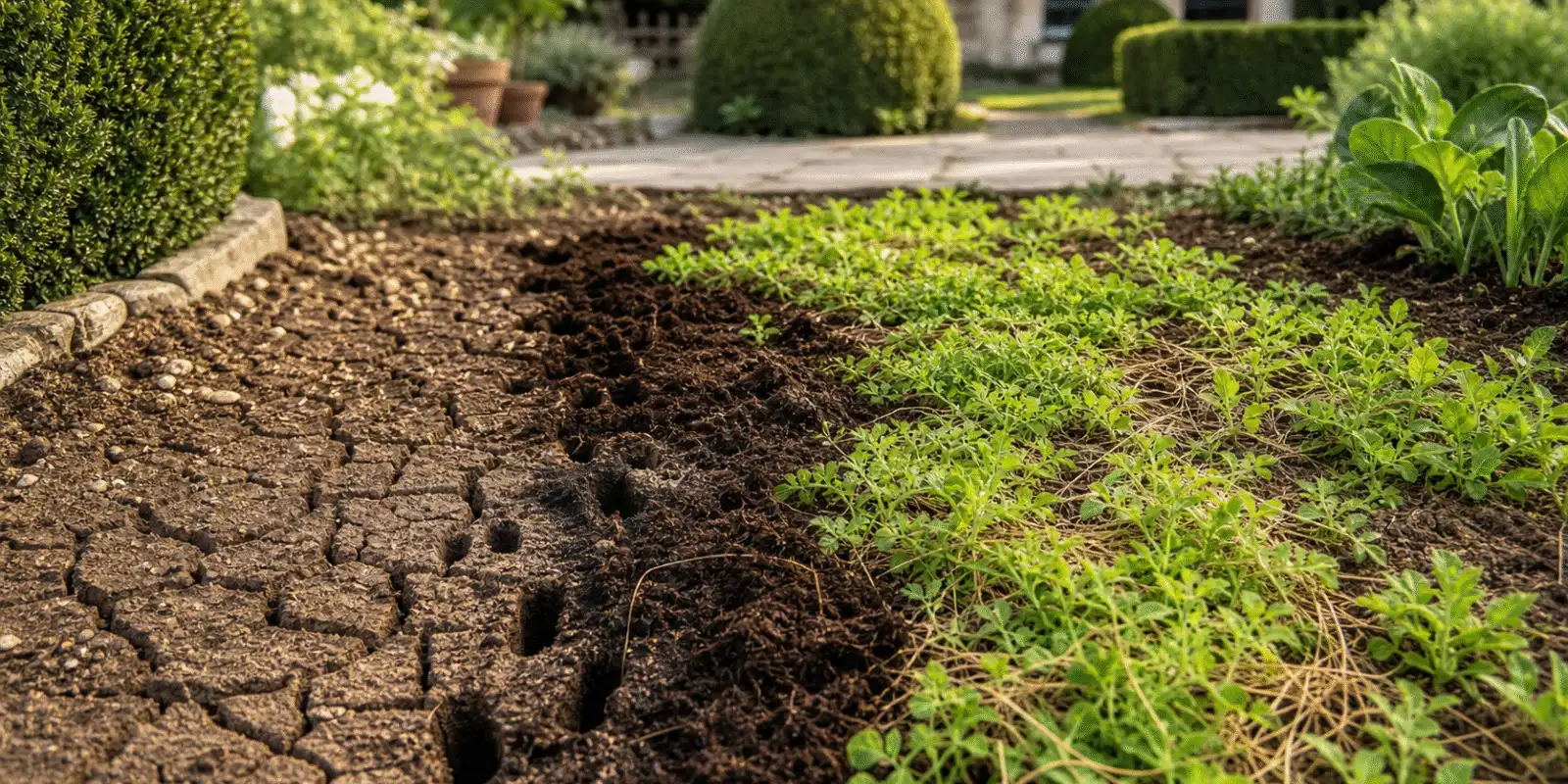
Heavy rain followed by heat can seal the surface into a hard crust. Water runs away, roots stay shallow and beds stop breathing. The repair fits naturally with our ramial chipped wood soil approach.
The Chatelain Method
Open air passages without turning the whole profile upside down. Feed the surface lightly, then keep it covered so rain cannot beat it bare again.
Read the damage before acting
A crusted surface is a structure problem. More watering alone often makes runoff worse; the soil first needs pores and living cover.
| Signal | Meaning | Action |
|---|---|---|
| Water runs off | Surface sealing | Scratch lightly and water slowly |
| Hard cracks | Clay shrinkage | Mulch and deep slow watering |
| Plants stall | Poor root oxygen | Lift with a fork or broadfork |
The recovery protocol
Use a garden fork or broadfork when the soil is moist but not sticky. Lift slightly, do not invert. Add a thin layer of mature compost and cover with mulch or a living cover crop.
Recovery calendar
First pass: reopen the surface. Month one: maintain mulch. Season one: keep beds planted or covered to rebuild structure.
Mistakes to avoid
- Do not rototill wet soil.
- Do not add sand alone to clay.
- Do not leave repaired soil bare.
Why your soil texture decides more than your care
Not all soils close up in the same way, and the difference owes less to how well they are tended than to what they are made of. Soils rich in silt are the most prone to surface crusting, because silt particles have poor structural stability. The less clay a soil holds and the more silt it holds, the more it seals under rain.
Three factors work the other way and raise structural stability, and therefore resistance to crusting: clay, organic matter and calcium ions. A limey soil resists better than people assume, while a silty soil low in organic matter and regularly worked seals again after every downpour.
This is measurable rather than impressionistic: French agronomic research established a crusting index computed from fine silt, coarse silt and clay content, organic matter and pH. If you have had your soil analysed, those figures are already on the report and the index can be worked out. That is far more useful than any general advice.
What our own analysis changed
Our ground was analysed in a laboratory: it is a sandy loam, which places it among the textures most exposed to crusting. The lime in our area works in our favour, the small amount of organic matter we apply works against us. That combination explains the rule we follow, and it is not an aesthetic preference.
We never mix the horizons. The top five centimetres carry the essential life of the soil, and that life is aerobic: tipping it beneath the layers below puts it into anaerobic conditions, which kills it. Work is done by vertical fracturing, with a fork, never by turning. The aim is not to open the soil in place of the life within it, but to let that life open it.
The same logic governs organic matter: wood chip and hay are laid on the surface and never dug in. Incorporated, they create waterlogging and cause nitrogen drawdown, because the micro-organisms breaking them down take up available nitrogen at the crop’s expense. Yet organic matter is precisely what raises structural stability: laying it feeds the surface that seals, burying it starves the crop without protecting the soil.
This approach has a cost and we accept it: we produce less, but better. A soil that is not opened mechanically takes longer to respond, and it responds more lastingly.
FAQ
Should I add sand to compacted clay?
Not by itself. Air, compost and cover are safer first steps.
When should I use a broadfork?
When soil is fresh and workable, neither muddy nor rock hard.