Provence Gardens: Design Lessons for Your Own Garden
Inland Provence is not the Côte d’Azur with less sea. Moving away from the coast towards Marseille, Aix, Avignon and Toulon, the air becomes less humid, temperature swings widen, and some species that thrive for us on the Riviera coast stop working altogether. What runs through the whole region instead is fire risk, and that is where the most transferable lessons come from.
We walked these gardens with the same question as elsewhere: what transfers to a genuinely cultivated holding, and what belongs only to the visitor’s garden? This notebook complements the one on the Côte d’Azur, with a different climate and a different thread.
What changes away from the coast
The coastal microclimate around Nice or Menton softens extremes: mild winters, residual humidity, moderate swings. Twenty to fifty kilometres inland, that cushion disappears. Summers are drier and hotter, winter nights colder, wind more constant. A plant considered reliably Mediterranean on the Riviera coast can struggle further inland for the opposite reason people expect: not cold, but the loss of the residual humidity that, on the coast, was quietly compensating for imperfect watering.
That is the first lesson brought back from these visits: never transpose a plant choice from one climate to another without checking what, in the first climate, was doing the work that watering alone should have done. A simple check is comparing the climate averages of both towns before any purchase, rather than trusting a shared ‘Mediterranean’ label.
What genuinely transfers: fire risk
The Bouches-du-Rhône department is among the most wildfire-exposed in the Mediterranean basin, with over three hundred fire outbreaks a year. The Var is no less concerned: access to forested areas there is regulated and published daily in summer. It is a constraint the Riviera coast knows too, but here it shapes everyday garden life far more than a mere visiting schedule.
Two points struck us, genuinely transferable to our own holding despite the different climate.
The first concerns plant waste. Open burning of green waste is restricted across France: composting, chipping or taking it to a recycling centre are the legal routes. On holdings that generate large volumes of pruning waste, this is not only a regulatory matter, it is also a question of fuel load. A stack of dry wood kept against a building or along a boundary is never neutral if a fire starts nearby. The composting and on-site reuse we observed in several of these gardens reduce that stock instead of letting it build up. It is exactly the logic we follow ourselves: nothing is stockpiled awaiting some eventual burn, everything is recomposed on the surface or chipped.
The second concerns clearance obligations. Properties in or near wooded land face a legal vegetation-clearance duty in France that is not settled by a single pass but maintained over time. Many owners discover it after the fact. A holding that plans for it from the start, keeping clear buffer zones around buildings, avoids an expensive catch-up job later.
The UK equivalent, and where it differs
Britain does not face wildfire risk on the same scale as inland Provence, but the underlying logic still applies, and UK conditions are shifting. The Met Office publishes a Fire Severity Index that assesses how dangerous a wildfire could become under current weather, drought and wind conditions, a real and growing concern in dry British summers.
On garden waste, official UK guidance allows burning only dry leaves, grass clippings, twigs and hedge trimmings at home, never household rubbish, and a council can issue an abatement notice if smoke becomes a nuisance to neighbours. Composting or council green-waste collection remain the preferred routes, which is the same principle observed in these Provençal gardens: reduce the stockpile rather than manage the fire.
Seven places, seven lessons
Marseille: several levels of upkeep on one site
Parc Borély and the Heckel botanical garden show a classical axis linked to a scientific collection organised by habitat. Campagne Pastré, now managed by the Calanques National Park, shows something else: upkeep that deliberately loosens the further one moves from the buildings, until it joins undisturbed scrubland. A directly applicable lesson on a large holding: not every area needs the same level of care, and deciding where that level drops is a design choice, not a lapse. See the Marseille parks overview and Campagne Pastré.
Aix-en-Provence: the water chain before the drawing
The Bastide de Romégas and the Jardins d’Albertas both make the same point: an old Provençal garden works because a system for bringing and distributing water exists upstream of the visible design. Copying the shape without understanding that system produces a garden that does not survive its first dry summer. The Albertas restoration documents this hydraulic work ahead of the planting. See Jardins d’Albertas and the Jas de Bouffan.
Avignon: restoring without inventing
The gardens of the Palais des Papes were recomposed from documented sources rather than aesthetic guesswork. A transferable discipline for restoring any old garden on one’s own holding: find what genuinely existed before drawing what looks pleasing. See the gardens in the time of the Popes.
Toulon: Domaine du Rayol, guiding rather than fixing
The Domaine du Rayol organises its gardens by major world climate zone, each run on its own logic rather than forced into a single standard. The lesson is methodological: guide what a soil and a climate make possible rather than imposing an identical plan everywhere on the property. See the Jardin des Méditerranées.
Planning a useful visit, with fire risk in mind
In inland Provence more than elsewhere, access to some sites depends directly on the day’s fire risk level. The Var publishes a daily forest access map in summer, and Marseille issues its own fire-risk alerts. Some gardens can close without notice on a day of strong wind. Always check the operator’s official page, never a fixed schedule printed in an article.
- Choose one or two places, not a six-stop tour in a single day.
- Notice, at each site, where the level of upkeep changes, that boundary is often the most instructive.
- Watch how each garden handles its own pruning waste, rarely advertised but often visible along a plot edge.
- On a wooded property, check before travelling whether a clearance operation or a forest closure is under way.
Frequently asked questions
Will a plant that thrives on the Côte d’Azur survive further inland?
Not automatically. The coast provides residual humidity that inland areas lack. Check the climate averages for your own location before transposing a choice that works elsewhere.
Does on-site composting alone reduce wildfire risk?
It reduces one real factor, the stockpile of dry biomass, but does not replace a legal clearance obligation where one applies. The two complement each other.
Is burning garden waste allowed in the UK?
Only dry leaves, grass clippings, twigs and hedge trimmings, and never if the smoke becomes a nuisance to neighbours. Composting or council collection are the preferred routes.
Official sources
- City of Marseille, parks and gardens
- City of Marseille, fire risk alerts
- Calanques National Park, Campagne Pastré
- Jardins d’Albertas, restoration approach
- Official Cézanne site, Bastide du Jas de Bouffan
- Palais des Papes, the gardens in the time of the Popes
- Domaine du Rayol, Jardin des Méditerranées
- Var Prefecture, forest access map
- GOV.UK, garden bonfires: the rules
- Met Office, Fire Severity Index
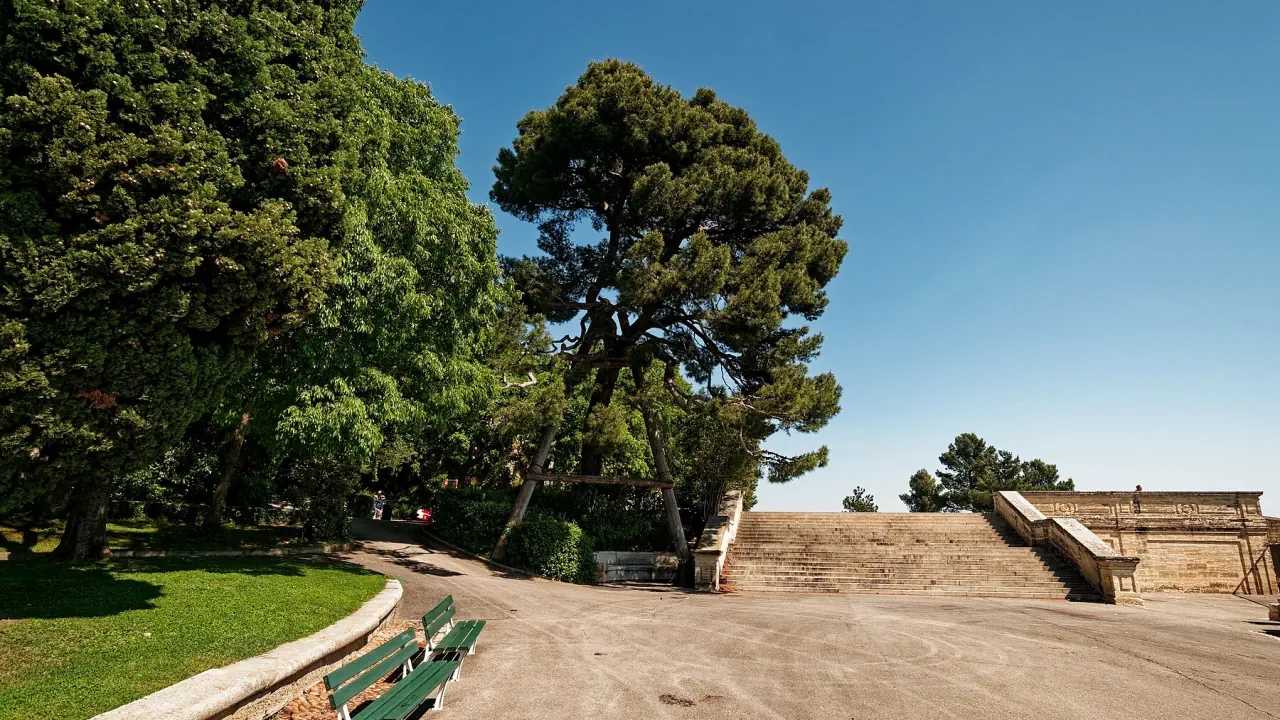
Opening photograph: the Rocher des Doms park in Avignon, by Txllxt TxllxT, 6 mai 2011, under CC BY-SA 4.0. Image cropped to 16:9, resized to 1,280 × 720 px and converted to WebP; the derivative remains under the same licence. This dated view documents the site, not its condition in 2026.
_-_View_NNE_on_verdant_hilltop_park_with_views.jpg)