Create a Driveway Garden Path: Stabilised Gravel, Pavers or Stepping Stones
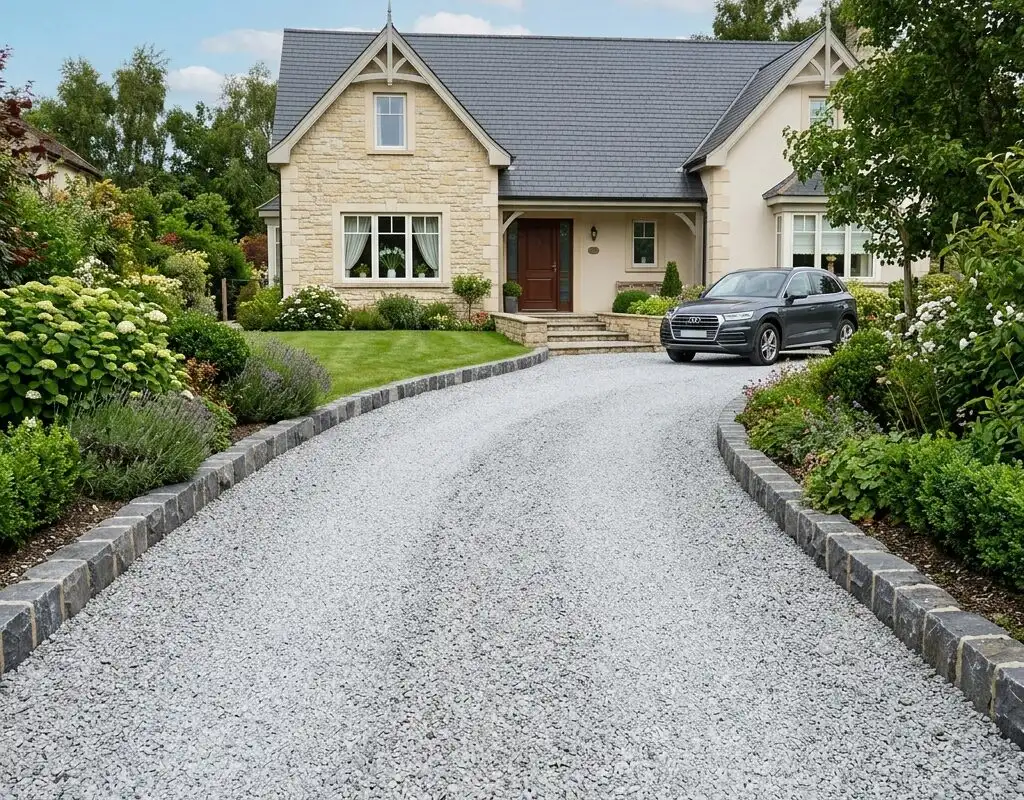
For a driveway that takes regular vehicle traffic, gravel stabilised on honeycomb grid panels gives the best value: it keeps the ground fully permeable, avoids ruts, and stays stable under wheels. Natural stone pavers (granite, sandstone) remain the most durable and refined choice for a prestige entrance, taking heavy loads without flinching. For purely pedestrian routes across a lawn, stepping stones in slate or reconstituted stone create a discreet, natural path that respects the landscape.
The foundation matters most: the golden rule for a drivable path
The most common DIY mistake is laying pavers or pouring gravel straight onto bare soil. Without a solid, draining foundation, a driveway sags under vehicle weight, creating deep, unsightly ruts after the first rains.
The structure of a durable driveway:
- Excavation: dig to a depth of roughly 25-40cm depending on soil type and expected traffic, with a minimum fall of 1-2% to drain rainwater away.
- Geotextile membrane: lay a permeable membrane at the base of the trench. It stops soil migrating up into the sub-base and helps suppress weeds.
- Sub-base layer: a compacted layer of crushed stone (roughly 30-63mm graded aggregate), typically 15-30cm depending on load, tamped firmly with a vibrating plate to create a stable, load-bearing base.
- Levelling layer: a bed of sharp sand or fine gravel a few centimetres thick, to perfectly even the surface before the final finish goes down.
Option 1: gravel stabilised on grid panels (permeable and low-maintenance)
This technique lays honeycomb-shaped polypropylene panels with a geotextile backing onto the sub-base, then fills them with decorative fine gravel. The panels lock the gravel in place: cars don’t sink or spin wheels, and the surface stays comfortable to walk, cycle or push a buggy over. The ground remains 100% permeable, meeting drainage requirements common across the UK for front-garden paving.
Option 2: natural stone pavers (character and longevity)
The traditional, prestigious choice for fine entrances. Laid on a stabilised sand bed (sand mixed with a little cement), natural stone pavers (granite, sandstone, slate) offer timeless charm and real durability, weathering beautifully with age. Maintenance is largely limited to an occasional pressure wash.
Option 3: stepping stones (pedestrian elegance)
For pedestrians only, stepping stones let you cross a lawn or border without damaging the planting. Large, flat natural stone or slate slabs are set roughly 60cm apart — about an average stride. Set them flush with the surrounding grass so a mower can pass straight over without catching the blades.
Permeable surfacing and planning rules
In England, front-garden hard surfacing of more than 5m² generally needs planning permission if it isn’t permeable or doesn’t drain to a permeable area — permeable gravel on a grid system typically avoids this requirement. Rules differ for driveways elsewhere in a garden and across the rest of the UK, so check with your local council before a large-scale project.
FAQ
What’s the best material for a driveway?
Gravel on stabilising grid panels for permeability and value; natural stone pavers for durability and prestige; stepping stones for pedestrian-only routes.
Do I need planning permission for a new driveway?
In England, over 5m² of impermeable front-garden surfacing usually needs permission unless it drains to a permeable area. Permeable gravel systems are generally exempt — check with your council.
How deep should the sub-base be?
Typically 15-30cm of compacted crushed stone, depending on soil and traffic, over a geotextile membrane, with a levelling sand layer on top.