Mediterranean Garden Wedding: Build the Mood with Olive, Citrus and the Garden You Have
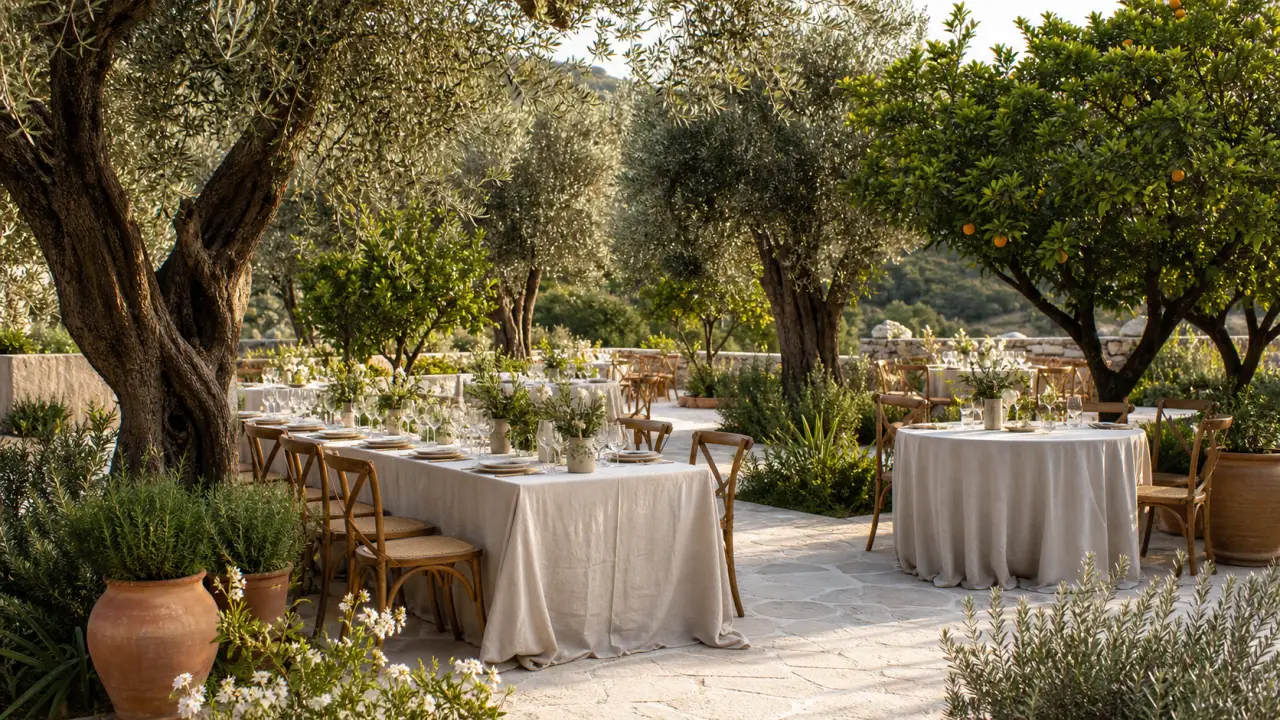
A Mediterranean garden wedding in Britain works best when it interprets the actual site rather than assembling a postcard of lemons, tiles and olive sprigs. Begin with the established planting, walls, paths and summer light. Add only container plants that can tolerate the journey and the proposed position, then use colour and texture to carry the idea when blossom or fruit is absent.
This is especially important in a British garden. An orangery, sheltered courtyard or south-facing terrace may support olive and citrus specimens, but it is not an Italian grove. The Royal Horticultural Society’s citrus guidance explains that citrus does not reliably survive a UK winter outdoors and is generally moved under protection. A wedding plan must respect that horticultural reality instead of treating a living plant as stage furniture.
Les Jardins d’un Châtelain is an editorial gardening website. It does not hire out an estate, garden or wedding venue. The landowner, plant owner, competent suppliers, current permissions and relevant authorities always take priority over this guide.
Read the British garden before choosing a theme
Visit at roughly the same point in the season as the wedding, then inspect again closer to the date. Record existing evergreens, herbs, fruit trees, gravel, pale stone, brick, terraces, glasshouses and sheltered walls. Note which plants belong to the garden, which may be moved, and which areas remain out of bounds.
Use botanical identification where safety or handling is involved. “Laurel” may refer to unrelated plants with very different hazards. “Lemon tree” does not reveal cultivar, rootstock, maturity, hardiness or whether a decorative fruit is safe to eat. Keep the supplier’s plant labels and obtain a current photograph of any hired specimen.
Make three versions of the visual plan: one with the flowering or fruiting state observed during the visit, one with foliage alone, and one without tender container plants. If all three still read as Mediterranean-inspired, the design has structure. If it collapses when the lemons disappear, it is a prop list rather than a garden scheme.
Keep survival, appearance and cropping separate
Three outcomes are often blurred in wedding imagery, yet each requires a different decision.
Plant survival and health concern roots, compost, watering, temperature, light, transport and pests. A citrus plant can remain green through one evening while its rootball becomes too dry or sits in trapped water. An olive can survive a move but still be damaged by poor lifting, an unstable pot or a cold, exposed overnight position.
Appearance on the day is the observed shape, leaf density, blossom and fruit. Our editorial planning method uses a current inspection and, if the parties choose it, a written substitution option; it does not claim that every hire contract contains such a clause. Leaves marked by wind or scale insects are not corrected safely by hiding the canopy under fabric.
Flower and fruit production depends on the plant, age, propagation, growing conditions and season. The RHS notes that some olive cultivars may fruit in favourable UK conditions; “may” is the important word. Its citrus advice also describes variable flowering and slow fruit ripening. Neither crop nor scent can be booked as though it were linen.
Protecting the plant is essential, but it does not guarantee a crop. Conversely, removing fruit or branches for a table display may damage a productive plant or breach the owner’s rules. Only the person responsible for the plant authorises harvesting or cutting.
Use the Chatelain Method
The Chatelain Method proceeds through four stages: Observe, Diagnose, Correct, Prevent.
Observe. Walk the garden at ceremony and dinner times. Note sun, shade, reflected heat, wind funnels, irrigation, steps, soft ground, service routes and dry vegetation. Photograph fixed viewpoints and label the date.
Diagnose. Mark each desired element as existing and usable, existing but protected, available from a suitable supplier, or better replaced by material and colour. Add the relevant risk: root pressure, pot instability, water stress, plant toxicity, allergy, obstruction, fire or weather exposure.
Correct. Move the function rather than forcing the plant. Two well-placed olive containers can frame an entrance more convincingly than a line of stressed trees. Limewash tones, terracotta, linen and warm stone can supply the southern note when citrus would be horticulturally unsuitable.
Prevent. Our editorial handover sheet suggests naming contacts for watering, final inspection, closed areas and collection, then circulating the venue-approved plan to the relevant teams. This is an organisational proposal, not a UK contractual standard or a claim that a verbal agreement is legally ineffective.
Build the palette in three layers
Work from the least movable layer to the most replaceable.
| Layer | Possible resources in a UK setting | Evidence required | Fallback |
|---|---|---|---|
| Existing garden | Silver foliage, clipped evergreen, fruit trees, rosemary in a sheltered bed, walls and gravel | Owner’s permission, current condition, protected root and branch zones | Reframe the ceremony or photograph without touching the plant |
| Mobile planting | Hired olive, citrus, myrtle, rosemary or scented pelargonium in containers | Provenance, current photograph, pot weight, stability, watering, delivery and collection plan | Locally available foliage plant suited to the position |
| Non-plant texture | Terracotta, limestone colour, linen, glazed ceramic, glass and timber | Stable, weather-resistant placement with clear routes | Retain the colour relationship with fewer objects |
This is not a universal plant list. A coastal Cornish courtyard, a London walled garden and an exposed northern lawn create different conditions. Check the particular plant and forecast; do not transfer a hardiness label into a promise for one night in an unusual location.
Limit the scheme to one foliage family, one mineral tone and one accent. Olive grey can meet warm clay and a restrained citrus yellow. If no fruit is present, use a textile, stationery or ceramic accent. Tying imitation lemons to a real tree neither respects the plant nor improves authenticity.
Treat blossom, fragrance and fruit as observations
Fragrance changes with temperature, humidity, air movement and the individual guest. A rosemary plant may be aromatic only when touched; a citrus without flowers will not perfume a terrace. Strongly scented flowers at dining height may be uncomfortable for some people and compete with food.
Record scent during the site visit, but do not make it a performance requirement. Do not diffuse essential oils through the reception or encourage guests to crush unidentified leaves. “Natural” is not a safety category. Ask about relevant allergies or sensitivities and keep the principal dining area botanically restrained.
Keep food fruit separate from display fruit and from the garden’s crop. Fruit intended for service needs an appropriate food supply chain and handling. Windfall, chemically treated ornamental fruit or a lemon heated all afternoon as a place marker must not quietly move to a drink or plate. Label crates backstage so that catering staff can tell the difference.
Check harmful plants before styling
Oleander is a familiar Mediterranean image but a poor casual wedding prop. The RHS plant profile marks it as toxic if eaten and warns that smoke from burning it is harmful. It should not be used on plates, cakes or drinks, left within easy reach of children or pets, or disposed of in a fire.
The RHS guide to potentially harmful garden plants recommends checking labels and stopping children from playing with or eating plants. Apply that principle to every hired pot and cut stem. Common names, edible relatives and an attractive scent are not proof of safety.
Avoid last-minute cutting that exposes sap, and brief handlers to use the precautions specified by the grower. If exposure or ingestion occurs, follow NHS and poison-service advice; a wedding article cannot diagnose or treat it. Keep a plant list with the event manager so that the specimen can be identified accurately.
Protect trees, roots and hired containers
For this guide, keep arches, cables, signs and festoons freestanding rather than fastened to an olive, fruit tree or container stem. This is a conservative editorial boundary, not a claim of a universal UK legal prohibition. The underlying damage risk is directly illustrated by GOV.UK tree-guard guidance, which says guards must not be fastened to the tree or allowed to rub, constrict or damage it. Event structures still need to be designed for their purpose and installed to their documentation on ground approved by the venue.
Record the filled weight, dimensions, lifting method, wind exposure and drainage of each container. A decorative cachepot must not collect irrigation water around the rootball or conceal an unstable base. Keep plants out of accessible routes, fire exits and service turns. Use trained people and suitable moving equipment for large specimens.
Our handover sheet asks the plant owner or supplier where each pot may stand and for how long; that is a proposed information request, not a universal supplier duty. A citrus moved from a greenhouse into strong sun or a cold draught can be checked by the change. Acclimatisation, delivery timing and collection are horticultural decisions, not just logistics.
If the wedding takes place in a productive orchard or around established fruit trees, the separate guide to an orchard wedding covers root protection, crown inspection and reversible routes in more detail.
Remove naked flame from the planting scheme
Pictures of candlelit rosemary and dry olive foliage are not a fire plan. Dry material, hot weather and wind can allow ignition to spread. The Met Office explains the role of dry vegetation in fire weather, while GOV.UK outdoor fire guidance provides general precautions. The venue’s risk assessment, fire authority and current local restrictions remain decisive.
Choose suitable outdoor-rated electric lighting as the default and have it installed by competent people. Do not place naked flames among dry herbs, foliage, fabric, mulch or low branches. Control smoking, hot equipment and any work that can create sparks. Keep emergency access and planned extinguishing provisions unobstructed.
On the day, review the actual forecast, wind and ground condition rather than relying on a planning-stage average. The design must allow risky pieces to be removed without dismantling the whole table. A credible alternative is designed in advance.
Use a plant handover sheet
As an editorial record, the sheet can note the botanical name where known, owner, source, arrival condition, location, purpose, stability method, watering contact, proposed collection time and destination. Arrival and collection photographs are optional comparison aids suggested by this guide, not mandatory commercial deliverables.
Before guests enter, our checklist proposes a visual review of leaf or fruit fall, compost condition, pot stability, routes, branches and cables. Any rule about who may authorise a move or the order of removal must come from the agreed venue plan; this article does not create that authority.
Inspect the garden again the next day. Look for bark rub, compacted soil, spilled compost, trapped water, forgotten ties and cut stems. Separate an immediate safety action from plant care. Pruning, feeding and extra irrigation are not automatic repairs: the plant owner diagnoses first.
FAQ
Can a hire company guarantee olive and lemon trees in full fruit for the wedding?
It can document the plants offered at a particular inspection and may agree a substitution, but a living plant cannot be guaranteed to retain an identical set of flowers, fruit and leaves. Without presenting a model contract, our editorial checklist proposes asking for current photographs, cultivar where known, dimensions, provenance, delivery conditions, watering, stability, contingency and collection. These are comparison questions, not mandatory clauses. Design the scheme to work with foliage alone. If yellow fruit is essential to the palette, source food or display fruit separately through an identified supply chain rather than claiming it came from the trees.
Evidence, method and limits
Our contribution. The three-layer palette and plant handover sheet turn a visual theme into a traceable plan. They keep plant health, day-of appearance and cropping as separate decisions.
Method. We compared UK search results for Mediterranean and citrus wedding styling with UK horticultural, plant-safety, tree-protection, weather and fire sources. The GOV.UK tree-guard specification supports only the risk of fastening, rubbing and constriction; it is not presented as an event-contract rule. Wedding galleries establish the visual intent; they do not establish plant performance or safety.
Limits. Without a visit, plant identification, owner records, container specifications, a current forecast and the venue’s rules, this guide cannot approve a plant, load, route, fixing or flame. It cannot predict blossom, scent or fruit.
Sources and further reading
- Royal Horticultural Society — how to grow citrus.
- Royal Horticultural Society — common olive.
- Royal Horticultural Society — potentially harmful garden plants.
- GOV.UK — fire safety outdoors.
- Met Office — UK and global fire weather.
- GOV.UK — Tree guard (tube and mesh) TE6, for the direct instruction not to fasten protection to a tree or allow rubbing, constriction or damage; used only to support the physical risk behind the guide’s freestanding-event rule.
“Written and checked by the Les Jardins d’un Châtelain editorial team”