Can a Golden Barrel Cactus Stay Outdoors All Year?
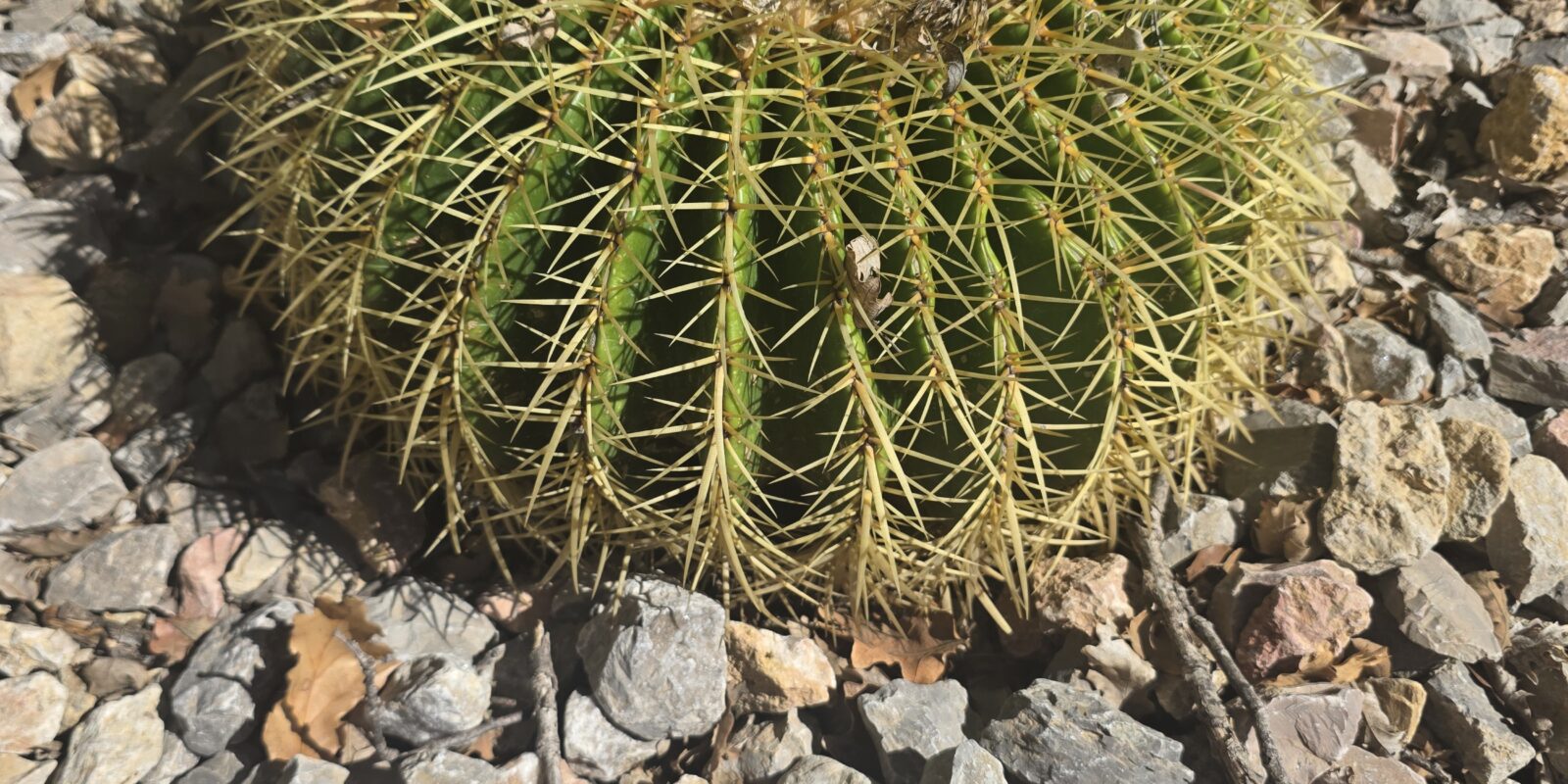
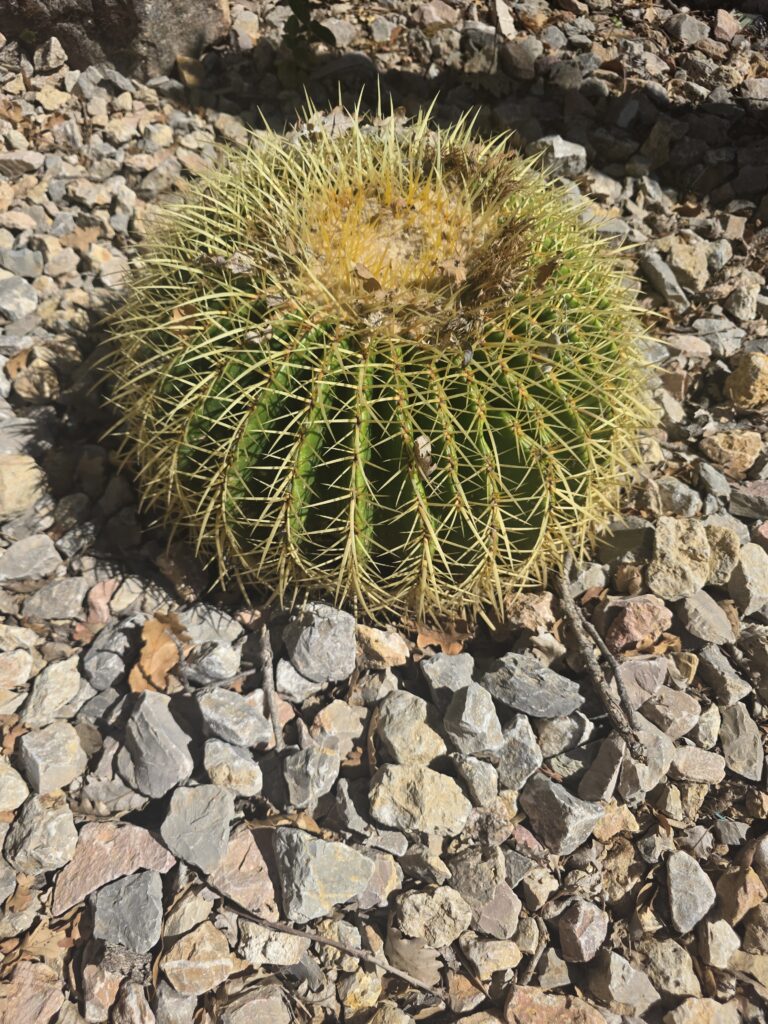
In almost every British garden, no. Our own golden barrel cacti spend the entire year outdoors in open ground, uncovered, and they thrive. But we garden on the Mediterranean coast at Nice, and the single figure that makes this possible is one most articles never state: our thermometer has never dropped below 1 °C. Move that same bed to Britain and the answer changes completely. Here is exactly why, and what you can do instead.
What the RHS actually recommends, and why
The Royal Horticultural Society is unambiguous for the British climate: Echinocactus grusonii is a plant to grow under glass, in a loam-based potting compost with added grit, watered moderately in growth and not at all during winter dormancy. It is not classed as a hardy plant here, and that assessment reflects British winters rather than any weakness in the species.
The reason is not simply that Britain gets cold. It is that Britain gets cold and wet at the same time, which is the combination this cactus tolerates least. A plant sitting in saturated compost at 2 °C is in far more danger than the same plant kept bone dry at −3 °C. Any survival figure you read that sounds surprisingly low assumes a dry substrate, and that assumption almost never holds in a British winter.
Our own case, and the honest reason it does not transfer
We keep our own readings on the estate. They give a minimum that has never fallen below 1 °C, with humidity moving between roughly 50 % by day and 90 % at night. That single figure is what allows a bed of golden barrels to sit outside here, uncovered, through winter after winter.
It is also what stops us telling you anything useful about frost. Our plants have never faced a freeze, so we have no experience of what they would do at −6 °C. We are not going to borrow someone else’s threshold and present it as tested. If your garden freezes, our case is a point of comparison, not a precedent.
Why published cold-hardiness figures disagree so wildly
Search for a survival temperature and you will find claims spread across an extraordinary range, from around −7 °C down to advice to protect the plant below +4 °C. That gap is not carelessness. Cold tolerance in a globular cactus depends on three variables that are rarely stated together:
- Dry cold versus wet cold. Water-filled tissue freezes and ruptures at temperatures that dry tissue shrugs off. Every low figure quoted by a serious source assumes a dry substrate.
- Duration. Two hours of morning frost and three consecutive nights below zero are not the same test.
- Age and establishment. A young plant in a pot and a specimen rooted for years in a sharply drained bed behave very differently.
A figure quoted without those three conditions is not necessarily wrong. It is answering a situation it has not described. This is why reasoning about your own site beats memorising a number.
What « outdoors » can realistically mean in Britain
The workable British approach is seasonal rather than permanent. The plant can spend the summer outside in full sun, which suits it, provided it is protected from prolonged rain and never left standing in a saucer of water. It then needs to come under cover before the first frosts and spend winter in a bright, cool, frost-free place, kept essentially dry.
Growing it in a container rather than in the ground is therefore not a compromise in Britain. It is the arrangement that makes the plant possible at all, because it is what allows you to move it. If you have a frost-free coastal microclimate and want to try open ground, the decisive factor is not the lowest temperature you can quote but whether winter rain drains away instantly.
Where to place it, and how far from a path
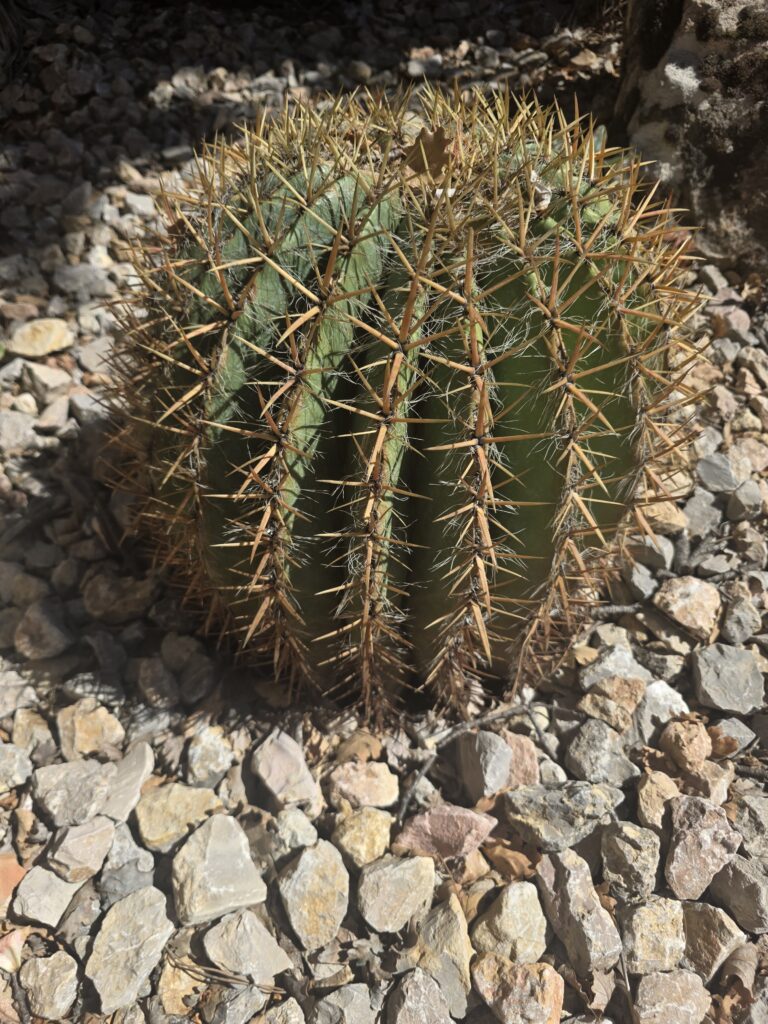
This is the constraint we learned by living with the plant, and in a small garden it matters more than the cold question. The spines are formidable. They are long, rigid and genuinely sharp, and they forgive neither a careless reach nor loose clothing.
It is worth separating two questions that often get mixed up. The University of Arizona’s arboretum describes the plant’s toxicity as benign, while some commercial listings claim the opposite without citing any toxicological source. The documented risk from this species is not chemical, it is mechanical. Placement, not a supposed poison, is what should guide your decision where children or pets are about.
- Plan for the mature plant, not the ball in your hands. Reference floras from its native range describe specimens around 1 m tall and 80 cm across.
- Check that no routine task will make you reach across it: a tap, a light, a neighbouring plant that needs cutting back.
- Remember that the bed itself needs weeding. A cactus you cannot reach around becomes a permanent nuisance.
Dead leaves caught in the spines: not the problem you expect
Anyone growing this plant under a tree or beside a hedge meets the same thing. Dead leaves, twigs and debris lodge among the spines and stay there. On our plants it is constant and plainly visible.
Our observation runs against the instinctive assumption: this debris does not harm the plant. We remove it for the look of the bed and for plants going out for sale, never for the cactus’s health. When we leave it, we see no damage.
That is an observation from our conditions, and those conditions matter: a sharply drained bed in full sun with near-constant light air movement, where nothing stays damp for long. In a wetter climate, or in a still, enclosed corner, a wad of damp debris pressed against the skin would deserve more caution. With us the question is cosmetic. In a British garden it could genuinely become a health one, and that is a fair reason to clear it there.
What to take away
- For nearly all of Britain, permanent open ground is not realistic. The RHS recommends growing under glass.
- Our Nice bed works because of a measured minimum that has never gone below 1 °C, not because the species is hardy.
- Published thresholds range from −7 °C to +4 °C because they describe different situations: dry or wet cold, duration, establishment.
- Wet cold is the real danger. Drainage and dryness matter more than the number on a thermometer.
- Summer outdoors and a bright, cool, dry, frost-free winter under cover is the workable British pattern.
- Keep it well away from paths: the risk from this plant is mechanical, and a mature specimen takes up serious space.
Frequently asked questions
Will it survive frost? We cannot tell you from experience, because our readings never fall below 1 °C. Horticultural sources describe some tolerance of dry cold in an established, sheltered plant, but their thresholds vary enormously. Treat wet cold as far more dangerous than dry cold, and treat drainage as more important than the temperature you can quote.
Should I water it in winter? No, not while it is dormant and cool. A damp substrate in the cold season is the most dangerous combination for this plant. A specimen overwintered in a heated room is a different case and may need a minimal amount to avoid shrivelling, judged by looking at the plant rather than following a calendar.
The base has gone soft and brown. What now? That is the classic sign of excess water, and it shows at the collar where the plant meets the compost. Stop watering entirely, expose the base so it can dry, and check that nothing is holding moisture there. A plant already soft over a wide area is rarely saved, which is why prevention through drainage matters so much.
Does it grow quickly? No, growth is slow, and that is worth knowing before you buy. Be wary of any figure given in centimetres per year: growth depends on container, light and substrate, and no universal rate holds. A large specimen represents many years of growing.
How long does it live? Far longer than the short lifespans sometimes quoted. The botanical garden of the University of Basel holds specimens well over a hundred years old. That is a documented example in a collection under controlled conditions, not a guaranteed life expectancy at home, but it settles the question of whether this is a short-lived plant.
Is it the same plant as the « mother-in-law’s tongue »? No, and the confusion is common. Mother-in-law’s tongue is Dracaena trifasciata, formerly Sansevieria, from an entirely different family.
For the full botanical entry, including its Mexican origin, its conservation status and where its nickname comes from, see our Encyclopedia entry on the golden barrel cactus.
Sources
- RHS — Echinocactus grusonii: cultivation under glass, compost, watering and winter dormancy for the British climate.
- RHS — Cacti and succulents growing guide: overwintering temperatures, water quality and propagation from seed.
- INECOL — Flora del Bajío, fasc. 209 (2019): botanical description and dimensions in the native range.
- University of Arizona — Campus Arboretum: toxicity described as benign, drying between waterings.
- University of Basel — Botanical Garden: specimens more than a century old.
Written and verified by the Les Jardins d’un Châtelain editorial team