Golden Barrel Cactus (Kroenleinia grusonii)
Kroenleinia grusonii (Hildm.) Lodé — basionym Echinocactus grusonii Hildm.
A golden ball that has become one of the most widely sold cacti in the world, and is nonetheless classed as endangered in its native Mexico. On our estate it lives outdoors year-round with no protection and almost no water, which is possible only because of a very specific climate.
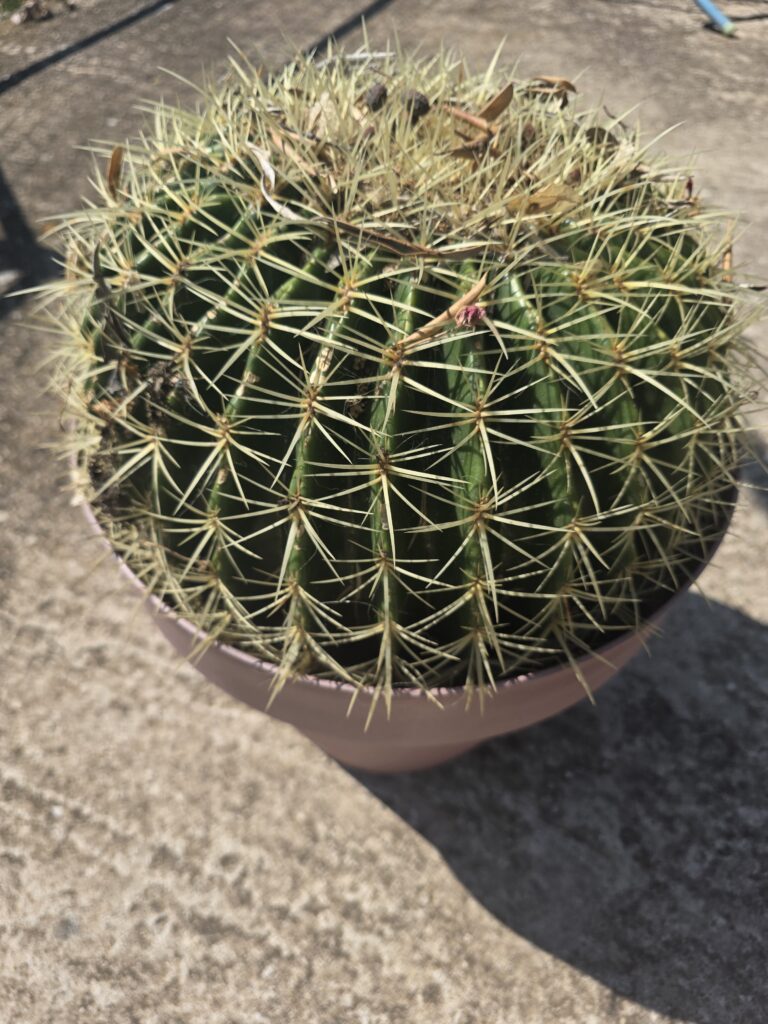
The golden barrel cactus is a globular cactus with pronounced ribs, covered in golden-yellow spines, its crown bearing a characteristic woolly felt. Its accepted botanical name today is Kroenleinia grusonii, a combination published in 2014, but the horticultural name Echinocactus grusonii, whose basionym dates from 1886, remains in general use in the trade and in gardening literature. Both refer to the same plant.
Do not confuse it with the mother-in-law’s tongue, Dracaena trifasciata (formerly Sansevieria), which belongs to an entirely different family despite the similar nickname.
The reliable facts first
Ribs, spines and a woolly crown
The plant forms a bright green globular stem organised into regular vertical ribs, which may number around thirty-five on a well-grown specimen. Each rib carries aligned areoles bearing stout, slightly curved radial and central spines of the golden yellow that gives the species its Spanish name of barril dorado. The crown is covered in a pale woolly felt: this is a normal feature of the species, not a pest.
Two identification points are worth knowing, because both are mistaken for problems. Young plants often show tubercles before the ribs are clearly formed, so a small knobbly plant is not necessarily a different species. And old specimens lose their perfect sphere, lengthening and becoming more cylindrical. That age-related elongation is easily confused with the drawn-up growth of a plant short of light, though it is entirely normal.
There are also horticultural selections with short spines, and plants with paler spination. Spine colour says nothing about the health of the plant: it is the firmness and colour of the body that matter, not the spines.
Everywhere in cultivation, endangered in the wild
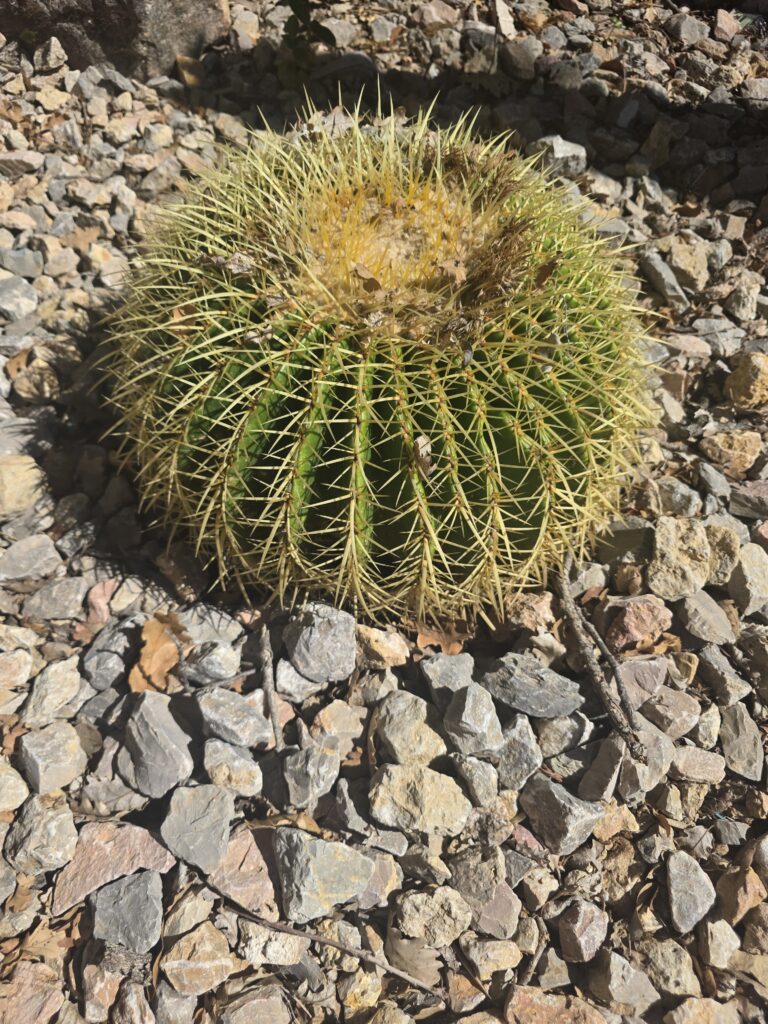
The species is endemic to Mexico, where it occupies rocky slopes in semi-arid country, on limestone and volcanic substrates alike. It has never been a plant of the southern United States, contrary to what the range of the genus Echinocactus in its older sense might suggest.
This is where the striking paradox of this plant lies. Although it has become one of the most widely sold cacti in the world, its wild populations are reduced and fragmented. The International Union for Conservation of Nature assessed it as endangered in 2013, a status that replaced an earlier and more severe listing. Two causes are documented: habitat destruction, including the filling of the Zimapán dam which drowned its best-described historical habitat, and collection from the wild.
The species is listed on CITES Appendix II. This regulates international trade; it does not make horticultural sale illegal. For a gardener the practical conclusion is simple: buy a nursery-grown plant, never one of uncertain origin that may have been taken from the wild.
We publish no figure for the remaining wild population. The very low counts that circulate are not, as far as we can establish, supported by any recent and verifiable survey.
Who Gruson was, and why the joke crosses every border
The epithet grusonii honours Hermann Gruson, a German industrialist and plant collector whose botanical legacy is preserved at Magdeburg.
The mother-in-law joke, however, is not a local quirk. It exists in every language this site publishes in, which is unusual enough to be worth recording: mother-in-law’s cushion, seat or chair in English, originally and chiefly British; coussin or siège de belle-mère in French; Schwiegermutterstuhl and Schwiegermuttersitz in German; asiento or cojín de la suegra in Spanish; perna, scaunul or fotoliul soacrei in Romanian. The same image recurs everywhere: a shape that suggests a seat, spines that make sitting unthinkable, and a joke at the mother-in-law’s expense.
A linguistic study published in the proceedings of the international congress of Romance linguistics and philology examines these names across several languages and their shared humorous mechanism. It does not settle whether they spread by borrowing from one language or arose independently in parallel. No founding anecdote, no first coiner and no date of origin is established, and the stories that circulate on the subject belong to pleasant explanation rather than documented history.
Of all the plants on the estate this is the least demanding and the least forgiving. It asks for almost nothing, and that is exactly what undoes gardeners: they think they are helping when they water it. Our plants live in open ground with no protection and no watering, and the only decision that mattered was taken before planting, when we chose ground that drains and a position well away from any path. After that there is little left to do but watch it grow by very little each year.
The cycle under British conditions
Calendar for a plant grown in a container in Britain, spending summer outdoors and winter under cover. The dormancy and watering rows are the ones that matter most: a dry, cool winter rest is what keeps this plant alive here.
| Jan | Feb | Mar | Apr | May | Jun | Jul | Aug | Sep | Oct | Nov | Dec | |
|---|---|---|---|---|---|---|---|---|---|---|---|---|
| Cool dry dormancy | ||||||||||||
| Growth | ||||||||||||
| Outdoors (frost-free) | ||||||||||||
| Watering | ||||||||||||
| Repotting |
Behaviour, mechanism and limits
The mechanism to grasp fits in one sentence: the fleshy stem is a reservoir. This cactus’s drought resistance is not an absence of needs, it is an adaptation that lets it cross long periods without water. From that follows the rule everything else applies: let the medium dry out between waterings, and never water compost that is still damp.
The same logic explains why excess water is far more dangerous than shortage. A dehydrated plant shrivels and recovers; a plant whose collar sits wet develops a rot that travels up through the tissue and cannot be reversed. That is why the growing medium outranks every other parameter. The RHS recommends a loam-based compost with added grit, and the criterion never changes even if the recipe does: water must pass through quickly.
Temperature guidance is general rather than species-specific. A growing range of roughly 18 to 29 °C is given for cacti of arid regions, and overwintering is done in a bright, cool place. Under British conditions the essential point is not a precise figure but the pairing of cool and dry: a plant kept cold and damp is in danger, one kept cold and dry usually is not.
An honest limit on propagation: this plant is raised from seed. Leaf-cutting methods that work for other succulents make no sense on a globular cactus. Seedling care is also the opposite of adult care, since young plants want warmth, controlled humidity and light without scorching sun, where the adult wants dryness and full sun.
Managing a golden barrel cactus
The collar, never the crown
Everything is decided at the base, where the plant meets the compost. It is the only place that needs checking regularly, and the one you cannot see when admiring the plant from above.
Tell woolly from cottony
A soft dark base on a medium that has stayed wet means rot. White waxy masses mean mealybugs, but the woolly felt of the crown is normal and treating it would be a mistake.
Cut the water before anything else
Faced with a softening base, stop all watering and expose the collar so it can dry. Damage already spread over a wide area is rarely reversed, which makes prevention decisive.
Settle the position once and for all
Sharp drainage, a mineral surface, a clear collar, and enough distance from any path. A slow-growing plant stays for decades where you put it.
Read the sign, trace the cause
On this plant most symptoms have several possible causes. The table gives what an observation allows you to suspect, and above all what it does not allow you to conclude on its own.
| Sign observed | Likely cause | Check before concluding |
|---|---|---|
| Base or stem soft and dark, medium wet for a long time | Rot at the collar or roots | Check moisture and drainage before adding any water. Do not cut on the strength of a mark alone. |
| Ball lengthening, pale and thin | Insufficient light | An old plant naturally becomes more cylindrical: elongation on its own is not a symptom. |
| Marks after a change of position | Scorching of the skin | Link the symptom to the recent move or to reflected heat. Colour alone is not a diagnosis. |
| White waxy masses, sometimes visible insects | Mealybugs | Look under the masses. Never confuse them with the natural woolly felt of the crown. |
| Yellow spines, firm green body | None: normal character | Do not mistake the golden colour of the spines for yellowing of the stem. |
| Dry brown patch, scar | Several possible causes | A handling scar can persist harmlessly. Progression and texture guide the diagnosis, not colour. |
What we do with it, and what our readings say
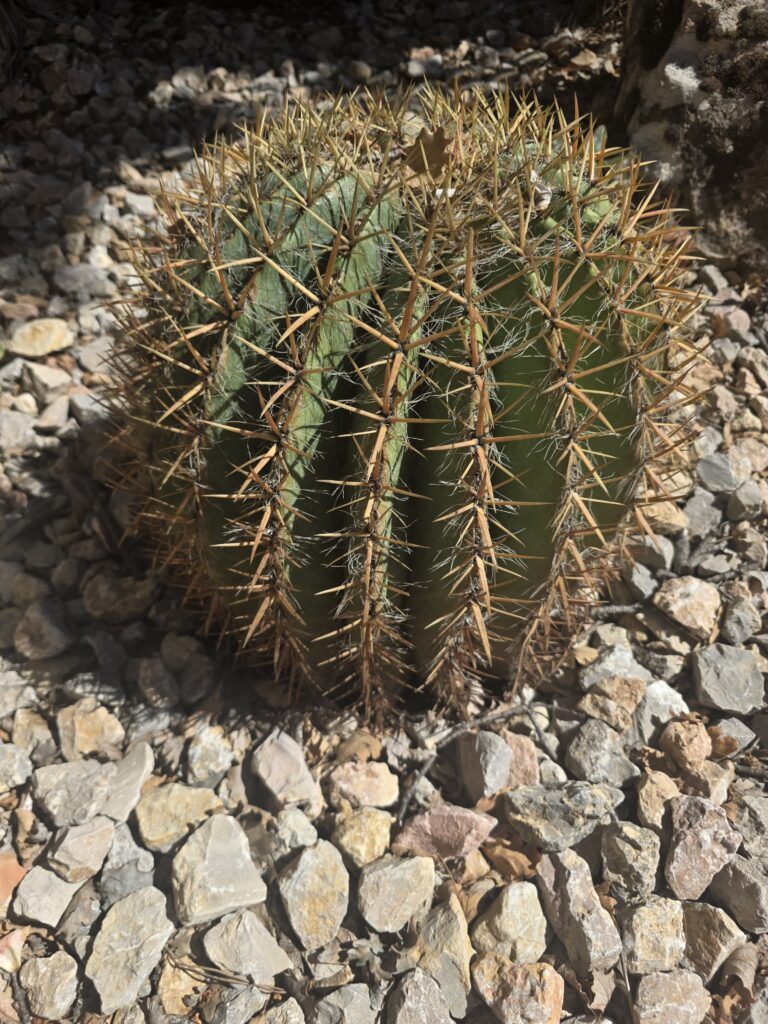
We grow the golden barrel cactus in cactus beds, in open ground, and we also raise plants in containers. Our open-ground specimens stay outside all year with no winter protection whatsoever, and receive virtually no watering. Our readings on the estate give a minimum that has never fallen below 1 °C: that is what makes this possible here, and equally what stops us saying anything about how the species behaves in a real freeze. In Britain the RHS recommendation to grow under glass stands, and our case does not overturn it.
Two practical constraints shape our planting. The first is distance from paths: the spines are formidable and we never place a plant at the edge of a walkway. The second is the build-up of dead leaves and debris between the spines, constant under trees. We remove it for the look of the bed and for plants going out for sale, but we see no damage when we leave it: on a sharply drained, sunny, well-ventilated bed the question is aesthetic rather than sanitary. In a wetter climate that judgement could reasonably differ.
We set out this reasoning, the contradictory published thresholds and the logic of placement in our article “Can a golden barrel cactus stay outdoors all year?”.
What people most often ask
How long does a golden barrel cactus live?
Far longer than the short lifespans often quoted. The botanical garden of the Universeity of Basel holds specimens well over a hundred years old. That is a documented example in a collection under controlled conditions, not an average life expectancy for a houseplant.
At what age does it flower?
No age can be guaranteed. Flowering depends on the development of the plant and its growing conditions far more than on the calendar. Singapore’s national parks board mentions plants of around 35 cm in diameter flowering in full sun, while commercial pages give widely differing thresholds. The flowers are yellow, 4 to 6 cm long, and appear at the crown.
Can it live outdoors in Britain?
Not permanently. The RHS recommends growing it under glass. It can spend summer outside in a frost-free, sheltered, rain-protected position, but it needs to come under cover for a cool, dry winter. Wet cold, not cold alone, is what kills it.
Does it need lime in the compost?
No, and this is a persistent misconception. In its native range the species occupies limestone and volcanic sites alike. The only criterion that matters is how fast water drains away, not pH.
Can I propagate it from cuttings?
No, the normal route is seed. Leaf-cutting recipes used for other succulents do not apply to a globular cactus. Seedlings also need the opposite conditions to adults: warmth, controlled humidity and light without direct scorching sun.
Is it toxic to children or pets?
The Universeity of Arizona’s arboretum classes its toxicity as benign, while some commercial listings claim the opposite without citing a source. We record that disagreement without concluding that it is guaranteed harmless. The documented risk from this plant is mechanical: the spines. Position is therefore what should be chosen with care.
Can I buy it freely given its protected status?
Yes. Listing on CITES Appendix II regulates international trade; it does not prohibit horticultural sale. The sound approach is to buy from a nursery and never to acquire a plant of uncertain origin that may have been collected from the wild.
Sources and verification
Last checked: 2026-09-07.
- Kew — Plants of the World Online, Kroenleinia grusonii: accepted name and taxonomic reference.
- RHS — Echinocactus grusonii: cultivation under glass, compost, watering and dormancy.
- RHS — Cacti and succulents growing guide: overwintering, water quality and raising from seed.
- INECOL — Flora del Bajío, fasc. 209 (2019): botanical description, dimensions, flowers and fruit.
- UNAM — Botanical Garden, barril dorado: morphology, habitat and maximum dimensions.
- Universeity of Arizona — Campus Arboretum: toxicity described as benign, drying between waterings.
- Universeity of Basel — Botanical Garden: specimens more than a century old.
- Word Histories — early occurrences of “mother-in-law’s chair”: the English nickname, originally and chiefly British.
- ATILF — A. Wirth-Jaillard, “Entre linguistique et botanique : l’étymologie des noms de cactus”: the nickname across several languages.
- Gruson-Gewächshäuser, Magdeburg: Hermann Gruson and the German common names.
- Kew / CITES — CITES and Cacti: Appendix II listing and what it covers.