Asian Hornet or European Hornet? Identify It Without Harming a Native Species
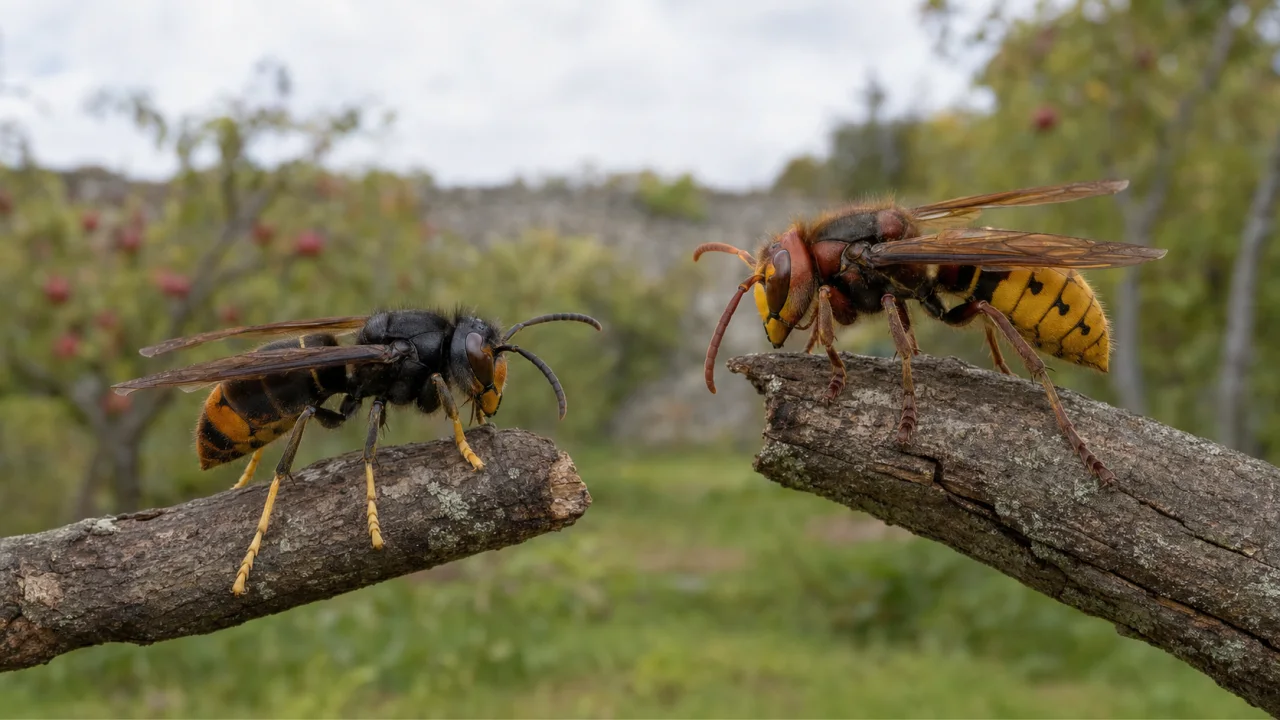
A hornet that looks almost black, with one broad orange-yellow band across the abdomen and conspicuously yellow lower legs, may be the yellow-legged hornet, Vespa velutina. A warmer red-brown hornet with a broadly yellow, black-marked abdomen is more likely to be the European hornet, Vespa crabro. Use several features together: size alone is unreliable, and the outline of a distant nest cannot confirm the species.
Repeated visits by large wasp-like insects were genuinely reported on the estate that prompted this guide. No usable photograph or verified specimen was kept. We therefore cannot claim that either species, still less both species, was present in that particular episode. This distinction between experience and proof is essential when a native hornet could be mistaken for an invasive one.
In the UK, the European hornet is native. It is a useful predator of other invertebrates and is not an invader to be killed on sight. The yellow-legged hornet, still widely searched for as the “Asian hornet”, is an invasive non-native species subject to official surveillance and response. Suspected sightings should be documented and reported, not pursued into a hedge or treated with a household insecticide.
Compare the whole insect, not a single stripe
| Feature | Yellow-legged hornet, Vespa velutina | European hornet, Vespa crabro |
|---|---|---|
| Overall appearance | Dark brown to almost black | Red-brown, yellow and black |
| Thorax | Almost uniformly dark | Warmer brown or red-brown |
| Abdomen | Mostly dark, with one broad orange-yellow band towards the rear | Extensively yellow with several black or brown markings |
| Legs | Dark above with bright yellow lower sections | Mainly brown or red-brown |
| Face | Orange-yellow against a dark head | Yellow and red-brown |
| Size | Often slightly smaller, but queens and workers vary | Often larger, with overlapping size ranges |
| Behaviour at hives | Workers may hover in front of entrances to intercept bees | May take insects, but a single hunting flight does not identify the species |
The most useful field impression is dark versus yellow. From a safe position, look for the combination of a very dark thorax, a largely dark abdomen, one broad orange band and yellow “socks”. A yellow abdomen with repeated dark markings and red-brown tones points towards the European hornet.
Do not turn that shorthand into a guarantee. Backlighting can hide yellow; motion blur can create a false band; and photographs from below may conceal the thorax. Compare a clear image with the current Non-Native Species identification guidance linked by Defra, or submit it for expert review.
The campaign hero image is atmospheric, not diagnostic. It must never replace an official plate or a clear photograph of the actual insect.
It is not the Asian giant hornet
The yellow-legged hornet is not the northern giant hornet, Vespa mandarinia, which has attracted dramatic “murder hornet” headlines. That giant species is not the subject of the UK’s yellow-legged hornet response. Using the scientific name Vespa velutina in a report helps prevent a sensational name from obscuring the evidence.
Several harmless lookalikes also reach impressive sizes. The hornet-mimic hoverfly has very large fly eyes, short antennae and only one functional pair of wings. A giant woodwasp has a more cylindrical body and no narrow wasp waist. Photographing rather than striking a suspect gives the reporting team a chance to dismiss these false alarms quickly.
A nest is supporting evidence, not a stand-alone identification
A yellow-legged hornet queen begins a small primary nest in spring, often under shelter in a shed, porch, outbuilding or dense shrub. As the colony expands, it may move to a much larger secondary nest, frequently high in a tree. A developed nest is enclosed and commonly has a side entrance.
European hornets often use cavities in hollow trees, roof spaces, walls and other protected voids. Their nest may remain partly open at the bottom where space is restricted. These are tendencies, not a key that works in every garden. Primary nests are small, structures can be hidden, and the entrance cannot be judged from a blurred image.
Never walk beneath an active nest to inspect the opening. Do not tap a wall, shake a branch, block a hole or start a mower to see what emerges. Any observation that changes the colony’s behaviour is too close.
Apply the Chatelain Method
The Chatelain Method gives a suspected sighting four stages: observe, diagnose, correct and prevent.
Observe. Note the date, time, exact place, number of insects and direction of travel. If a hornet settles and can be photographed with zoom, take a side and top view without following it. For a nest, record the wider setting from well outside the flight path. A location pin is more valuable than a dangerously close photograph.
Diagnose. Compare several features with official guidance. Separate feeding from nesting: a hornet taking fallen fruit or sap may have travelled some distance, whereas repeated traffic through the same opening suggests an active nest. Neither pattern identifies the species on its own.
Correct. Move people and pets away and stop hedge cutting, tree work, mowing or building work near a suspected flight line. Report a credible yellow-legged hornet or nest through Asian Hornet Watch or the UK Centre for Ecology & Hydrology form. Do not try to retain a flying insect unless an official monitoring scheme has supplied the equipment and instructions.
Prevent. Check outbuildings visually before spring maintenance, repair screens around living rooms and brief staff or contractors when a flight line is known. Clear overripe fallen fruit from heavily used areas while leaving ecologically valuable deadwood, hedges and woodland margins to be managed for their proper purpose. Prevention means reducing hazardous encounters, not sterilising the estate of native wasps.
Choose the next action from the evidence
One hornet feeding away from a nest
Give it room and a clear exit. A feeding visit is not proof of an infestation. Take a photograph if it can be done without pursuit. If the markings are credible for Vespa velutina, report it even when the insect has flown away; include the direction of flight and avoid guessing missing details.
Repeated hornets travelling along one route
Record the direction from the same safe observation point. Do not follow them into woodland, a loft or dense vegetation. Trained teams use verified sightings and structured techniques to find nests; a member of the public moving closer may enter the defensive zone without seeing it.
A nest or an opening with regular traffic
Stop nearby activity and prevent accidental approach. Do not use a ladder, pole camera or drone around an active nest unless you are the competent operator working within the official response. Submit the location and whatever distant images are already available. The UKCEH reporting page expressly advises people not to disturb or provoke an active hornet nest.
Official response arrangements differ across the UK. The rolling Defra page covers confirmed sightings and links the reporting route; it is better authority than an old article with a frozen county list. In Great Britain, credible reports are triaged and the National Bee Unit/APHA can investigate. Do not commission treatment for a supposed yellow-legged hornet until the species and responsibility have been clarified.
Risk depends on the situation, not a frightening name
Both species can sting when trapped or when their nest is threatened. The yellow-legged hornet is not described by Defra as posing a greater individual health risk than a bee simply because it is invasive. The most serious circumstances are multiple stings, a sting in the mouth or throat, and a severe allergic reaction.
Call 999 for rapidly developing swelling of the mouth, tongue or throat, breathing difficulty, collapse or other signs of anaphylaxis. The current NHS insect-bite and sting guidance explains when to use 999, NHS 111 or routine self-care. Do not delay emergency help while attempting to identify the species.
Identification is not permission for DIY destruction
A likely identification does not make shooting, burning, flooding, sealing or spraying a nest safe. These actions can provoke mass defence, spread live insects and expose other wildlife or occupants to chemicals. If the nest is European hornet, needless destruction also removes a native predator.
The proportionate response changes with season and location. Our guide to yellow-legged hornet control, spring monitoring and apiary protection separates the official nest response from targeted monitoring and the very local role of electric harps at beehives.
FAQ
Can the nest alone confirm an Asian hornet?
No. Height, shape and entrance position can support an identification, but small primary nests and concealed structures overlap with other social wasps. Use adult markings, activity and expert verification together. Never move closer to obtain the missing view; report the existing evidence and location instead.
Evidence, method and limits
Our contribution. This guide links visible features to a proportionate UK action: leave undisturbed, record, stop work or report. It protects the official early-warning system without turning the native European hornet into collateral damage.
Method. We compared current UK search intent with Defra/APHA records, UKCEH reporting advice and Natural History Museum identification material. The unphotographed estate experience remains context, not species evidence.
Limits. We cannot identify the insects reported on the estate. We cannot confirm a nest, prescribe a safe working distance for every site or replace the current authority response. Confirmed sighting totals change; consult the rolling official page rather than relying on a number copied into an article.
Sources and further reading
- Defra — laboratory-confirmed yellow-legged hornet sightings, for current records, guidance and reporting links.
- UK Centre for Ecology & Hydrology — report a yellow-legged hornet, for Asian Hornet Watch and safe reporting.
- Natural History Museum — Asian hornet lookalikes, for comparison with the native European hornet and harmless mimics.
- NHS — insect bites and stings, for health advice and emergency signs.
Written and checked by the editorial team of Les Jardins d'un Châtelain.