Fertilise Citrus Trees: Calendar and Right Fertilisers
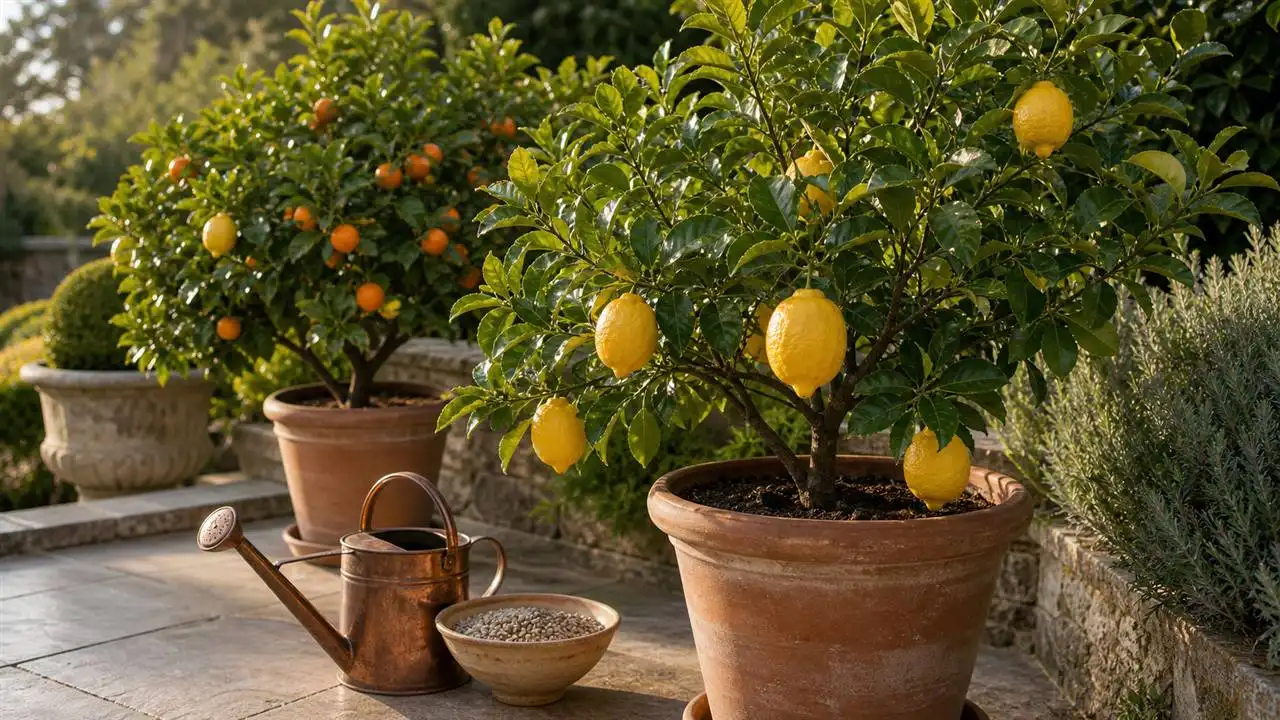
Citrus are hungry feeders: give them a high-nitrogen citrus feed from late March to mid-summer, then switch to a balanced feed through to autumn, and stop completely over winter, the resting period. On alkaline soil or with hard water, correct chlorosis with an EDDHA iron chelate. Here’s the full calendar and how to spot deficiencies.
The Chatelain Method for citrus nutrition
You observe the foliage (colour, pattern); you diagnose the likely deficiency; you correct with the right feed; you prevent with regular in-season feeding, never in excess.
The feeding calendar
| Period | Feed |
|---|---|
| Late March-mid-summer | High-nitrogen liquid citrus feed to support vigorous growth |
| Mid-summer-late autumn | Switch to a balanced feed as growth slows |
| Winter | No feed at all (dormancy) |
The Chatelain note. Feeding in winter is pointless and harmful: a dormant tree isn’t using nutrients, and excess salts burn the roots. The golden rule: feed when it’s growing, roughly late March through autumn, tailing off as growth slows.
Spotting deficiencies
- Yellowing between veins, veins stay green → iron deficiency (chlorosis), usually from alkaline soil: EDDHA iron chelate + rainwater.
- Pale general yellowing, weak growth → nitrogen shortage: citrus feed.
- Dull leaves, dropping → check watering first, the most common underlying cause.
How we decide on a feed
The calendar above sets the frame. On the holding the decision is nevertheless taken in a particular order, and that order changes everything: we start from the need, never from the product.
First, the stage of the plant. A citrus in full flower does not have the same need as a tree swelling fruit or a specimen at rest. So we look at where the tree stands in its cycle before reaching for anything.
Second, reading the NPK. Once the need is identified, we read the composition of whatever we are about to apply, shop-bought fertiliser as much as manure or a soil amendment, and check that it genuinely answers it. This step is rarely taken in this order: the common reflex is to pick a product and then hope it matches.
Third, estimating what is already in the soil. This is the hard part, because we do not have an analysis done every year. A full analysis gives a durable baseline of texture, pH, lime content and organic matter, none of which shifts from one season to the next. The actual availability of nutrients, by contrast, varies and remains an estimate.
We do not cover that uncertainty with a safety dose. We apply little and observe, which also follows from two constraints particular to the holding: manure stays deliberately limited, because it draws earthworms and therefore wild boar onto an unfenced plot, and organic matter is laid on the surface and never dug in, on pain of nitrogen drawdown. Occasionally we use a little Osiryl, a root biostimulant approved for organic farming, to help the plant make better use of what is already there rather than adding bulk.
No plant protection product enters this reasoning. Feeding and treating are two separate subjects, and only the first is at stake here.
Leaf analysis, the answer to what the soil will not tell you
The difficult point described above has a professional solution, and it is counter-intuitive:
when you cannot work out what the soil holds, you measure the leaf rather than the
earth. A soil analysis shows what is present; a leaf analysis shows what the
tree actually took up, which captures availability, root function and antagonisms between
nutrients all at once.
Reference standards are established for orange on leaves three to seven months old,
read as a percentage of dry matter.
| Nutrient | Deficient | Optimum | Excess |
|---|---|---|---|
| Nitrogen (N) | below 2.2% | 2.4 to 2.6% | above 2.8% |
| Potassium (K) | below 0.40% | 0.70 to 1.09% | above 2.30% |
A full analysis is not limited to those two: it covers nitrogen, phosphorus, potassium,
calcium, magnesium, sulphur, manganese, zinc, copper, iron and boron. The deficiencies most
commonly met on citrus are nitrogen, zinc and manganese.
One point deserves attention on limey ground. Potassium deficiency is considered
likely on calcareous soils, through antagonism between nutrients, and also where heavy
crops meet high nitrogen rates. A calcareous soil can therefore hold potassium that the tree
cannot use, and only the leaf reveals it. Below 0.35% potassium in three to seven month old
leaves, the references advise starting potassium fertiliser trials.
What each nutrient does, and when
Reading an NPK figure only makes sense if you know what each letter triggers in the tree.
- Nitrogen (N): tree growth, quality of flower buds, then fruit swelling. Demand is marked coming out of winter to launch growth and flowering, at the end of flowering for fruit set, and in late summer for the final flush and reserve building.
- Phosphorus (P): root development, faster fruit set, influence on maturity and on flavour.
- Potassium (K): fruit quality and sugar content, reinforcing fruit set, limiting physiological drop.
That reading explains a common symptom in the table below: very green foliage with no flowers
usually signals nitrogen in excess relative to potassium, not a lack of vigour.
A poorly fed citrus speaks through its leaves
The classic mistake is feeding a citrus like a houseplant: a little feed when leaves pale, then hoping for a miracle. A potted citrus is more demanding. It grows, flowers, fruits and lives in a limited volume of soil, so its feeding calendar has to match its effort.
| Symptom | What it may indicate | First correction |
|---|---|---|
| Yellow leaves, green veins | Possible iron chlorosis | Less alkaline water, chelated iron |
| Weak new growth | Nitrogen shortage or root-bound pot | Gentle feed + check the pot |
| Fruit dropping | Water stress or deficiency | Regular watering, stable nutrition |
| Very green foliage, no flowers | Too much nitrogen | Rebalance with potash |
The resolving rule: feed lightly but regularly from spring through summer, then ease off. A citrus prefers a well-set table during its active season to a late feast that produces fragile growth ahead of winter.
The final call: feed or repot?
When a citrus struggles, feed isn’t always the answer. A root-bound pot, compacted substrate or overly alkaline water can all block nutrient uptake. Adding feed in those conditions is like serving a meal to a tree that can no longer absorb it.
Lift the pot, check the drainage, look at the roots if you can. If water passes through poorly or the rootball has gone hard, repot first. If the structure is fine but growth is weak, feed. Diagnosis comes before nutrition.
FAQ
When should I feed a lemon tree?
From late March to autumn, with a citrus feed, and never in winter (dormancy).
What fertiliser suits citrus?
A dedicated citrus feed, high in nitrogen with trace elements. On alkaline soil, add an EDDHA iron chelate against chlorosis.
My citrus yellows between the veins: what should I do?
That’s iron chlorosis: apply an EDDHA iron chelate and water with rainwater to lower the pH.
Can you over-fertilise a citrus?
Yes: excess salts burn the roots and weaken the tree. Stick to recommended doses and stop over winter.