Sweet lime (Mosambi)
Citrus limettioides — the Indian and Palestine sweet-lime cluster
A disarming lime with very little acidity and mild, thirst-quenching juice. “Mosambi” is an ambiguous market name, so identify the plant before expecting this exact fruit.
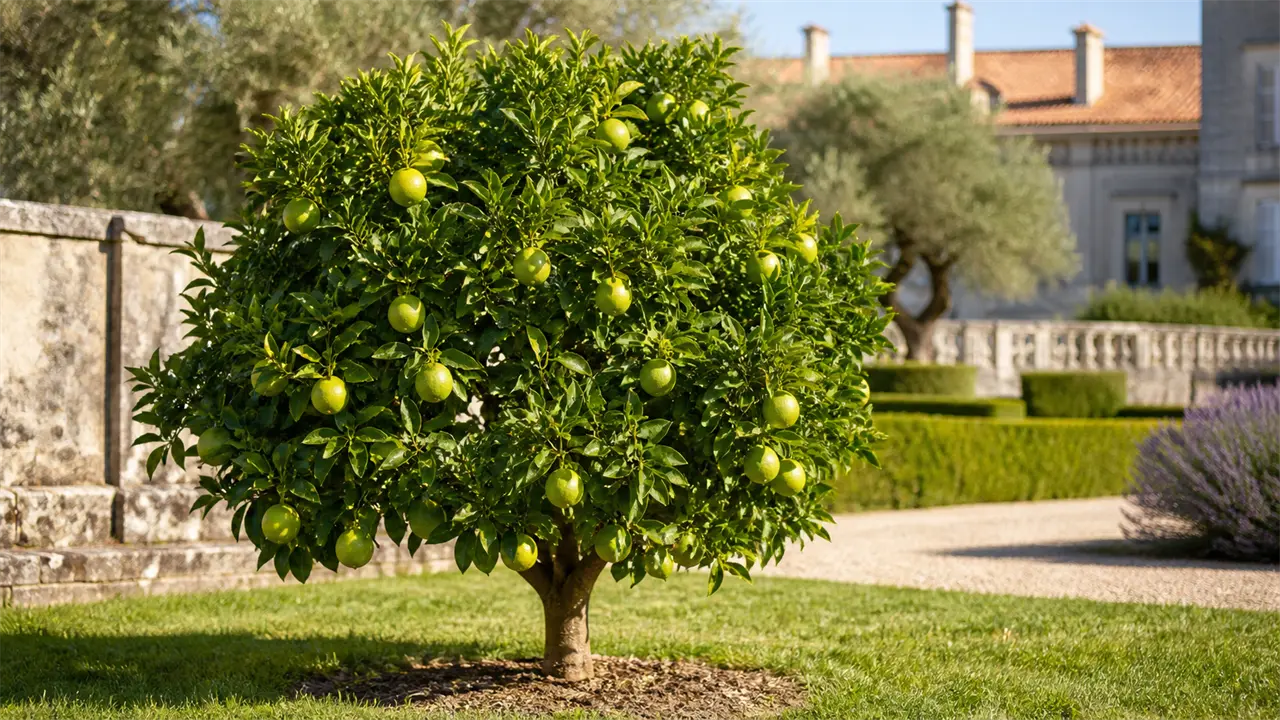
Sweet lime in this profile means the Indian or Palestine sweet-lime group filed as Citrus limettioides. Its defining character is very low acidity: the juice is mild and refreshing, not sharp or perfumed like an acid lime. The label “Mosambi” is not botanically precise. Indian sources also use it for Citrus limetta, and in trade it may even refer to sweet-orange material. Compare the nursery label with Key lime and Persian lime before buying. A correctly identified fruit can taste mild rather than faulty. Never treat an unidentified Mosambi as an aromatic Key-lime substitute.
Its appeal is different: sweet-lime juice is a popular South Asian drink, valued for mildness rather than bite. The plant remains a tender citrus (F1 class) and, in Britain, normally needs a container and bright, frost-free winter shelter.
Reliable pointers — after the identity is checked
Verify the name, then expect mildness rather than lime bite
The real trap is a mismatched expectation. Buyers often expect the bright aroma and acidity of an ordinary lime, but this cluster has mild, low-acid juice. Properly identified, it suits a refreshing sweet-lime drink and people who prefer less acidity. The name “Mosambi” alone is not enough: ask for the botanical name and clone, because Indian horticultural sources also apply Mosambi to Citrus limetta.
This is a tender citrus (F1) for genuine warmth or frost-free container culture in Britain. CultivarA variety produced through selection or cultivation, distinct from the wild original plant. behaviour varies within the group. Choose a rootstock for local soil and container needs, and have the exact scion–rootstock pairing confirmed by the nursery.
| Your situation | Rootstock option | Reason — and trade-off |
|---|---|---|
| Warm site, vigorous growth | Volkameriana or Citrus macrophylla, only if locally proven | Can promote vigour in warmth. ⚠️ Neither makes the canopy frost hardy. |
| Calcareous or saline soil | A locally tested tolerant combination | Soil response belongs to the whole pairing. ⚠️ No rootstock is universal. |
| Container, restrained growth | Trifoliate or Flying Dragon, after compatibility checks | May restrain vigour. ⚠️ Poor choice for actively calcareous compost or water. |
| Remember | Winter shelter is decisive | Confirm identity, rootstock and frost-free winter space before buying. |
A sweet-lime calendar for Britain
Keep it in open ground only where frost is genuinely absent. Elsewhere use a container, bright winter shelter and a conservative watering regime during slow growth.
| Jan | Feb | Mar | Apr | May | Jun | Jul | Aug | Sep | Oct | Nov | Dec | |
|---|---|---|---|---|---|---|---|---|---|---|---|---|
| Plant / repot once warmth is established | ||||||||||||
| Keep bright and frost-free indoors | ||||||||||||
| Move outside after nights exceed 10–12 °C | ||||||||||||
| Flowering in sustained warmth | ||||||||||||
| Harvest in its producing season | ||||||||||||
| Feed citrus while actively growing |
Give sweet lime its proper identity and use
Read the complete label
Look beyond “Mosambi”: record the botanical name, cultivar or clone, and rootstock before comparing fruit or care advice.
“The fruit tastes flat”
If a correctly identified sweet lime has mild juice, that is not a defect. Very low acidity is the character sought in this group.
Choose a suitable use
Use the juice as a mild, thirst-quenching drink rather than to acidify food; it cannot perform the same job as Key lime.
Protect it from frost
As an F1 tender citrus, it needs a warm climate or a container kept bright and frost-free through winter.
Read the symptom, trace the cause, correct and prevent
Sweet lime shares the normal problems of container citrus. Check identity and winter conditions before calling mild juice or leaf fall a disease.
| Observed sign | Likely cause | Correct | Prevent |
|---|---|---|---|
| Juice seems flat | Very low acidity normal for a sweet lime, or an ambiguous Mosambi label | Check identity and use it as a mild drink rather than “correcting” it | Buy a named clone with botanical identity |
| Leaf fall or winter scorch | Winter quarters too cold or dark (F1 tenderness) | Move into bright, frost-free shelter and reduce watering | Use a suitable greenhouse or conservatory |
| Yellow leaves with green veins | Iron chlorosisYellowing of the foliage caused by poor iron uptake, often linked to chalky soil. from high pH, lime or excess water | Check watering; use iron chelate and a suitable rootstock | Free-draining compost and low-lime water |
| Cottony deposits or scales on stems and leaf backs | Mealybugs or scale insects | Clean by hand, isolate, then use an authorised control if needed | Ventilate winter quarters and inspect before moving indoors |
| Fine webbing and yellow stippling | Glasshouse red spider mite in warm, dry air | Rinse foliage and improve humidity without waterlogging | Avoid excessively dry winter air |
Keep treatment proportionate: clean foliage, ventilated shelter and balanced feeding come first. Check current UK plant-health and pesticide guidance before treating a suspected regulated pest.
The mild juice of sweet lime
Sweet lime is chiefly valued for juice: mild, low in acidity and refreshing, the quality associated with Mosambi drinks in South Asia. It may also be eaten fresh when a gentle citrus flavour is wanted. It is not a useful acidifier, so do not expect it to sharpen a dish like Key lime. The zest and peel can have minor preserving uses, but the fruit’s defining register is mildness, not acidity.
What the current commercial standard actually says
The figures below apply to Indian sweet limes under the fresh-citrus marketing standard, not automatically to every fruit sold as Mosambi.
- EU commercial minimum for Indian sweet lime: diameter at least 25 mm and juice content at least 40%; size codes run from 1 to 5.
- Low acidity: this is a sensory and varietal character, not one of the size grades. Identity still needs checking.
No universal yield is credible: clone, rootstock, soil, plant age, light and temperature all matter. Record the crop from your own identified tree.
Practical answers about sweet lime and Mosambi
Does sweet lime replace Key lime?
No. Its juice is mild and low in acidity, unlike sharp, aromatic Key lime. Choose it for a gentle drink, not as an automatic culinary substitute.
Why does the fruit taste flat?
Low acidity is normal for a true sweet lime. Also check the full plant identity, because “Mosambi” may be applied to more than one citrus group.
What does Mosambi mean?
It is a South Asian market name associated with sweet citrus and juice, not a precise botanical diagnosis. Ask whether the plant is Citrus limettioides, Citrus limetta or another named clone.
Is sweet lime hardy in Britain?
No. Treat this F1 citrus as tender: use a container and provide bright, frost-free winter shelter unless the site is genuinely frost-free.
Evidence, terminology and limits
Evidence checked on 4 August 2026. “Mosambi” is retained as a search term, not treated as proof of botanical identity.
- Indian Council of Agricultural Research — sweet lime cultivation: an Indian authority uses Mosambi for Citrus limetta, documenting why the market name must not be equated automatically with this cluster.
- EUR-Lex — current citrus fruit marketing standard: separately defines Indian and Palestine sweet limes from Citrus limettioides and supplies the 25 mm and 40% figures.