Persian lime (Tahiti lime)
Citrus × latifolia — the large, nearly seedless shop lime
This is the familiar large, smooth, juicy and almost seedless lime. It is less floral than Key lime but exceptionally convenient, and each commercial trait has a botanical explanation.
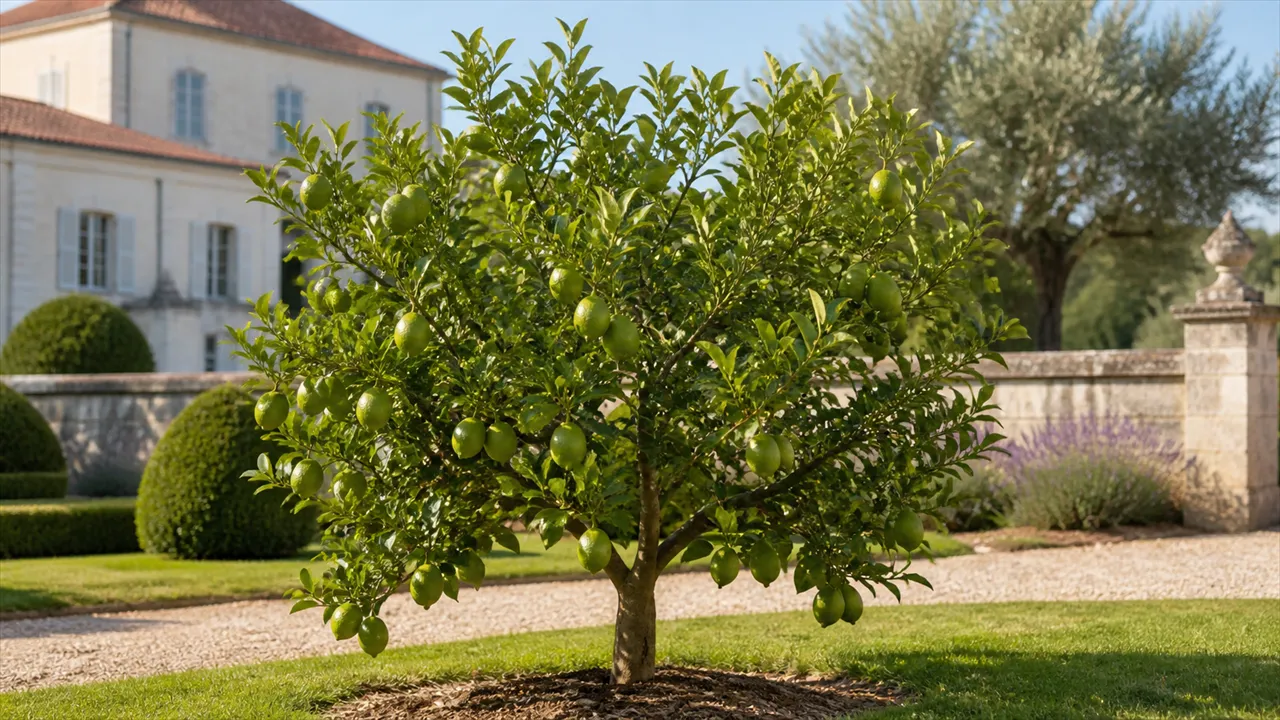
The familiar supermarket lime is usually this one: Persian or Tahiti lime (Citrus × latifolia). Its polyploid hybrid origin explains the commercial traits. It is large and smooth-skinned because this clone was selected; nearly seedless because triploidy makes it largely sterile; and sold green because that is the marketing stage, although it turns yellow when fully ripe. It is less floral than Key lime, but highly convenient: lightly thorned, very juicy and not dependent on a polliniser.
It remains a tender citrus (F1 class). It is slightly less tender than Key lime, yet in Britain usually needs a container and bright, frost-free shelter. Grow it for juice and zest, not as dessert fruit.
Reliable checks before you buy
Why Persian limes are large, seedless and sold green
Choosing Persian lime means choosing convenience. Three familiar traits have straightforward explanations:
- Nearly seedless: triploidy makes it largely sterile, so it sets fruit without useful seed or a polliniser.
- Sold green: markets harvest at the green stage; left on the tree, it naturally turns yellow at full maturity. A sound yellow fruit is not spoiled.
- Large and smooth: the selected clone carries traits that are easier to market than the small Key lime.
The trade-off is a less floral aroma than Key lime. Choose rootstock for soil and vigour, never as a promise of frost-hardy foliage; winter protection remains essential.
| Your situation | Rootstock option | Reason — and trade-off |
|---|---|---|
| Vigour, light soil, warm site | Volkameriana, Citrus macrophylla | Vigour and productivity. ⚠️ Neither makes foliage frost hardy. |
| Calcareous soil or high pH | Forner-Alcaide 5 (FA5) | Useful chlorosisYellowing of the foliage caused by poor iron uptake, often linked to chalky soil. tolerance only where the soil requires it. |
| Do not expect | Frost-hardy canopy | Rootstock acts on roots, not on the canopy’s response to freezing. |
| Remember | Winter shelter is decisive | Match the soil and confirm the exact pairing with the nursery. |
A Persian lime calendar for Britain
Container culture and bright, frost-free shelter suit most British sites. Open ground is for genuinely frost-free places; warmth can extend the harvest.
| Jan | Feb | Mar | Apr | May | Jun | Jul | Aug | Sep | Oct | Nov | Dec | |
|---|---|---|---|---|---|---|---|---|---|---|---|---|
| Plant / repot once warmth is established | ||||||||||||
| Keep bright and frost-free indoors | ||||||||||||
| Move the container outside after mild nights | ||||||||||||
| Flowering, repeated in warmth | ||||||||||||
| Extended harvest, commonly green | ||||||||||||
| Feed citrus during active growth |
Keep a Persian lime productive and safely overwintered
Choose the harvest stage
Pick green for familiar sharp lime character or yellow at full maturity. Decide the use first; sound fruit is useful at either stage.
Leaves deteriorate in winter
Leaf fall or scorch usually means winter quarters are too cold or dark, not that the plant is diseased. Persian lime remains tender.
Provide bright, frost-free shelter
Move the container into a bright frost-free room, reduce watering during slow growth, and wait for mild nights before moving it out.
Do not overstate rootstock
Rootstock can add vigour, not canopy hardiness. Winter protection is what safeguards survival and future cropping.
Read the symptom, trace the cause, correct and prevent
Persian lime shares the usual problems of container citrus, and its tenderness governs winter care.
| Observed sign | Likely cause | Correct | Prevent |
|---|---|---|---|
| Leaf fall or winter scorch | Winter quarters too cold or dark (F1 tenderness) | Move into bright frost-free shelter; reduce watering | Plan suitable bright winter quarters |
| Yellow leaves with green veins | Iron chlorosis from high pH, lime or excess water | Check watering; use iron chelate and a suitable rootstock | Free-draining compost and low-lime water |
| Cottony deposits or scales on stems and leaf backs | Mealybugs or scale insects | Clean by hand, isolate, then use an authorised control if needed | Ventilate and inspect before moving indoors |
| Fine webbing and yellow stippling | Glasshouse red spider mite in warm, dry air | Rinse foliage and improve humidity without waterlogging | Avoid excessively dry winter air |
| Winding silvery mines in young leaves | Citrus leafminer | Remove only badly damaged shoots and conserve beneficial insects | Avoid excess nitrogen and repeated soft flushes |
Keep treatment proportionate: clean foliage, ventilated shelter and balanced feeding come first. Check current UK plant-health guidance for a suspected regulated pest.
The versatile everyday lime
Persian lime is the versatile choice: juicy and nearly seedless, it gives clean juice quickly for food and drink. Its zest is less floral than Key lime but remains bright and practical. The smooth peel suits marmalade, salt-preserving, fermentation and drying. Too acid for dessert eating, it is designed to sharpen and perfume. For more distinctive aroma, choose Key lime.
What the commercial standard actually says
Persian lime has its own requirements in the current fresh-fruit marketing standard.
- EU commercial minimum for Persian lime: diameter at least 42 mm and juice content at least 42%; the standard uses size codes 1 to 5.
- Colour: marketed green or colour-breaking, but it turns yellow naturally at full maturity; yellow alone is not a defect.
No universal yield is credible: rootstock, soil, plant age, light and climate all matter. Record the crop from your own tree.
Practical answers about Persian lime
Is this the usual supermarket lime?
Almost always: the large, smooth, seedless shop lime is Persian or Tahiti lime, Citrus × latifolia.
Why is it nearly seedless?
It is triploid and therefore largely sterile, setting useful fruit without seeds or a polliniser.
Why is it sold green?
Markets harvest it green, but fruit left on the tree naturally turns yellow at full maturity. A sound yellow lime remains usable.
Persian lime or Key lime?
Persian lime is larger, nearly seedless, convenient and slightly less tender; Key lime is smaller, more aromatic, seedy and more cold-sensitive.
Evidence and limits
Evidence checked on 4 August 2026. Rootstock performance still needs an exact, locally tested scion–rootstock pairing.
- Royal Horticultural Society — Persian lime: British profile for the nearly seedless fruit and protected culture of (Citrus × latifolia).
- EUR-Lex — citrus fruit marketing standard: current 42 mm size and 42% juice requirements for Persian lime.