Star Ruby grapefruit
Citrus × paradisi ‘Star Ruby’
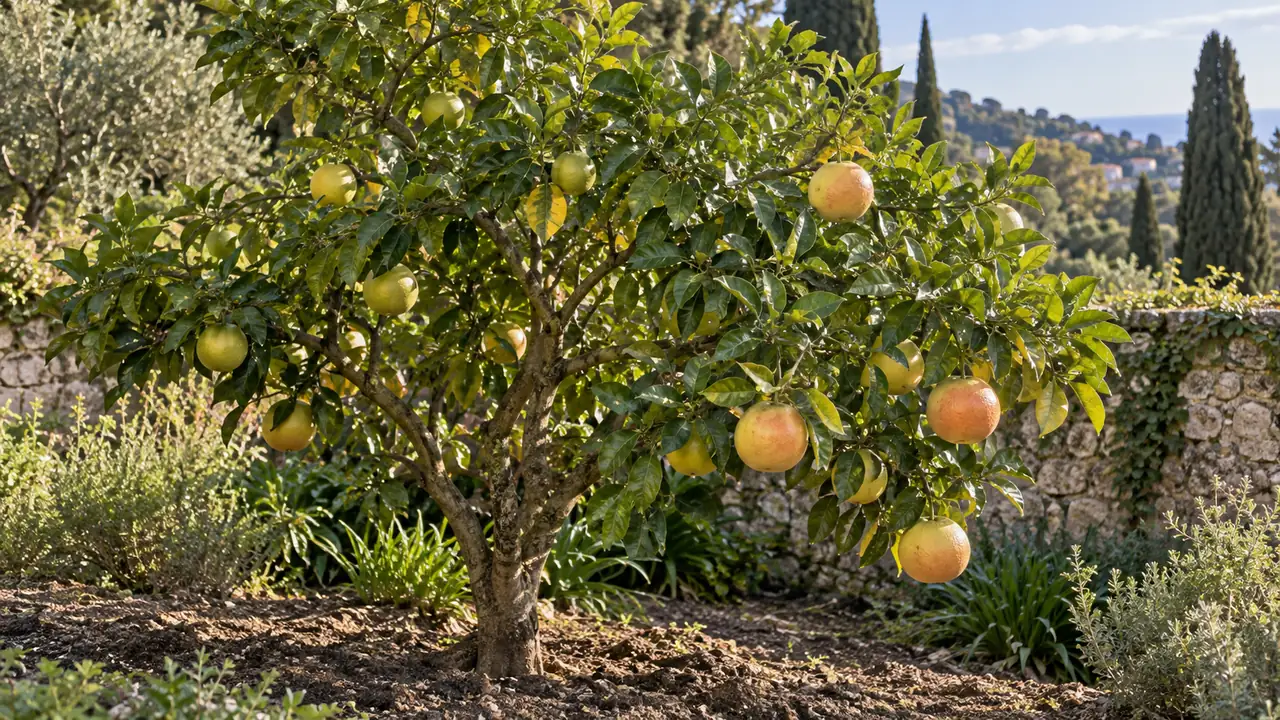
Star Ruby offers dark red, juicy grapefruit flesh with few seeds. For a UK grower, the harder question is not which colour to buy, but where the tree will ripen fruit and spend winter. Plan a bright protected space before choosing the container. A supermarket grapefruit cannot predict the result from a tree kept on a cool patio.
Know the cultivar you are buying
UCR’s CRC 3770 record traces Star Ruby to irradiated Hudson grapefruit seed in R. A. Hensz’s Texas breeding programme. It is distinct from Ruby Red. The familiar name Citrus × paradisi is used horticulturally; the RHS also lists it within Citrus × aurantium, Grapefruit Group.
Ripe fruit can have a yellow rind with a red blush. The rind need not match the dark flesh. Keep the nursery label and ask for the rootstockThe root and base onto which a variety is grafted to give it vigour or resistance. name: red colour alone is not reliable cultivarA variety produced through selection or cultivation, distinct from the wild original plant. identification.
A greenhouse plan before a patio plan
The RHS citrus guide recommends protected winter accommodation for container citrus in Britain. A sunny summer position is useful, but it does not remove winter light and space constraints. Check whether the mature container can still be moved into the proposed shelter.
UCR reports weaker growth and more cultivation difficulties than with some other grapefruits. These are accession observations, not proof of what is wrong with your plant. Inspect drainage and roots before assuming that slow growth needs more fertiliser.
Rootstock names are not a substitute for conditions
Carrizo and C35 appear in UCR’s accession record. That does not establish either as the best choice for every British container. Ask the nursery about the actual scion–rootstock combination, the growing medium and the intended final size.
Use a pot with drainage holes and inspect moisture rather than watering to a fixed weekly timetable. Reduce watering when growth slows, without leaving the rootballThe block of soil left around a plant's roots when it is planted or moved. completely dry. A heated, dim living room is not equivalent to a bright winter growing space.
Judge a ripe fruit, not just a red fruit
If grapefruit is compatible with your medication, sample a fruit before harvesting the crop. Assess acidity, bitterness and juice, not colour alone. Juice supplies acidity and volume; zest supplies aroma. Use peel only from healthy food-intended fruit with a suitable treatment history. A Riverside ripening season is not a UK harvest timetable.
Check medicines before tasting
Grapefruit and grapefruit juice can affect some medicines. Ask your pharmacist or prescriber and read the patient leaflet before eating home-grown fruit. The FDA explains this interaction; Cambridge University Hospitals also includes grapefruit in its advice for people taking anti-rejection medicines. Red flesh and organic cultivation do not remove the interaction.
The Chatelain Method : separate fruit quality from tree care
Observe
Record plant identity, growing position and the time fruit has remained on the tree.
Diagnose
Distinguish normal grapefruit bitterness from immature fruit and weak tree growth.
Correct
Address a confirmed light, drainage or root problem without changing every input together.
Prevent
Compare later fruit under similar conditions before deciding that the cultivar is unsuitable.
Practical questions
Is Star Ruby completely seedless?
It commonly has few or no seeds, but every fruit cannot be promised seedless.
Will a container tree crop in Britain?
It may, with suitable protection and light. A fruiting guarantee based only on the cultivar name is not credible.
Sources and limits of the observations
- UCR CRC 3770 : Description of the identified accession, not a yield or frost guarantee.
- RHS : growing citrus : UK container and protected-winter guidance; not a cultivar trial.
- FDA : grapefruit and drugs : Pharmacological information, not personal medical clearance.
- Cambridge University Hospitals : UK advice specifically for transplant patients; not a list of all interacting medicines.
- RHS : Star Ruby : Horticultural classification and synonyms of Star Ruby; not a cultivar trial.
- INRAE : Les agrumes du Nord de la Méditerranée, p. 195 : Rootstock choice depends on variety, environment and compatibility; no universal guarantee.
- RHS : understanding and avoiding chemical use : Edible-plant restrictions and product-specific label requirements in the UK; no pesticide or waiting period prescribed.