Diamante Citron
Citrus medica ‘Diamante’ — the confectionery citron of Calabria
A citron almost all peel: elongated, with a massive pith and an intense fragrance, it is grown not for its juice — near non-existent — but for the noble material of its skin, queen of candying.
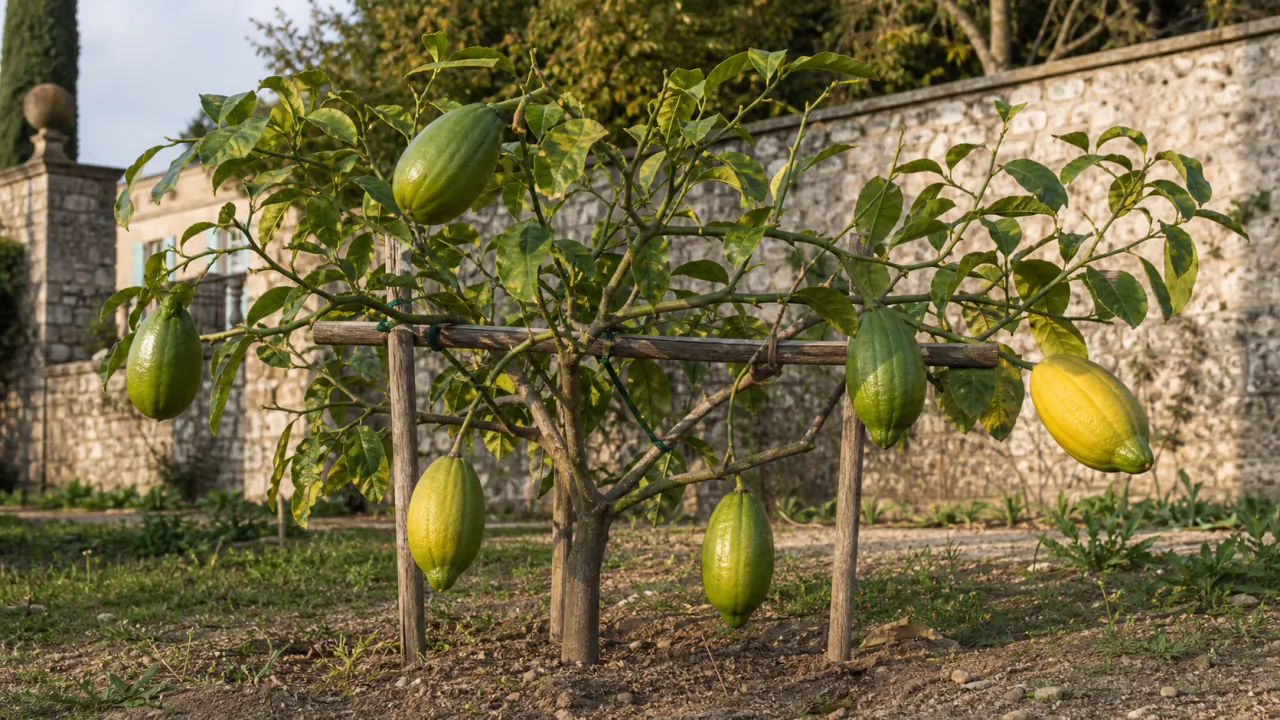
The ‘Diamante’ is the confectionery citron par excellence, a Calabrian selection associated with the Diamante region. Like all citrons (Citrus medica), it is not grown for a fleshy fruit: its interest is its very thick, aromatic peel, its massive pith and its intense fragrance, while it yields almost no juice. It is the raw material of candied peel and glacé citron. A fruit to be understood through its terroir and its clone, not through a standard figure.
To be set alongside the other Citrus medica of the encyclopedia: the Corsican citron, the Buddha’s hand (fingered citron) and the Etrog citron. Like them, it is frost-tender (class F1). See also the Citrus & Orchard section.
The reliable facts before you buy
A peel fruit, to understand through its terroir
You choose the ‘Diamante’ for its peel, not its flesh. Its very developed white pith, dense and fragrant, is exactly what the confectioner seeks: it is what is candied, turned into candied peel. Wanting to press juice from it makes no sense — it gives almost none. It is a citrus grown and judged by the quality of its skin.
This citron is judged on its Calabrian terroir and its clone rather than on measurements: size and season vary too much from one orchard to the next for figures to mean much. The rootstock is chosen to suit the soil, and the exact combination is confirmed with the nursery.
| Depending on your situation | Rootstock(s) | Why — and the trade-off |
|---|---|---|
| Vigour, light soil | Citrus macrophylla, Volkameriana | Vigour suited to citrons. ⚠️ to be validated for the clone. |
| Pot, contained size | Trifoliate, Flying Dragon | Useful dwarfing in a tub. ⚠️ sensitive to active lime. |
| Calcareous or saline soil | Forner-Alcaide 5 (FA5) | ChlorosisYellowing of the foliage caused by poor iron uptake, often linked to chalky soil. tolerance. ⚠️ not « universal ». |
| To keep in mind | Combination to confirm | Frost-tender citron: validate the pairing and the winter shelter with the nursery. |
The ‘Diamante’s rhythm: tub or mild climate
A frost-tender citron: a tub overwintered warm and bright outside a mild climate. Autumn-winter harvest, set on the peel’s ripeness more than on a fixed date.
| Jan | Feb | Mar | Apr | May | Jun | Jul | Aug | Sep | Oct | Nov | Dec | |
|---|---|---|---|---|---|---|---|---|---|---|---|---|
| Plant / repot (settled warmth) | ||||||||||||
| Overwinter bright frost-free (tub in) | ||||||||||||
| Move the tub out (mild nights) | ||||||||||||
| Flowering (fragrant) | ||||||||||||
| Harvest (autumn-winter) | ||||||||||||
| Feed (citrus, in growth) |
A ‘Diamante’ with fine peel
The skin, not the juice
Judge this citron by the quality of its peel and pith, never by a juice yield it will not have.
Thin or lightly scented peel
A disappointing peel often betrays a lack of warmth or a mistimed harvest, not a disease. Warm terroir makes the material.
Warmth and ripeness
Give it the warmest spot and let the fruit reach the full ripeness of its peel before harvesting.
Protect from cold
Frost-tender citron (F1): bright frost-free overwintering is imperative outside a mild climate, on pain of losing the tree.
Read the sign, trace the cause, correct, prevent
The ‘Diamante’ shares the troubles of tubbed citrons; its great cold-tenderness is its major weak point.
| Sign observed | Probable cause | Correct | Prevent |
|---|---|---|---|
| Leaf drop, scorch in winter | Overwintering too cold or dark (F1 tenderness) | Bring in warm and bright; ease off watering | Bright frost-free greenhouse/conservatory |
| Yellow leaves with veins staying green | Iron chlorosis (high pH, lime, waterlogging) | Iron chelate; review watering; suitable rootstock | Free-draining compost, low-lime water |
| Cottony masses or shells on stems and undersides | Scale insects (mealybugs or armoured scale) | Clean off, white oil or soft soap, isolate | Ventilate overwintering, inspect when bringing in |
| Fine webbing, leaves stippled yellow | Red spider mites (hot dry air in overwintering) | Mist the foliage, raise humidity | Avoid too dry an atmosphere in winter |
| Winding silvery galleries on young leaves | Citrus leaf miner | Remove badly affected shoots; let beneficials act | Avoid nitrogen excess that multiplies young leaves |
Stay sparing with treatments: clean foliage, bright frost-free overwintering, balanced nutrition. If a notifiable citrus disease is suspected, follow the official instructions in force.
It is all in the candied peel
The ‘Diamante’ is made for candying: its thick peel and massive pith turn into candied peel and glacé citron, the noble material of confectionery. Its fragrant skin also feeds marmalades and gives a powerful zest. It yields too little juice for any liquid use, and is not eaten raw. It is a citrus of transformation, its value concentrated in the skin.
What the standards say (and do not)
Like the other citrons, the ‘Diamante’ does not fall within the lemon size scale.
- Regulatory group: off the cited scale; the lemon sizing does not apply to the citron, a peel fruit.
- Dimensions and season: to be documented by the Calabrian terroir and the clone, not generalised or invented.
No generic yield can be published: it depends on the clone, the rootstock, the soil, the age and the climate. Measure your own crop.
What people most often ask
What is the Diamante citron used for?
Above all for candying: its thick peel and massive pith give excellent candied peel. It is not eaten raw and yields very little juice.
Why does it have almost no juice?
That is the nature of the citron: the fruit is dominated by peel and pith. It is grown for the skin, not the juice.
Is it hardy?
No, it is a frost-tender citron (class F1). Outside a mild climate, it needs a tub overwintered warm and bright.
How does it differ from the Corsican citron?
They are two citrons (Citrus medica) of distinct terroirs: the ‘Diamante’ is Calabrian and emblematic of candying. The details of size and season are read by clone and by terroir.
Sources and control
Last scientific check: 2026-07-18. A Calabrian supply-chain source remains to be found for the dimensions and season.
- UC Riverside — Citrus Variety Collection: citrons (Citrus medica) and peel characters.
- Citron — Wikipedia (EN): candying uses and citron terroirs.