Japanese Matting for Pond Filters: Role, Cleaning and Mistakes
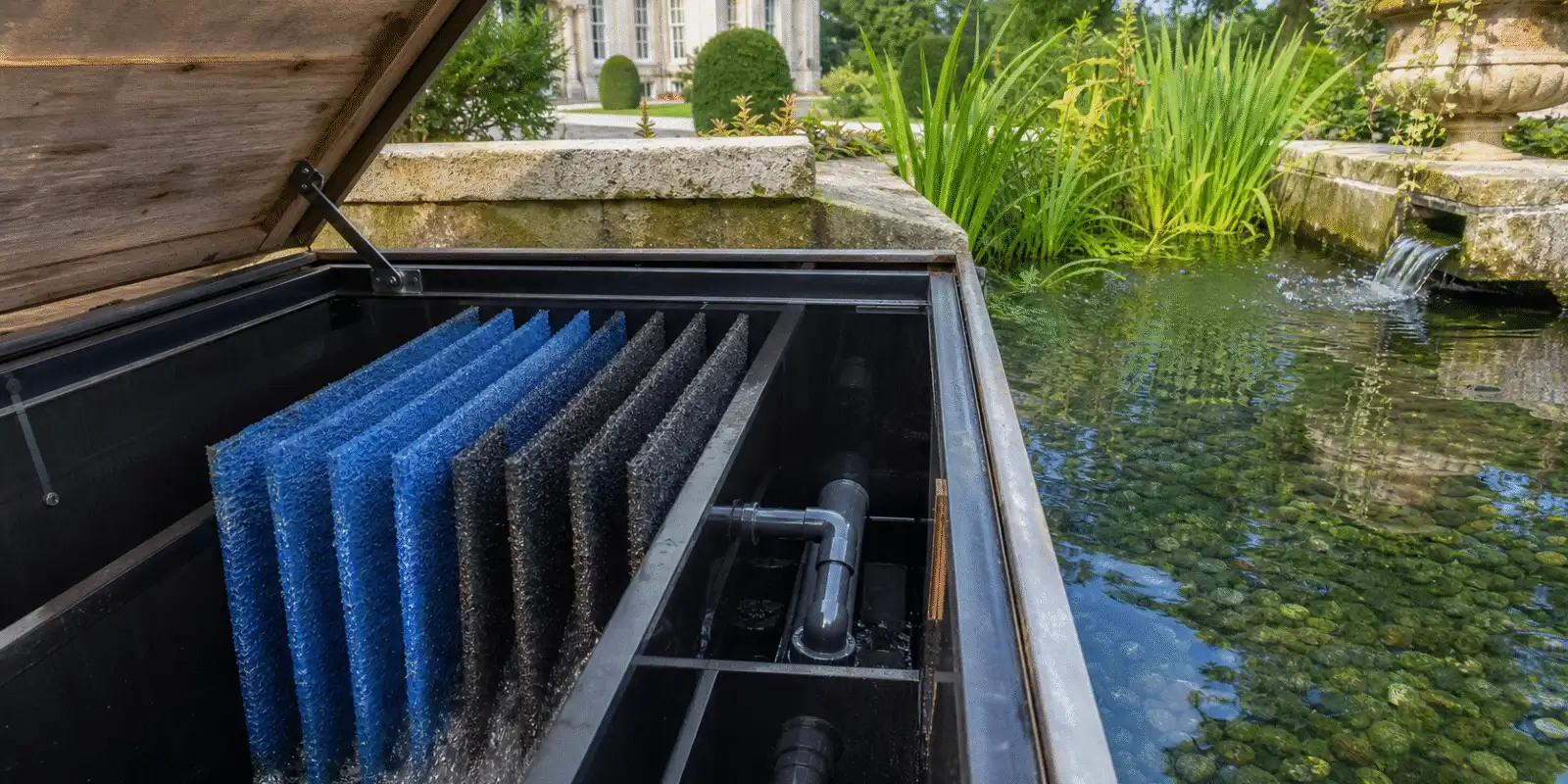
Japanese matting is a pond filter medium: it traps some particles but mainly hosts beneficial bacteria. Place it after coarse pre-filtration, rinse it with pond water and never clean every sheet on the same day. For flow, start with our pond pump and filtration guide.
People search for it when water clouds, fish grow or the original filter struggles. The matting is almost invisible in the garden, but it often decides whether the pond remains stable.
Read it as biology, not housekeeping. A perfectly scrubbed sheet may look clean and still be weaker as a living filter.
The Chatelain Method
Observe organic load, diagnose media order, correct water flow and prevent ammonia spikes through partial cleaning. Elegant pond filtration should stay discreet, but it should never be treated brutally.
Where Japanese matting belongs
| Position | Role | Maintenance |
|---|---|---|
| After brushes or screen | Receives water without coarse waste | Limits rapid clogging. |
| Vertical sheets | Lets water pass evenly | Easy module cleaning. |
| Before pond return | Adds biological stability | Never sterilise everything. |
| With water tests | Tracks ammonia and nitrite | Clean less if values move. |
What does Japanese matting really do?
Japanese matting is an open support. Its surface hosts bacteria that process nitrogen waste, the basic principle of a biofilter. It works through microbial life more than simple sieving.
It also catches particles, but that should not be its first job. Leaves, sludge and food waste clog it fast, so a screen, brushes or settlement before the matting protects its biological value.
- Pre-filter before the biological chamber.
- Avoid compact blocks that water can bypass.
- Keep flow slow but regular.
How do you clean it without losing bacteria?
Clean in a tub of pond water, squeezing gently. Chlorinated tap water and pressure jets reduce bacterial life. The safest rule is to clean only one third of the sheets at once.
That slowness protects fish better than a dramatic clean-out. In koi ponds, where organic load is high, it matters even more.
Which mistakes reduce performance?
The first mistake is confusing clean with alive. The second is undersizing the chamber: too little surface, too much flow, too little contact. The third is side bypass, when water avoids the matting.
Cut sheets neatly, wedge them correctly, test the water and review the whole pond if needed. Stable filtration starts with the installation too, from the EPDM pond liner to the water return.
A cleaning protocol that protects biology
Before acting, treat Japanese filter matting as a garden decision, not as a stand-alone purchase. In practical terms, clean only part of the sheets in pond water. This small pause prevents visible corrections once the garden is already finished.
The main risk is sterilising the filter, losing biofilm and creating unstable water after a major wash. In a refined garden, that mistake remains visible for a long time: it costs time, weakens the scene and often forces repairs when conditions are least convenient.
For timing, keep this marker in mind: be gentler in hot weather, when fish and bacteria are already under pressure. If one point still feels uncertain, wait a few days, watch the weather and check that the chosen solution will remain easy to maintain, not merely attractive on paper.
Keep a simple record of the decision: a nitrite test before and after cleaning if the pond holds fish. It helps later when ordering compatible material, understanding what was done or adjusting maintenance without starting the diagnosis from scratch.
Finally, check that the suggested gear truly supports the action described in the article. The buying block should help the work, not add a decorative or fragile accessory that makes maintenance harder.
The Chatelain rule is simple: a good garden solution must still look clear, maintainable and proportionate six months after installation. If it fails that test, it needs one more adjustment.
- Clean with pond water.
- Work in thirds.
- Avoid strong jets.
- Watch nitrites.
- Improve prefiltration if clogging returns.
FAQ
Is Japanese matting mechanical or biological?
Both, but its main value is biological because it gives beneficial bacteria a stable surface.
Can I clean it with a hose?
Avoid pressure and chlorinated tap water. Use pond water and clean in sections.
Should it be replaced every year?
No, as long as it keeps its structure. Replace it when it breaks down or clogs permanently.
Related Reading
Useful Sources
Written and checked by the editorial team of Les Jardins d’un Chatelain.