Privacy Hedge: Hide With an Elegant Living Screen
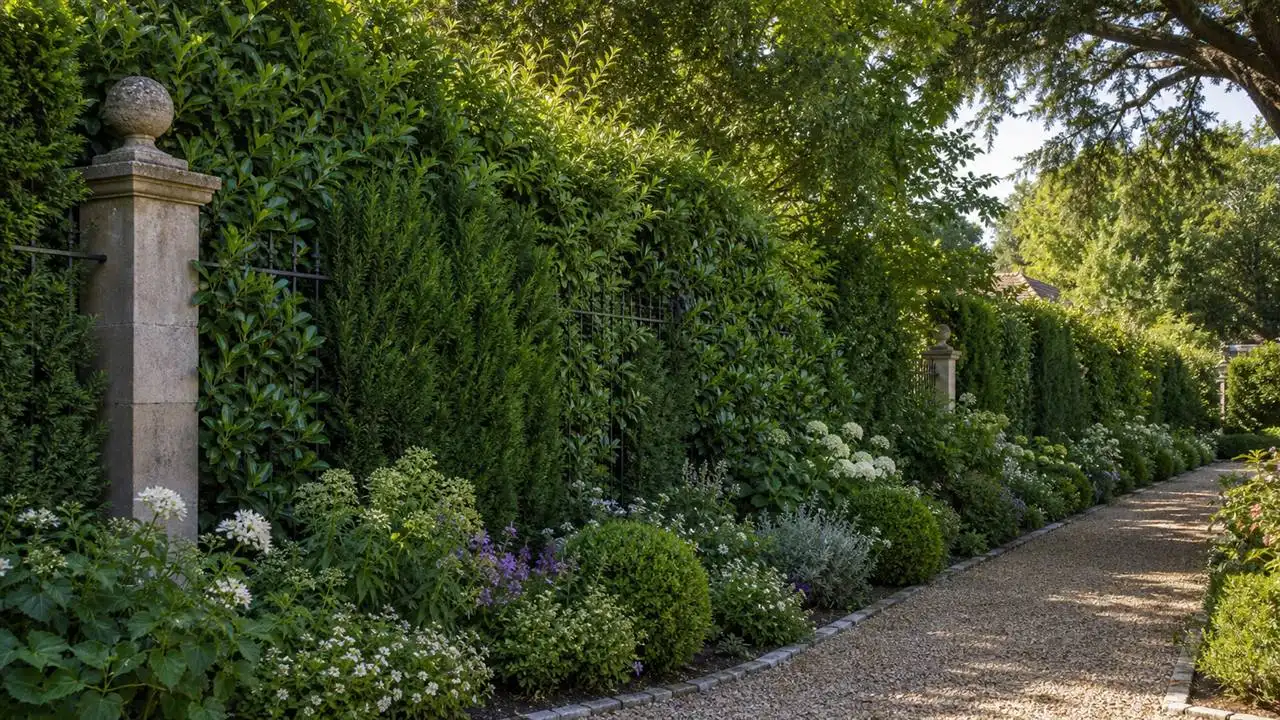
For a year-round privacy hedge, choose evergreen shrubs (laurel, photinia, holly, non-invasive bamboo) planted as a informal or clipped hedge. A mixed hedge grows more healthily than a single-species wall and offers shelter to birds. Here’s how to compose one that hides you quickly and well.
The Chatelain Method for a hedge
You observe the screening height needed and the aspect; you diagnose evergreen or deciduous, informal or clipped; you correct with a mix of species; you prevent monotony and disease by varying what you plant.
Which hedge to choose?
| Need | Recommended shrubs |
|---|---|
| Evergreen, dense | Laurel, photinia, holly, privet |
| Fast growth | Photinia, leylandii (with caution), non-invasive bamboo, privet |
| Informal / wildlife-friendly | Hornbeam, hazel, dogwood, viburnum |
| Small space / pot | Potted bamboo, tall ornamental grasses |
The Chatelain note. A mixed hedge (3-4 species) is healthier than a single-species wall: it resists disease better, flowers and feeds wildlife while screening just as well. A flat, monotonous green wall is worth avoiding.
Planting and maintaining
Ideal planting is in autumn (easier establishment), at a suitable distance from the boundary. There’s no fixed statutory planting distance in England and Wales, but professional guidance suggests at least 60cm to allow for growth and access from your own side. What does carry legal weight is the High Hedges provision (Part 8 of the Anti-social Behaviour Act 2003): if an evergreen hedge over 2m tall blocks a neighbour’s light or reasonable enjoyment, they can complain to the local council after trying to resolve it directly. Scotland has its own separate high hedges legislation.
Mulch at the base, water in the first year. A informal hedge needs little trimming; a clipped hedge needs 1-2 trims a year.
A privacy hedge should filter, not seal you in
A poor hedge looks like a green wall: opaque, monotonous, demanding, often bare in winter or scorched in summer. An elegant hedge works differently. It filters views, slows the wind, shelters birds, gives the garden depth and shifts gently with the seasons.
| Goal | Recommended mix | Avoid |
|---|---|---|
| Quick privacy | Evergreens + a few deciduous | A fragile monoculture |
| A living garden | Local species + flowering shrubs | A purely defensive hedge |
| Low maintenance | Moderate growth rate | Overly vigorous laurel everywhere |
| Elegance | 2-3 foliage textures | Too motley a mix |
Plant in two rows if space allows: a structural line at the back, then a few looser shrubs in front. That gives softer privacy, better biodiversity, and a hedge that reads as a woodland edge rather than a disguised fence.
FAQ
Which hedge grows fastest for privacy?
Photinia, privet and non-invasive bamboo screen quickly. A temporary screen bridges the gap while it establishes.
Do I need an evergreen hedge?
For year-round screening, yes (laurel, photinia, holly). A mixed evergreen/deciduous hedge still screens well.
How far from the boundary should I plant a hedge?
There’s no fixed statutory distance in England and Wales, but at least 60cm is sensible for access and growth. If the hedge is evergreen and grows above 2m, the High Hedges rules can apply if it affects a neighbour.
When should I plant a hedge?
Preferably in autumn: still-warm soil and rain favour rooting before the following summer.