Public gardens in Villefranche-sur-Mer: 4 stops
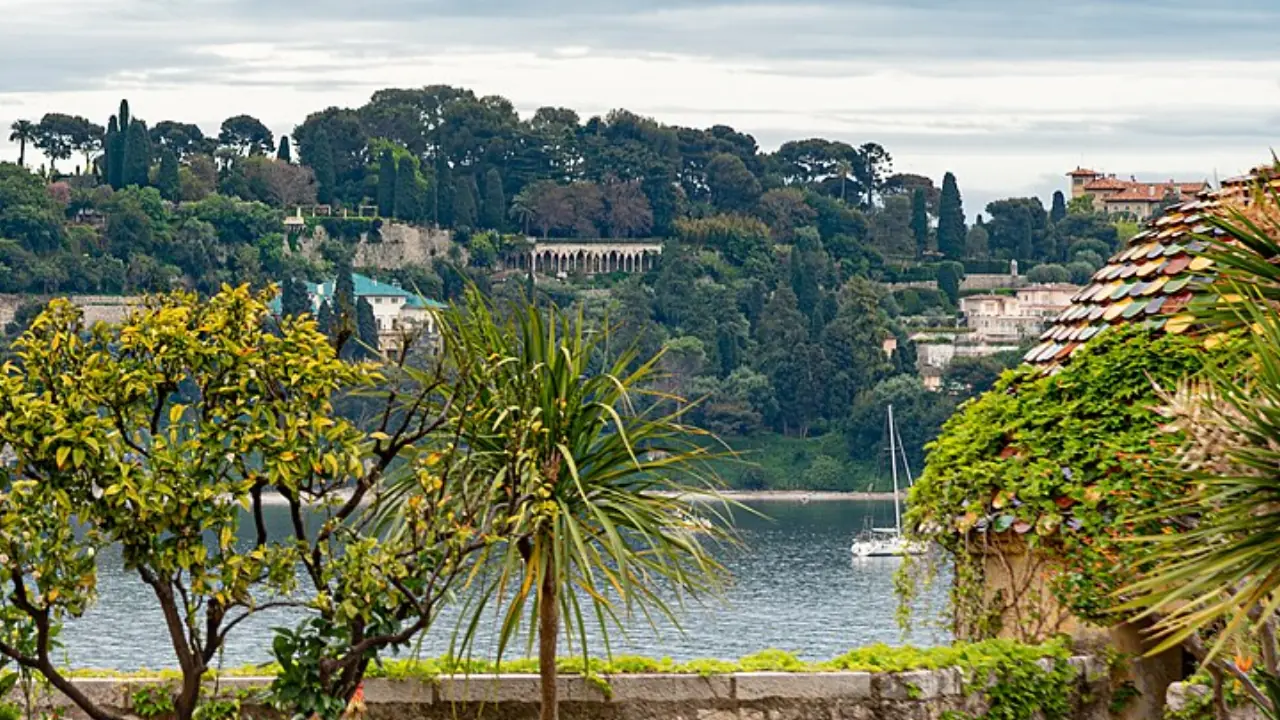
The public gardens in Villefranche-sur-Mer make sense as three levels, not as a top-ten list. Near the harbour and town centre, François-Binon is a modest urban pause and Narvik a young municipal biodiversity garden. In the Citadel, planting mediates between masonry, shade and views across the bay. High above town, the official Saint-Michel circuit reaches a wooded, panoramic plateau. That last option is a medium-grade walk, not an easy extension of a town-centre stroll.
For a short outing, pair the Citadel with Narvik or François-Binon. Give Saint-Michel a separate half-day after checking the weather and the current route sheet. Search results also surface the terraced gardens above the Darse harbour; the French Ministry of Culture describes these as part of a private second residence, so they are not included as a public stop.
Access information was checked against manager and municipal pages on 19 July 2026. Events, works, heat and local closures may alter it. This is a documentary guide, not a claim that our editorial team inspected every site in person on that date.
It complements our outdoor-design guides: read one relationship in an existing landscape, then adapt that relationship rather than copying its planting list.
Opening photograph: planting and bay seen from the Citadel gardens, by Jorge Franganillo on 14 April 2025, CC BY 2.0. The local asset is a 16:9 crop from a 1,280 × 768 Wikimedia rendition, resized to 1,280 × 720 and converted to WebP. The crop fully removes the bust, plaque, cannon and temporary art; this dated view does not prove 2026 access or planting condition.

Which Villefranche garden suits your visit?
| Priority | Best match | Check before setting out | Useful landscape lesson |
|---|---|---|---|
| A shaded cultural pause | Citadel gardens | Garden hours and events; the museum route remains closed | Join wall, threshold, shade and framed view |
| A recently made public garden | Jardin Narvik | Current access and the condition of young planting | Stack small habitats within a shared space |
| A seat in the town centre | Jardin François-Binon | Local access and any event | A bench, shade and position may matter more than a collection |
| A walk through a botanical landscape | Saint-Michel plateau | Weather, heat, road crossings and the official route | Shape a woodland edge and reveal a panorama |
This is a choice tool, not a ranking. In particular, free access to the Citadel gardens must not be confused with reopening of the indoor museum circuit.
Two workable outings, not one overfilled route
The lower route: Narvik, the Citadel and town
Narvik stands on Rue de la Citadelle near the Darse. Our internal itinerary worksheet records the Citadel and François-Binon as optional town-centre stops; it does not guarantee timings or connections. Its observation fields are shade, wall, seat and framed view.
The Citadel currently advertises its gardens as open from 10am to 7pm throughout the year except public holidays. Its museum route has, however, been closed for refurbishment since January 2022, with the first reopening phase announced for 2028. In summer and autumn 2026, contemporary art also occupies gardens, courtyards and ramparts until 31 October. Check the programme on the day: an open garden is not a fixed stage set.
The upper route: Saint-Michel
The 2026 official leaflet gives the Saint-Michel circuit as 5km, about three hours and medium difficulty. The plateau has a picnic area, orientation table and botanical garden. Those numbers describe the published route; they cannot guarantee a personal walking time.
Road crossings and hillside exposure mean this should be prepared as a separate walk. Carry water, use suitable footwear, load the route before leaving and turn back when heat, wind or visibility make the plan unwise. A 2023 municipal publication described the botanical garden as needing rehabilitation and its labels as difficult to read. That does not establish its exact state in July 2026, but it is a good reason to come for woodland structure and panorama rather than expect a flawlessly labelled collection.
The Citadel: making a threshold between stone and sea
Context photograph: Citadel entrance by Broenberr, CC0 1.0, resized and converted to WebP. It documents the masonry entrance, not reopening of the museum route.

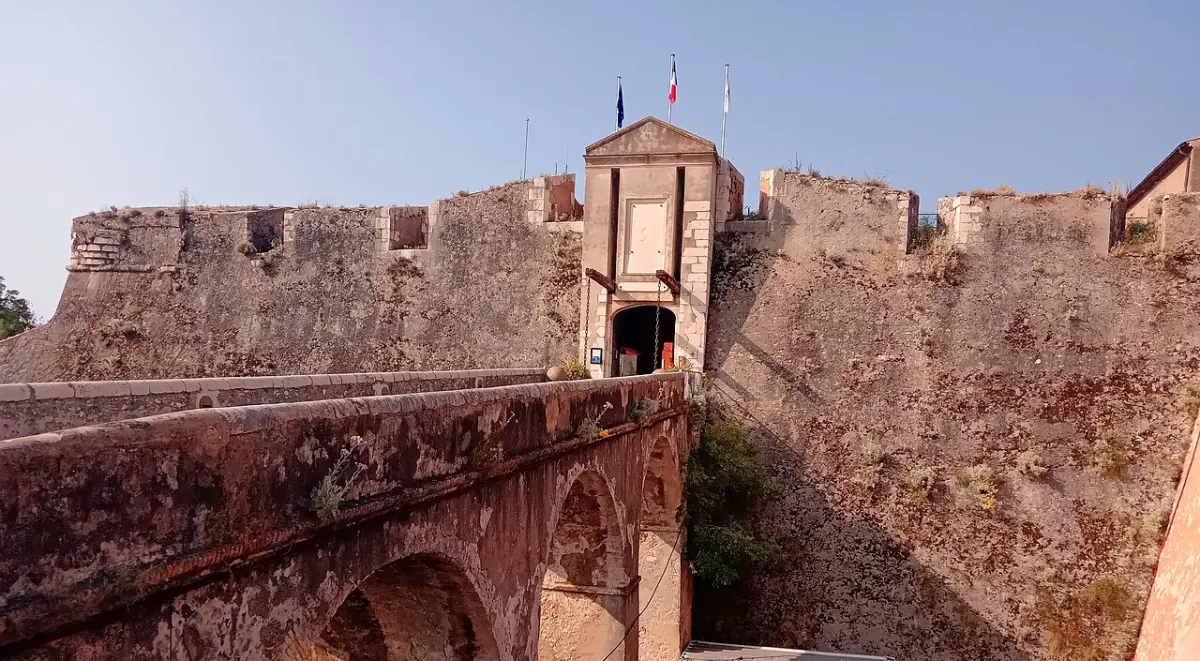
Saint-Elme Citadel is a sixteenth-century municipal fortress now used for civic, artistic and heritage purposes. Its planting does not need to hide the architecture. It softens transitions: dark foliage before a bright court, a planted edge beside a wall, or a restrained opening towards the bay.
The first lesson is to rank views. A completely exposed panorama can make every smaller space feel incidental. A low hedge, wall return or shrub group can delay the view by a few steps. At home, this might mean revealing one focal point from a doorway or after a bend, rather than scattering ornaments across the plot.
The second lesson is microclimate. Masonry stores heat, screens some winds and creates very dry pockets. Record hours of sun, reflected heat and the real path of rainwater before choosing plants. The spatial idea travels; a plant’s Riviera performance does not prove that it will tolerate a British winter.
Temporary art creates a further documentary boundary. A reusable photograph of the Citadel does not automatically clear the rights to a contemporary artwork visible within it. The selected crop therefore excludes every identifiable work.
Narvik: a young biodiversity garden
The municipality presents Narvik, opened in 2025, as a place for learning, sharing and rest. Its published planting combines fruit trees, nectar plants, a bee-bee tree, lavender, rosemary and thyme with olive, pine and oak. Teaching hives, insect hotels, bird boxes, composters, benches and picnic tables support collective use; a fenced dog area lies alongside it.
Its value is not a shopping list. A new garden changes quickly and each feature needs maintenance. The stronger lesson is the overlap of functions: food, shelter, learning and rest can share a site when their flows do not conflict.
A small home version could combine one fruit tree suited to the soil, three nectar-rich perennials with staggered flowering, a safe shallow water source and dead wood kept away from circulation. A decorative insect hotel is not a replacement for habitat. Pesticide-free management, undisturbed stems, connected flowers and some quiet soil matter more.
Narvik also shows why an opening-year photograph is only a snapshot. Tree canopies, ground cover and patterns of use need time to settle; honest planning allows for that immature stage.
François-Binon: the quiet value of an urban pause
Reliable botanical information about François-Binon is sparse. The metropolitan tourism office identifies it as one of Villefranche’s free, year-round reading-box locations. We do not infer a gated timetable, a collection or a horticultural programme from that limited evidence.
The restraint is useful. Our internal observation grid records a seat outside the pedestrian flow, shade available at the hour of use and a planted edge clear enough to make a pause. Before adding species, ask where a person can stop, what they see while seated and whether the route remains legible.
In a small British courtyard, the translation might be a backed bench, an appropriately sized tree or pergola for afternoon shade, and low planting that does not consume the passage. The space becomes an outdoor room rather than a crowded display.
Saint-Michel: read a woodland edge, not a catalogue
At plateau level, landscape works at a larger scale. Ground layer, shrubs, trunks and crowns shape the experience, while gaps connect the path to the bay. One named specimen matters less than the way the edge thickens, recedes and opens.
The Chatelain Method uses four moves here:
- Observe each layer and mark where the eye can pass.
- Diagnose the visible relationship — openness, density or framing — without inferring site risks that the visitor sources do not document.
- Correct the home site with one relationship — perhaps a low edge that opens a view from a seat.
- Prevent literal copying: record what the observation cannot prove and leave planting, water and maintenance decisions to a local site assessment.
At home, do not turn every boundary metre into five stacked layers. Alternate enclosure and breathing room. An evergreen shrub may shelter; a lower group may create a window; a tree may form the ceiling. The structure should still read clearly out of flower.
Four ideas worth carrying home
Frame before decorating
Choose the useful view from the house or main seat. Remove conflicting obstacles, then add no more than one foreground and one side mass. The Citadel demonstrates that open space can be the most valuable material.
Connect habitat rather than collecting gadgets
Place food plants beside an untreated patch and safe water. Nesting aids work best as part of a year-round habitat, not as isolated ornaments.
Design shade for the hour of use
Shade at 9am does not help a bench used at 4pm. Plot the sun at several times and seasons before specifying tree, sail or pergola.
Give a boundary windows
Repeat two or three coherent masses and keep one opening. For many UK gardens, also test drainage and winter wet; a Mediterranean look built on saturated roots will not be resilient.
What to recheck on the day
- Citadel garden access and the events calendar;
- the continuing closure of the museum route and any work zones;
- weather, wind, heat and fire-related access restrictions;
- the current Saint-Michel route sheet and road crossings;
- in our internal departure checklist: water, footwear and navigation for the plateau;
- each visitor’s access needs: a generic difficulty label is not a substitute for surface, steps and gradient.
Frequently asked questions
Are the Citadel gardens open during the museum works?
The manager distinguishes the accessible gardens from the museum route, closed since January 2022. Check the day programme because works or events may still alter circulation.
Is Narvik a historic garden?
No. It opened in 2025. Its interest lies in public biodiversity features and shared use, not invented age.
Can I easily combine the Citadel and Saint-Michel?
It is not our recommended plan. The Citadel is an urban visit; Saint-Michel is published as a 5km, three-hour, medium-grade circuit. Treat them as separate outings.
Is the Saint-Michel botanical garden fully labelled?
Official material calls it a botanical garden, but a municipal publication reported rehabilitation needs and fading labels. Expect a wooded panoramic landscape first and verify current conditions locally.
Can the Darse terraced gardens be visited?
The Ministry of Culture describes them as a private second residence. An exceptional event would not create permanent public access, so they are excluded here.
Which design idea transfers most safely to Britain?
Frame one view with a plant mass and an open interval. It is less climate-dependent than importing a Riviera plant list. Then check hardiness, drainage and winter wet for every species.
Official visit sources and UK adaptation source
- La Citadelle — official site
- Nice Côte d’Azur — Citadel gardens in English
- Villefranche municipality — Jardin Narvik, French primary page
- Nice Côte d’Azur — Villefranche walking trails and 2026 French route leaflet
- French Ministry of Culture — private Darse terraced gardens
- Royal Horticultural Society — Mediterranean garden plants
Pages checked on 19 July 2026. French manager pages are retained where no equivalent English primary page exists; current access must be checked again before travel.
Written and checked by the editorial team at Les Jardins d’un Châtelain.
Documentary status — editorial selection. We acknowledge the gardeners, municipal teams, maintenance staff and managers without implying an association. This is not a personal-visit claim, a ranking, a ticket offer or an affiliate page.