Gardens Near Aix-en-Provence: 6 Inspiring Estates
Plan gardens to visit near Aix-en-Provence by area, not as six pins to collect. The Pavillon de Vendôme and Jas de Bouffan are both in Aix, but the latter follows a limited 2026 season linked to its restoration. Romégas is a private garden north of the city. Albertas lies south at Bouc-Bel-Air. The two wine estates lie farther out and are treated as separate outings in this guide.
This is not a ranking. The six places reveal six different relationships: public geometry; an estate under restoration and a painter’s memory; the water chain of a rural bastide; the infrastructure beneath an historic garden; contemporary art in a working agricultural landscape; and productive terraces sheltered from wind. Their character depends as much on sustained care as on design. We thank the gardeners, municipal teams, families, conservators and estate staff who keep this French heritage alive, without implying that any of them has a relationship with our editorial team.
Access information was checked with official managers on 16 July 2026. Seasons, booking, private events, restoration work and extreme heat can alter a visit, so check the official source again on the day. This is a documentary synthesis, not a claim that our team personally made all six visits.
It complements our outdoor design guides: first understand how an existing landscape works, then adapt one relationship to your own ground.
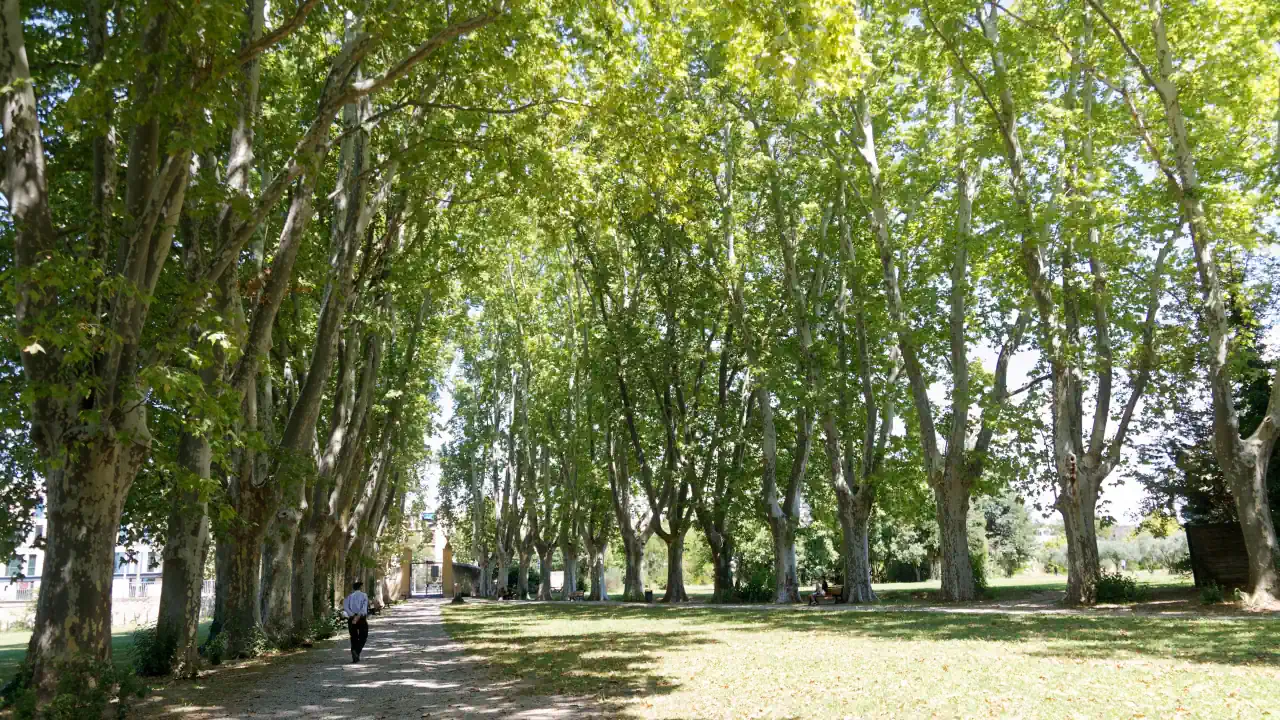
Opening photograph: the plane-tree avenue at Jas de Bouffan, photographed by Bjs on 16 August 2018, CC BY-SA 4.0; cropped, resized and converted to WebP under the same licence. The photograph predates the current restoration campaign and is not evidence of the site’s condition in 2026.

Choose one of five realistic outings
The decisive question is not how many stops fit on a map, but which access condition and landscape mechanism suit your day.
| Area | Place or places | Essential check | Main lesson |
|---|---|---|---|
| Central and western Aix | Pavillon de Vendôme; Jas de Bouffan if a place is secured | Seasonal municipal hours at the Pavillon; a limited 2026 season and limited capacity at the Jas | A public axis and a landscape under restoration |
| North of Aix | Bastide de Romégas | Private property, seasonal opening and restricted visiting slots | Distribute water before adding display |
| Southern Pays d’Aix | Jardins d’Albertas, Bouc-Bel-Air | Days and hours change by month; follow the restoration updates | Repair the structure of an historic garden |
| Northern Pays d’Aix | Château La Coste, Le Puy-Sainte-Réparade | Outdoor distance, heat and any guided-tour booking | Place art within an agricultural landscape |
| Eastern Pays d’Aix | Château Val Joanis, Pertuis | Telephone before travelling: a private event can close the gardens | Shelter and order productive terraces |
Even the two Aix sites should only be paired once Jas de Bouffan is confirmed. Elsewhere, leave time for slopes, heat and observation. A slower visit with one precise question is more useful than a hurried checklist.
Use The Chatelain Method: Observe → Diagnose → Correct → Prevent
A Provençal bastide is not a shopping list of cypress, lavender and pale stone. Its form comes from terrain, water, wind, walls, farming and decades of maintenance.
- Observe: record axes, shade, levels, walls, water routes, views and evidence of care.
- Diagnose: name the constraint being solved. A terrace may retain soil, shelter people, distribute water or stage a view.
- Correct: reduce that mechanism to your scale. A grand vista can become a sightline; a chain of pools, a safe sequence from roof to storage and planted ground.
- Prevent: test soil, winter wet, frost, drainage, safety, water availability and future labour before choosing plants.
For a UK garden, the transfer test is crucial. A plant thriving in dry Provençal ground may fail in a wet British winter even if summer drought is increasing. The Royal Horticultural Society’s guidance on drought-resistant gardening and Mediterranean garden plants both point back to soil, drainage and local conditions. Transfer the structure first; reassess the palette.
1. Pavillon de Vendôme: keep a formal axis alive
In central Aix, the Pavillon de Vendôme garden links its façade to a central walk, clipped volumes and open public ground. The geometry gives immediate orientation, yet this remains a lived municipal garden with daily footfall and seasonal hours. Formal order and public use have to coexist.
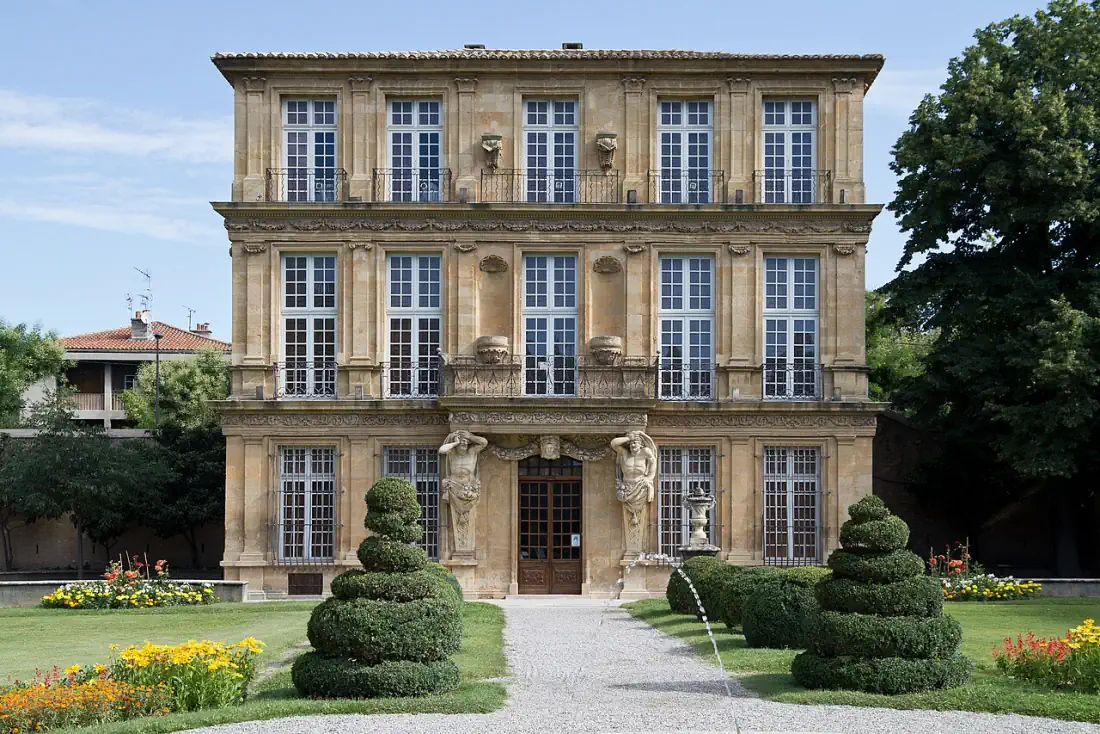

Observe: stand on the axis, then move away from it. The frontal view explains the order; side routes reveal how trees, lawns and topiary make it usable. A successful axis links a starting point, a destination and intermediate activity rather than offering symmetry alone.
Adapt: choose one view from a window or threshold and give it a calm endpoint—an existing tree, pot, seat or opening. Mirror only elements that genuinely need to read together. Two evergreen masses can be enough; every extra clipped edge adds future labour.
The City of Aix-en-Provence and its gardeners maintain this public space. The Tourist Office publishes seasonal hours. Check both garden and building access on the day: an open garden does not necessarily mean that the pavilion interior is open.
2. Jas de Bouffan: survey before redesigning
The Bastide du Jas de Bouffan was Paul Cezanne’s family home. Today the site links the house, surviving landscape structure and interpretation of the painter’s work while a restoration programme continues. That makes the garden useful for a wider reason: restoring an historic landscape is not simply a matter of replanting a single imagined date.
Observe: look for the structures that still organise the estate—avenue, tree masses, open ground and the relationship between house and park. Ask what is original, retained, reconstructed or still under work. That distinction is part of the visit, not an inconvenience to ignore.
Adapt: before remaking a domestic garden, map healthy trees, levels, walls, permeable ground, views from the house and routes that already work. Photograph it through the seasons. Then correct a defined problem rather than erasing all its memory.
The City of Aix, site team and conservation professionals are responsible for this transmission. For 2026, the official information gives a season from 4 July to 31 October, with different October hours, limited places and booking recommended; a garden ticket is indicated as available on site. These dates should not be projected into another year. The opening photograph records the park in 2018, before the present work.
3. Bastide de Romégas: read the whole water chain
Romégas is a rural bastide, not a public park available throughout the day. Parterre, threshing area, wells, wash house, fountains and agricultural features describe water moving from one use to another. Its relationship with the wider landscape, including views towards Sainte-Victoire, also places house, cultivation and territory in one system.
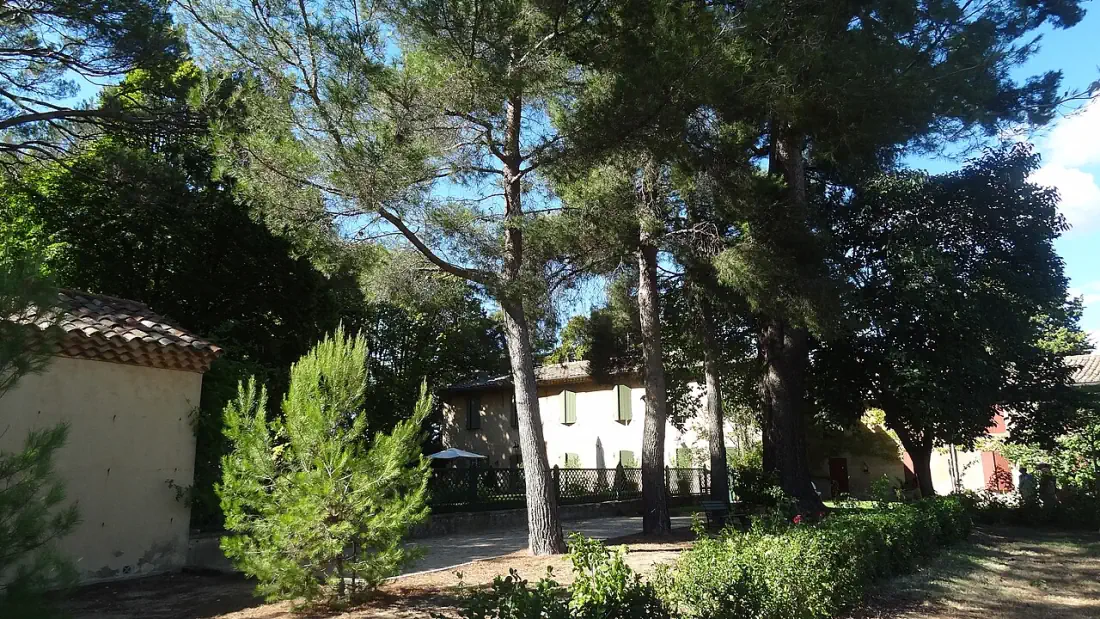

Observe: do not treat each water feature as a separate ornament. Reconstruct the likely order: collect, store, conduct, use and release. Compare the ornamental garden, courtyard, productive ground and farm. Their hierarchy explains more than the mere presence of a fountain.
Adapt: draw every roof-water route at home. Assign priorities—closed storage, safe infiltration away from foundations, then trees or planting. A dry rill can reveal the route without pretending that water flows permanently. Prevent standing water, protect children and never shift runoff onto a neighbour.
The owner-manager, Loïc Ducastel and the people who maintain and interpret Romégas open this private heritage according to a restricted calendar. Secure direct confirmation before travelling. Without it, choose a public garden rather than building a day around a closed gate.
4. Jardins d’Albertas: repair what supports the composition
At Bouc-Bel-Air, Albertas unfolds as a theatre of terraces, steps, pools and long views. Water and masonry are not decoration added after planting; they are the garden’s working structure. The estate’s published restoration approach accordingly starts with infrastructure.
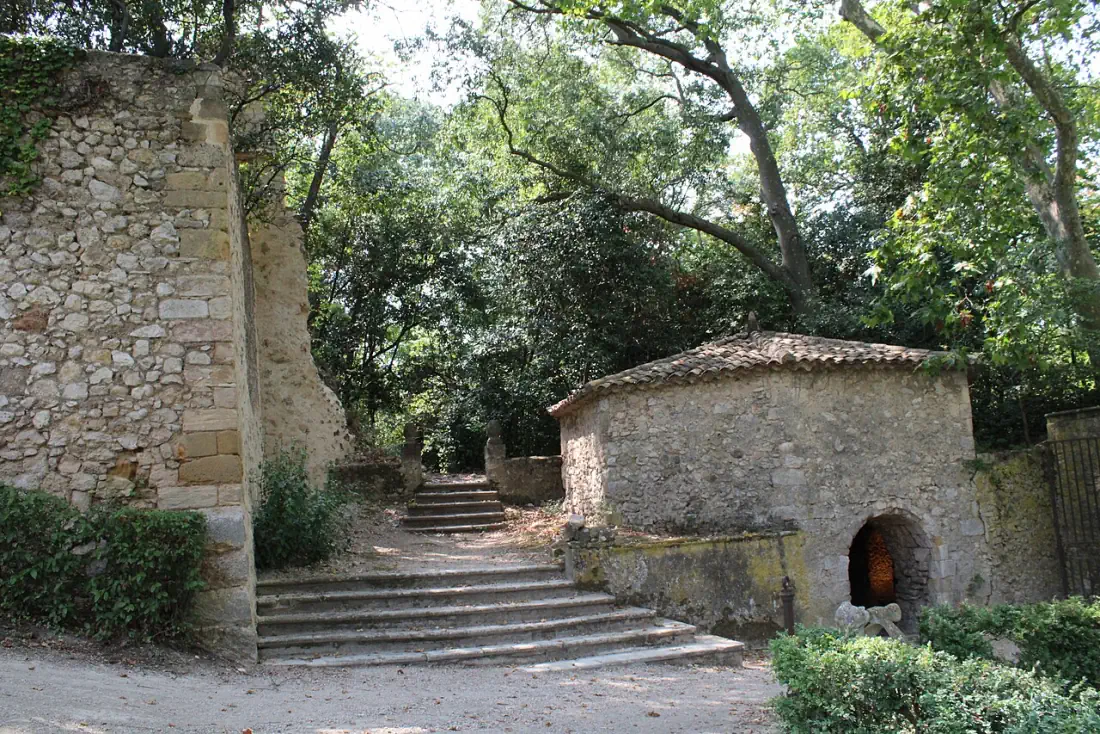

Observe: identify the parts working quietly—walls retaining levels, gradients carrying water, steps controlling pace and alignments creating depth. A coherent restoration resolves those dependencies before seeking an immediate floral effect.
Adapt: order domestic work as follows: stability and drainage, safe access, soil, shade, then planting. A sloping plot may need professional structural or drainage advice. Historic inspiration is not a substitute for an engineered retaining wall or planning consent.
The family and Albertas team, together with public partners and restoration supporters, maintain this private site. At our check, its manager listed weekends and public holidays in May, June and September, then daily opening in July and August, with different hours. Consult the practical page for the exact date.
5. Château La Coste: use distance to connect art and land
At Le Puy-Sainte-Réparade, Château La Coste combines wine production, architecture and contemporary works among woodland, olive groves and vines. It is neither an historic bastide like Romégas nor a municipal garden like the Pavillon. Its lesson here is the way an outdoor route alternates artwork, walking, cultivation and horizon.
Observe: study the intervals as much as the objects. Approach, turn, framed view and walking time prepare each encounter. Vines, woodland edges, relief and season are active parts of the route, not a neutral backdrop.
Adapt: choose one focal point and design its approach from a real daily route—a door, terrace or path. Leave breathing space around it. A stone, tree, sculpture or seat does not need a collection of competing effects.
The estate’s landscape and vineyard teams, alongside participating artists and architects, sustain this relationship. When checked, the official site described an outdoor Art & Architecture walk of about 4 km, open daily, with booking recommended for guided visits. Recheck hours, programming, heat and accessibility.
We deliberately publish no photograph of Château La Coste. None of the garden or route images found combined a sufficiently certain match with an unambiguous reuse chain, and visible contemporary artworks can carry separate rights. A generic picture would be less informative and could falsely appear to be evidence of the place.
6. Château Val Joanis: layer production, pleasure and shelter
Near Pertuis, Château Val Joanis is organised across three terraces. Kitchen garden, fruit, ornamental planting, paths and shade structures share a system protected from the mistral. The estate credits the design to landscape architect Tobbie Loup de Viane. The transferable lesson is not to gather collections, but to match use, exposure and maintenance on each level.
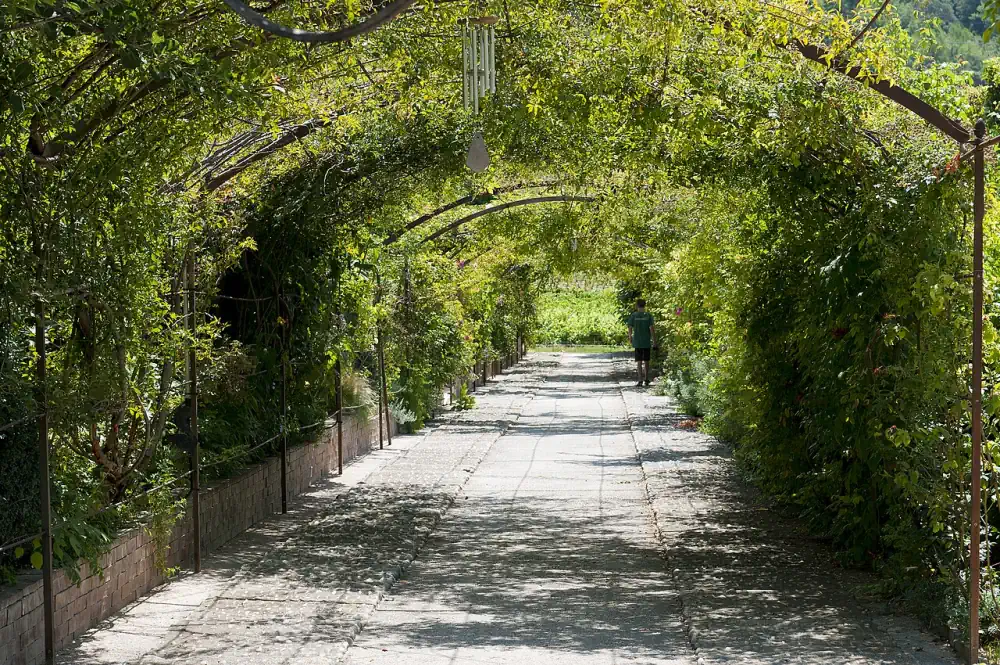

Observe: compare the terraces. Which areas are exposed, sheltered, irrigated or close to regular routes? Notice how edible and ornamental planting can share a composition without sharing identical care. Shelter changes comfort, evaporation and structural demands.
Adapt: group by need rather than catalogue. Keep crops requiring regular attention near paths and water; reserve drier ground for genuinely suitable plants. A porous wind filter often creates less turbulence than a solid barrier, but every structure still needs safe anchoring and inspection.
The estate team and gardeners maintain Val Joanis. The hours published at our check covered Monday to Saturday, with shorter Saturday access, but the manager explicitly asks visitors to telephone first because private events can close the gardens. That call is a condition of the outing, not a minor formality.
Three checks before setting out
An apparently open site may still be unsuitable for your plan. Check separately:
- permission to enter: booking at the Jas, confirmation at Romégas, the Albertas calendar and a telephone call to Val Joanis;
- the actual route: distance, steps, slopes, shade and which terraces are accessible;
- the day’s conditions: heat, wind, restoration work, an event or changed hours.
Do not infer a fully step-free garden from an accessible entrance. Ask which route is genuinely open and what remains visible from it. In summer, one well-prepared morning visit with water and sun protection can teach more than a crowded itinerary.
Bring home one decision, not six styles
Reduce one observation to a measurable action:
- Pavillon de Vendôme: a sightline with a clear endpoint;
- Jas de Bouffan: a survey of what already works before redesign;
- Romégas: a ranked rain route from roof to soil;
- Albertas: infrastructure repaired before decorative planting;
- La Coste: a focal point revealed by approach and empty space;
- Val Joanis: productive zones grouped by need and sheltered from wind.
Ask which problem it solves, what resource it needs, who will maintain it and what evidence will show success in a year. The Pays d’Aix is most useful when it makes you read your own soil, water and habits more closely—not when it tempts you to reproduce a Provençal stage set.
Frequently asked questions
Which garden can I visit without making a long excursion from Aix?
The Pavillon de Vendôme garden is the most flexible central option in this selection, subject to seasonal municipal hours. Jas de Bouffan is also in Aix, but its limited 2026 season, capacity and restoration make advance planning more important.
Can all six be visited in one day?
No. They are spread across Aix, the northern and southern Pays d’Aix, Le Puy-Sainte-Réparade and Pertuis, with several private or seasonal conditions. Choose one area and one or two landscape questions.
Which place best explains water management?
Romégas exposes a chain of rural uses; Albertas shows how pools, gradients and masonry support an entire composition. At home, begin with roof water, drainage and actual plant demand. Copying a fountain before solving the route reverses the lesson.
Which idea works in a small UK garden?
For a small UK garden, our proposed reduction is one sightline and one focal point, subject to the site’s actual dimensions and use. A few metres between a kitchen window and an existing tree, or a seat revealed by a turn, may be enough. Recheck drainage, winter wet and wind before importing Mediterranean plants.
Why do the photographs not prove current conditions?
A photograph records a view on its capture date. It cannot establish that planting, access or restoration remains identical in 2026. That is why each caption is dated, while current visiting conditions come from separately checked official pages.
Why is there no Château La Coste photograph?
Because no sufficiently precise view with an unambiguous permission chain was validated. We would rather state the gap than insert another estate, a generic stock scene or an artwork whose rights are not safely covered.
Official visit sources and adaptation references
- Aix-en-Provence Tourist Office — Gardens of the Pavillon de Vendôme
- Official Cezanne site — Bastide du Jas de Bouffan and Aix Tourist Office listing
- Bastide de Romégas — site manager and DRAC PACA heritage notice
- Jardins d’Albertas — practical information and restoration approach
- Château La Coste — Art & Architecture walk
- Château Val Joanis — gardens
- RHS — drought-resistant gardening and Mediterranean garden plants
Pages checked on 16 July 2026. Details are time-sensitive and must be checked again before travel. This guide fixes neither prices nor journey times and offers no guarantee of opening.
Written and checked by the editorial team of Les Jardins d'un Châtelain.
Documentary status — editorial selection. This guide is based on the cited managers and heritage institutions. The editorial team does not claim to have personally visited all six places for this article, does not rank them, sells no tickets and implies no commercial partnership.