Gardens to Visit in Monaco: 5 Gardens, 4 Areas
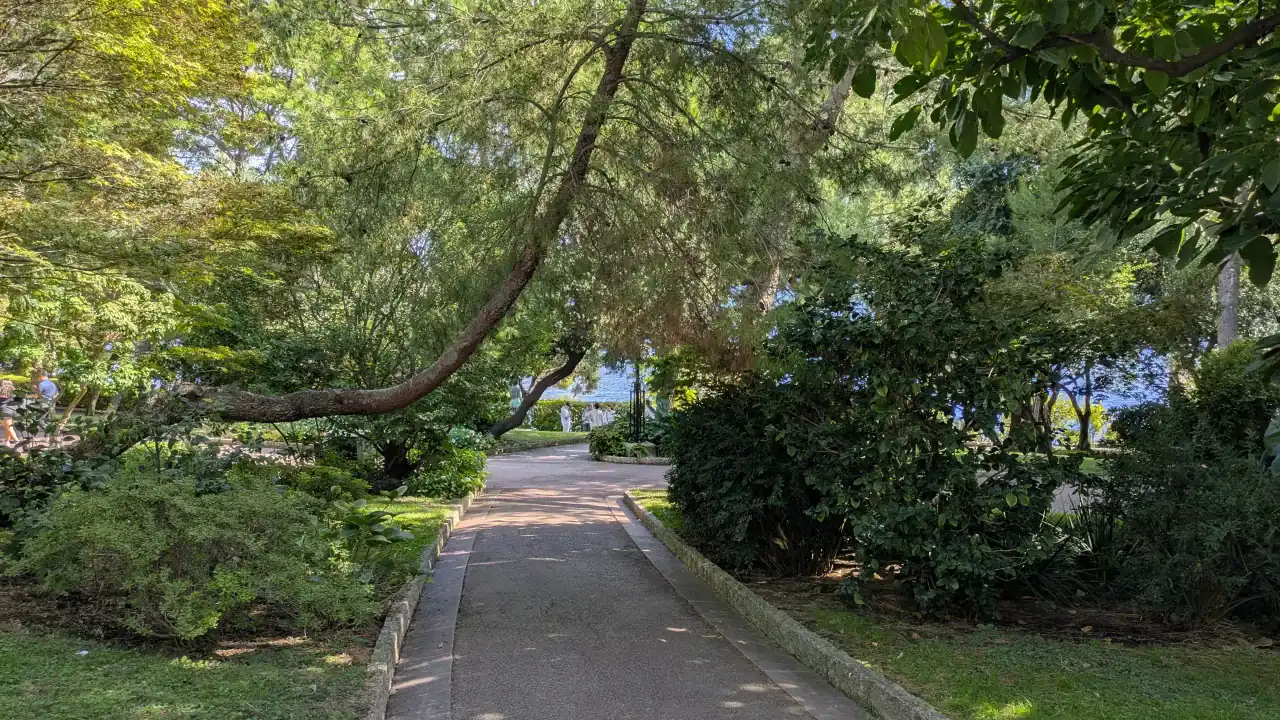
The gardens to visit in Monaco make more sense as five answers to limited space than as a ranking. The Exotic Garden uses a cliff; the Japanese Garden composes calm around water; the Saint-Martin Gardens follow the Rock’s slopes; Fontvieille Park gives roses and olives a permanent framework; and the UNESCO Garden brings Mediterranean planting, sea views and contemporary art together.
This is a documentary guide, not a claim that our editorial team personally visited every site. Visitor information was checked with the operators on 19 July 2026. Opening times, prices, temporary restrictions, cave tours and access arrangements can change, so follow the official links before travelling.
Monaco is the deliberate cross-border exception in this French–Monegasque Riviera series. The purpose is not to collect attractions. It is to acknowledge the gardeners, botanists, designers, public teams and hosts who keep living heritage in good order, then turn close observation into a usable garden idea.
Opening photograph: the real Saint-Martin Gardens, photographed by Mx. Granger on 28 September 2025 and released under CC0 1.0. The image was cropped to 16:9, resized and converted to WebP. A dated photograph documents the place; it cannot guarantee present planting or visitor conditions.

Which Monaco garden should you choose?
Our internal itinerary worksheet records gradients separately from mapped distance and does not infer walking pace. Choose one area and allow time to look.
| Garden | Area and access to recheck | Main physical condition | Useful design lesson |
|---|---|---|---|
| Exotic Garden | Jardin Exotique district; paid admission, partly accessible route | Cliff, steps and terraces | Layer a dry garden and leave deliberate gaps |
| Japanese Garden | Larvotto; advertised as free entry | Mostly level route around water | Create calm with curves, stone and a restrained palette |
| Saint-Martin Gardens | Monaco-Ville on the Rock; public garden | Sloping walk and viewpoints | Let shade and framed views lead the route |
| Fontvieille Park and Princess Grace Rose Garden | Fontvieille; advertised as free | Gentler urban route | Support seasonal flowers with permanent structure |
| UNESCO Garden | Fontvieille; advertised as free | Terraces and open views | Give a focal point enough visual space |
The table is a selector, not a promise to visit all five in one day. The Exotic Garden can fill a considered visit. Fontvieille provides the most coherent combination of park, rose garden and UNESCO Garden. The Rock and Larvotto are separate sequences across a steep city.
Use The Chatelain Method while you look
The Chatelain Method — Observe → Diagnose → Correct → Prevent — replaces a shopping list of plants with four useful notes.
- Observe: draw the route, levels, shade, views and water before photographing individual plants.
- Diagnose: identify the problem being solved: slope, drought, noise, density, heat or a transition between city and sea.
- Correct by adapting: take one principle — a line, terrace, contrast or rhythm — and resize it for your plot.
- Prevent: test every plant against your soil, winter low, available water and maintenance time.
For a UK garden, the distinction matters. A tender plant can thrive beside the Mediterranean and still fail in a wet, cold winter. Use the RHS hardiness ratings and your local conditions before choosing species. Shapes, routes and container culture travel more reliably than Monaco’s plant list.
1. Exotic Garden: design with the cliff
After almost six years of closure, the Exotic Garden officially reopened on 30 March 2026. Its succulent collection occupies a cliff. The geology is not background scenery: it determines stairs, viewpoints, drainage, plant silhouettes and the pauses in the route.

.jpg)
What to observe: read groups of shapes before labels. A low rosette, a column and a rock mass provide three clear heights; visible mineral ground stops the collection becoming a continuous wall.
Idea to adapt: start a small dry garden with drainage, safe maintenance access and three repeated silhouettes. In much of Britain, a raised, rain-sheltered bed or movable containers may be more realistic than copying plants into open clay. Never treat “drought tolerant” as “happy in winter wet”.
The reopening also makes stewardship visible. Teams had to reconcile a living collection, geology, visitor movement and safety. Check the operator’s current visitor page for admission, the accessible upper route and guided cave access.
2. Japanese Garden: compose calm through movement
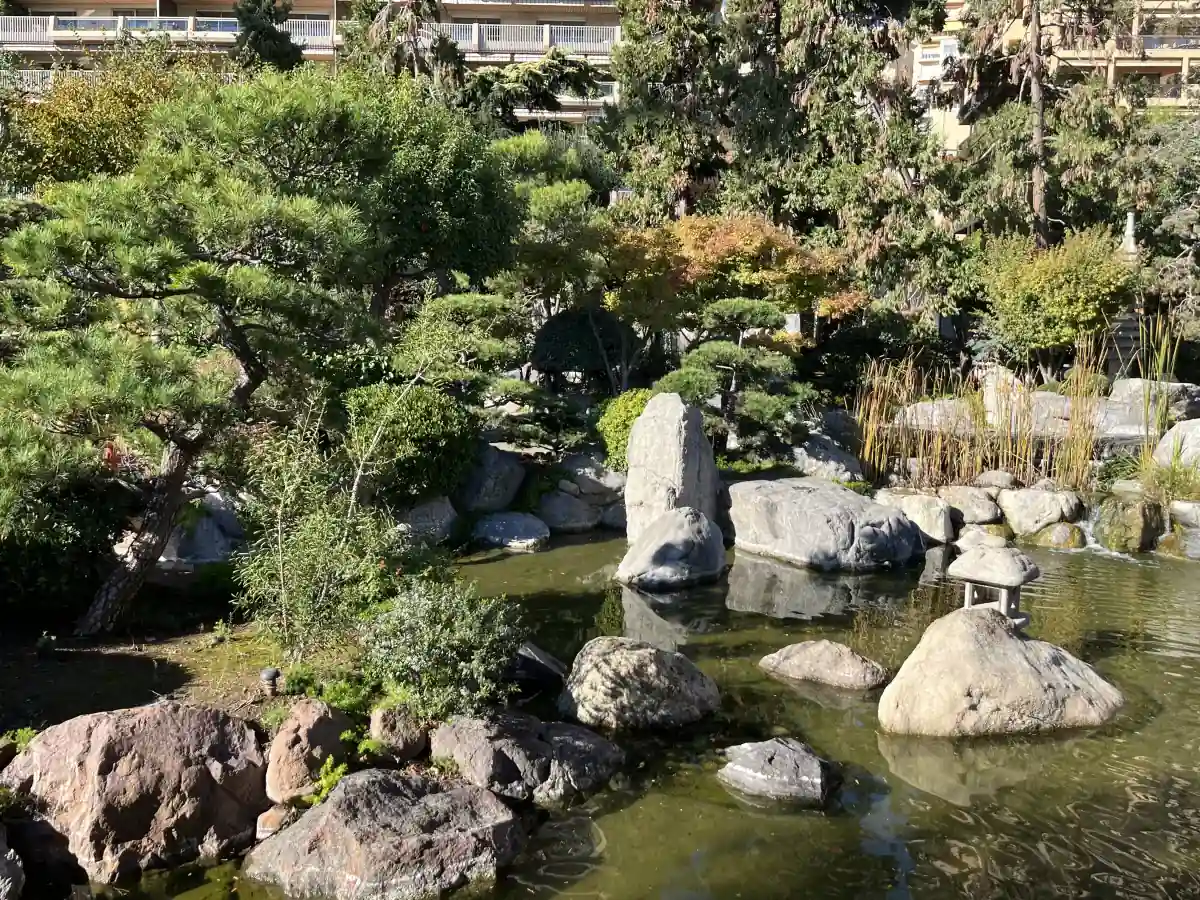
At Larvotto, the Japanese Garden uses a different vocabulary. Its effect does not depend on adding many symbols. Our visit notes record water, stone, a curved route, clipped vegetation, changing views and deliberate gaps. Empty space gives weight to what remains.
_en_novembre_2021_(1).jpg)
What to observe: track the sequence from entrance to pond. Notice how the garden creates an inward-looking place within a heavily built district.
Idea to adapt: a small garden rarely benefits from more ornaments. Choose one gently curved line, one dominant material and one focal point. If you add a pond, solve filtration, child safety and maintenance before its outline. A gravel plane and a carefully placed stone can provide a pause without water.
Use the official Larvotto information to recheck access. The clarity visitors enjoy depends on exacting pruning, water care and continual repair of edges.
3. Saint-Martin Gardens: let shade lead the walk
The Saint-Martin Gardens on the Rock combine Mediterranean canopy, sculpture, sea views and changing levels. Their lesson is sequential: a shaded path prepares an opening to the horizon; planting gives depth to a work of art; a bench turns circulation into observation.
What to observe: look at branch height, the way planting and railings frame the sea, and each transition between mineral ground, shade and full light.
Idea to adapt: if your garden already has a mature tree, design from that resource. Let a path follow useful shade, widen near a seat and open towards a view. Our internal worksheet records disturbed root zones and available moisture; it does not prescribe construction or underplanting work. Established canopy is heritage at domestic scale too.
4. Fontvieille and the Princess Grace Rose Garden: build beneath the bloom
Fontvieille Park and the Princess Grace Rose Garden bring together roses, olives, water and everyday routes. Published numbers of roses and cultivars vary by page and date, so this guide does not freeze a total. The durable lesson is that a seasonal collection stays legible because permanent structure supports it.
What to observe: note what remains when roses are quiet: olive trunks, edging, water, junctions and evergreen mass. Our internal worksheet records working access, pruning, feeding, monitoring and renewal as separate fields; it does not prescribe an intervention.
Idea to adapt: do not design a rose border only for its June peak. Establish winter lines and a maintenance path first. Add flowering groups large enough to read from the main viewpoint, choosing roses for your soil, disease pressure and available care.
Recheck practical information on the official Fontvieille Park and Princess Grace Rose Garden pages.
5. UNESCO Garden: leave room around art
Also in Fontvieille, the UNESCO Garden relates Mediterranean planting and contemporary works to the horizon. When art enters a garden, the challenge is not to fill every space around it, but to provide distance, a quiet background and more than one angle of discovery.
What to observe: compare each work with the route, skyline and plant mass behind it. A calm background can strengthen a form; busy planting can dissolve it.
Idea to adapt: give one pot, stone or sculpture a breathing space. Test its position with a temporary box, view it from the house and the path, then plant. One well-sited focal point is usually stronger than several scattered objects.
We intentionally publish no photograph of this garden. Official images document it, but our audit found no sufficiently explicit reuse licence. Useful information is not permission to reproduce a picture. The official UNESCO Garden page remains available for visit planning.
Two sensible routes, not a five-garden race
For half a day, choose one language of landscape: the Exotic Garden for cliff and dry collections, or the Rock for the shaded Saint-Martin walk. On another visit, Fontvieille offers the clearest sequence between park, rose garden and UNESCO Garden. The Japanese Garden works as a focused Larvotto stop.
Our internal itinerary worksheet records gradients, connections and the number of stops; official access pages remain the practical reference. Remove a stop if it would reduce each garden to a few minutes. Stay on paths, take nothing and respect temporary works.
Five ideas to take home
- On a slope, solve drainage, safety and maintenance access before planting.
- In a small space, repeat a few forms and materials instead of accumulating.
- Under a tree, make shade part of the route and protect the roots.
- Beneath seasonal flowers, build an attractive off-season framework.
- Around a focal point, preserve empty space and check several sightlines.
Principles can travel; plants cannot always. A garden of character grows from a sound relationship between place, use, upkeep and time, not from a prestigious catalogue.
FAQ
Is Monaco’s Exotic Garden open in 2026?
Yes. Monaco’s town hall announced that it reopened to the public on 30 March 2026 after almost six years. Check the garden’s own site before travel for hours, prices, accessibility and cave tours.
Which Monaco gardens are free?
Official visitor pages advertise free access to the Saint-Martin Gardens, Japanese Garden, Fontvieille Park, Princess Grace Rose Garden and UNESCO Garden. The Exotic Garden charges admission. Recheck current conditions before setting out.
Can you visit all these gardens on foot in one day?
The distances look short, but the gradient and time needed to observe make that a poor plan. Choose one area and add a second site only if conditions suit. Fontvieille is the simplest group; the Exotic Garden deserves its own visit.
Can a British garden copy Monaco’s dry planting?
Not plant for plant. Check winter drainage, minimum temperatures, exposure and rain. First translate the layers, gaps and silhouettes; then select plants for your plot, using containers and winter shelter where needed.
To carry those observations into a personal project, our outdoor design collection brings together further ways to compose a garden around its site conditions.
Sources and checks before travel
- Monaco Town Hall — reopening of the Exotic Garden
- Monaco Exotic Garden — prepare your visit
- VisitMonaco — Princess Grace Rose Garden
- VisitMonaco — UNESCO Garden
- VisitMonaco — Fontvieille Park
- Royal Horticultural Society — hardiness ratings
“Written and checked by the Les Jardins d’un Châtelain editorial team”
Editorial status — documentary selection. No ranking, ticket sales, affiliate relationship or claim of personal visits. Visitor facts come from the cited operators; landscape observations are editorial analysis.