Gardens and parks in Cagnes-sur-Mer: four landscapes
The gardens and parks in Cagnes-sur-Mer are useful precisely because they are not one collection. Les Collettes preserves an agricultural landscape around the Renoir Museum; Canebiers Park makes room for the River Cagne inside the town; the Coulée Bleue is a connected green-and-blue framework rather than a single park; and the Loup riverbanks belong to a broader natural corridor.
This is a documentary guide, not a report of personal visits. Official information was checked on 19 July 2026. Seasonal hours, works, weather closures and access rules can change, so use the linked operator pages before travelling.
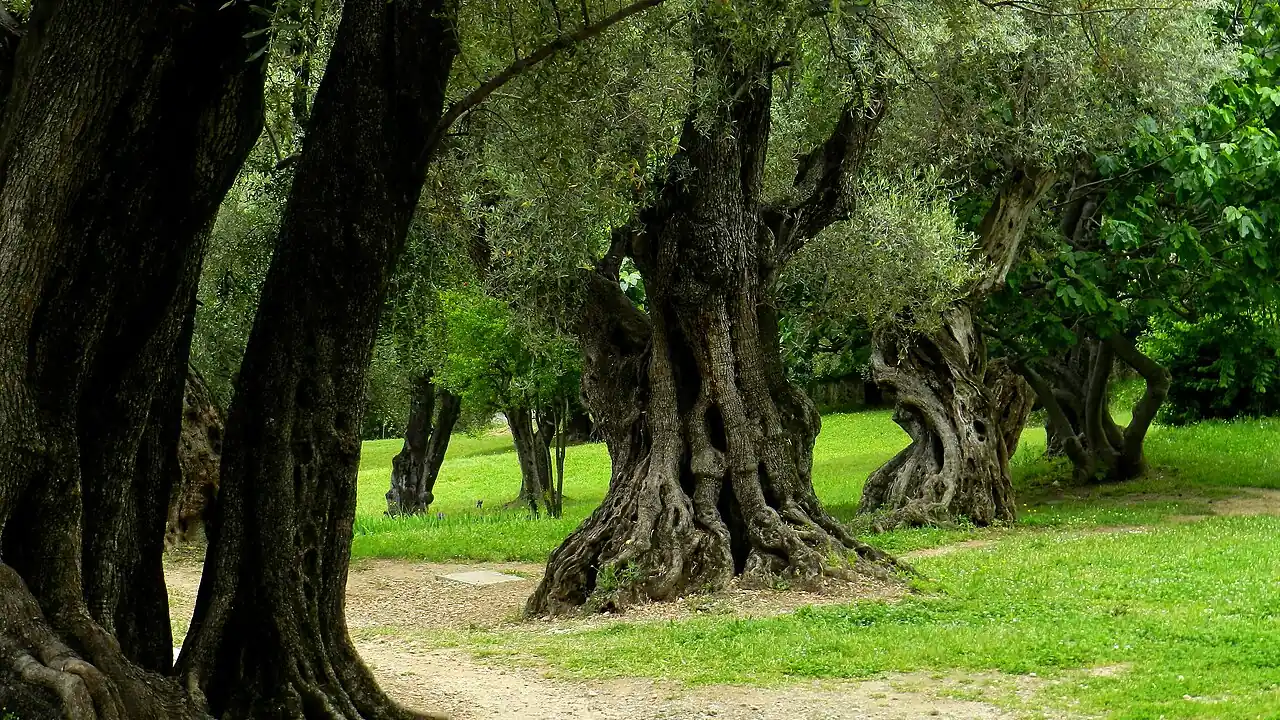
Opening photograph: the old olive trees at Les Collettes by Guerinf, 17 May 2019, licensed CC BY-SA 4.0. The file was cropped to 16:9, resized and converted to WebP. A dated photograph documents the estate; it does not establish its appearance or access in 2026.

Choose by landscape, not by a numbered ranking
| Place | What it is | Look for | Planning point |
|---|---|---|---|
| Les Collettes / Renoir Museum | Museum garden within a former agricultural estate | Old olive trunks, filtered shade, the relation between house and ground | Seasonal garden and museum hours; closed on Tuesdays |
| Canebiers Park | Restored urban river park | River margins, layered planting and areas kept away from footfall | Biodiversity refuges are deliberately not all public |
| Coulée Bleue | A connected framework along the Cagne | Links between parks, paths, shade and permeable ground | Each component retains its own hours and rules |
| Loup riverbanks | Departmental nature park | Woodland edge, riparian vegetation and a less formal river landscape | Check current access with the operator |
The museum estate makes sense as a focused visit. Canebiers and the Coulée Bleue can be read together as urban planning. The Loup is a different outing: do not reduce it to a decorative garden.
Use the Chatelain Method
The Chatelain Method — Observe → Diagnose → Correct → Prevent turns a visit into a design decision.
- Observe mature trees, water movement, desire lines and quiet areas before recording individual plants.
- Diagnose the constraint being addressed: heat, flooding, fragmented habitat, shade or heavy use.
- Correct at your own scale with a canopy, planted edge, swale or linked border.
- Prevent false equivalence: the editorial record keeps “ground condition”, “service route” and “water dependency” separate so a Riviera scene is not treated as a planting specification.
Riviera growth is not evidence of British hardiness. This article transfers only spatial structure; it makes no UK planting recommendation from the species seen at Cagnes-sur-Mer.
Les Collettes: read the grove before the paintings
The Renoir Museum’s official visitor page describes the artist’s final home within an estate of olives and citrus. The city’s more detailed practical information gives seasonal hours and notes the garden’s wider ecological setting, including its LPO refuge status and a recreated kitchen garden.
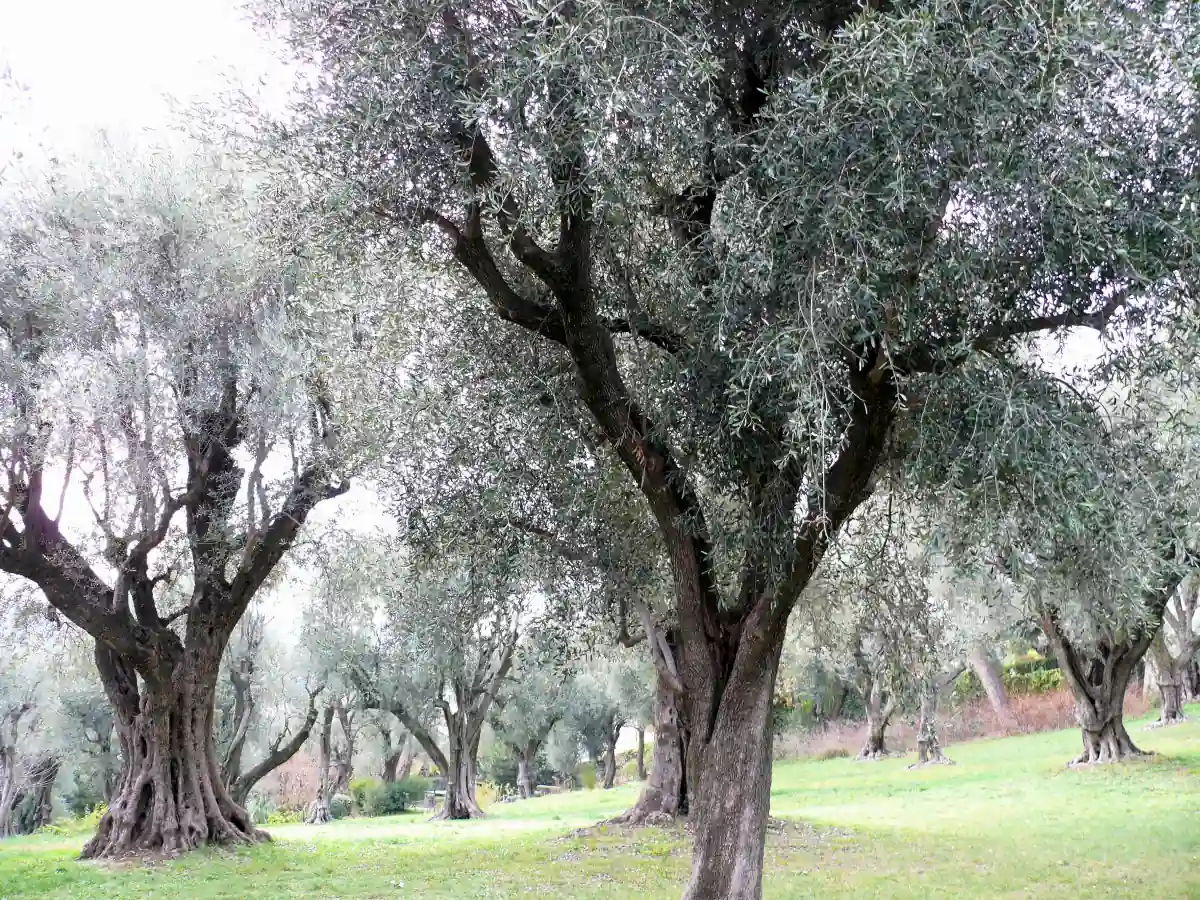

The important composition is loose rather than ornamental. Irregular trunks establish rhythm; gaps preserve light and a view of the house; the ground remains legible as part of an old productive site. Dense decorative underplanting would tell a different story.
Limit of the lesson: the grove supports a compositional reading — established trunks, a discontinuous canopy and visible ground — but not root-zone, soil-level or irrigation advice. Work around a mature tree requires a site-specific arboricultural assessment.
Museum and garden hours change with the season, and the stated weekly closure is Tuesday. Road works may affect the approach. Recheck both official pages rather than relying on an old itinerary.
Canebiers: public access has ecological limits
The town’s Canebiers restoration page lists substantial new planting, paths and areas beside the Cagne. Its most useful design fact is not a total, however. Some biodiversity zones are not open to the public.
That boundary prevents “nature” from becoming only a surface for recreation. Watch how the public path approaches the river in places and withdraws in others. Notice whether low planting, shrubs and tree canopy make a gradual edge rather than an abrupt fence.
At home: reserve one genuinely undisturbed strip. It might sit behind a hedge, beside a pond or against a boundary without night lighting. Connect it to other planting and leave it in place. A pile of habitat material moved whenever the garden is tidied cannot provide the same continuity.
The maintenance team matters here. More layers mean more knowledge: paths must remain usable, young trees need establishment care, litter cannot be allowed into the river and refuges must not be simplified merely because a short-mown surface looks tidier.
Coulée Bleue: connection can matter more than size
Cagnes-sur-Mer’s official parks overview presents the Coulée Bleue as a long-term framework around the River Cagne and several public spaces. A connected line of soil, shade and planting can do work that isolated pocket parks cannot.
For a small garden, the equivalent is not a miniature municipal masterplan. It is a continuous hedge, a repeated ground layer or a permeable edge linking the front and rear plots. Three disconnected “wildlife corners” can be less coherent than one modest but unbroken route.
Avoid solving visual connection with a fully sealed path. A hard strip may improve circulation while worsening runoff and soil fragmentation. Set the path width from real use, then keep infiltration and root space beside it.
“Coulée Bleue” does not mean every associated park is open continuously. Follow the published hours for the particular space you intend to use.
The Loup riverbanks: learn from an edge, not a plant list
The Alpes-Maritimes departmental park guide places the Loup within a larger natural landscape. River, damp ground, scrub and tree cover form a sequence rather than a neat garden border.
Study the change of density as a spatial sequence. The visitor source does not establish a domestic rain-garden palette or hydroperiod, so this article draws no planting prescription from it.
Stay on the designated routes, take nothing and accept temporary restrictions after bad weather. The living river and public safety take priority over completing an itinerary.
Four ideas to take back to a UK garden
- Our internal base map uses separate layers for existing trees, drainage and worn routes; it is a documentation tool, not a bed plan.
- Give one habitat area a stable position and connect it to other cover.
- Repeat one layer of planting to link separate areas rather than adding more features.
- Build a graded edge from path to low planting, shrub and canopy where space permits.
The transferable idea is the relationship between soil, winter moisture, wind and care. The label “Mediterranean” is not used here as a plant specification.
Frequently asked questions
When is the Renoir Museum garden open?
The city publishes seasonal hours for the museum and garden and states a Tuesday closure, plus certain public holidays. Check the official practical page because times and the approach can change.
Is all of Canebiers Park open to visitors?
No. The municipal scheme explicitly includes biodiversity reserve areas that are not public. Respecting that boundary is part of visiting a restored river park.
Is the Coulée Bleue one park with one set of hours?
No. It is a connected landscape framework involving several spaces around the Cagne. Each place keeps its own hours and rules.
What can a British gardener copy from Cagnes-sur-Mer?
Copy the relationships: protect an existing canopy, link planted areas, keep a quiet refuge and shape a gradual river or pond edge. Check hardiness and winter drainage before selecting species.
For the next step from observation to a workable plan, see our outdoor design guides.
Official sources
- Cagnes-sur-Mer Tourism — Renoir Museum
- Town of Cagnes-sur-Mer — Renoir Museum practical information
- Town of Cagnes-sur-Mer — parks and protected spaces
- Town of Cagnes-sur-Mer — Canebiers restoration
- Alpes-Maritimes Department — Loup riverbanks park
- RHS — hardiness ratings
French operator pages are retained where no equivalent complete English page was available; they are the primary evidence for current management and access.
Written and checked by the editorial team of Les Jardins d’un Châtelain.
Editorial status — documentary selection. This guide uses official operator information and makes no claim of a personal test visit. It contains no ranking, ticket sale or commercial partnership.