Gardens and coastal walk in Cap-d’Ail: a modular route
Cap-d’Ail makes more sense as a sequence than as an attractions list. The Château des Terrasses frames the sea from a villa garden, Sacha-Guitry Park uses canopy and thresholds around Belle Époque architecture, the Douaniers Garden concentrates Mediterranean planting, and the coastal path reveals the rock, salt and exposure behind those designed landscapes.
This documentary guide is not an account of a personal visit. Official information was rechecked on 26 July 2026. Sea state and works can alter which coastal section is usable; confirm it on the day.
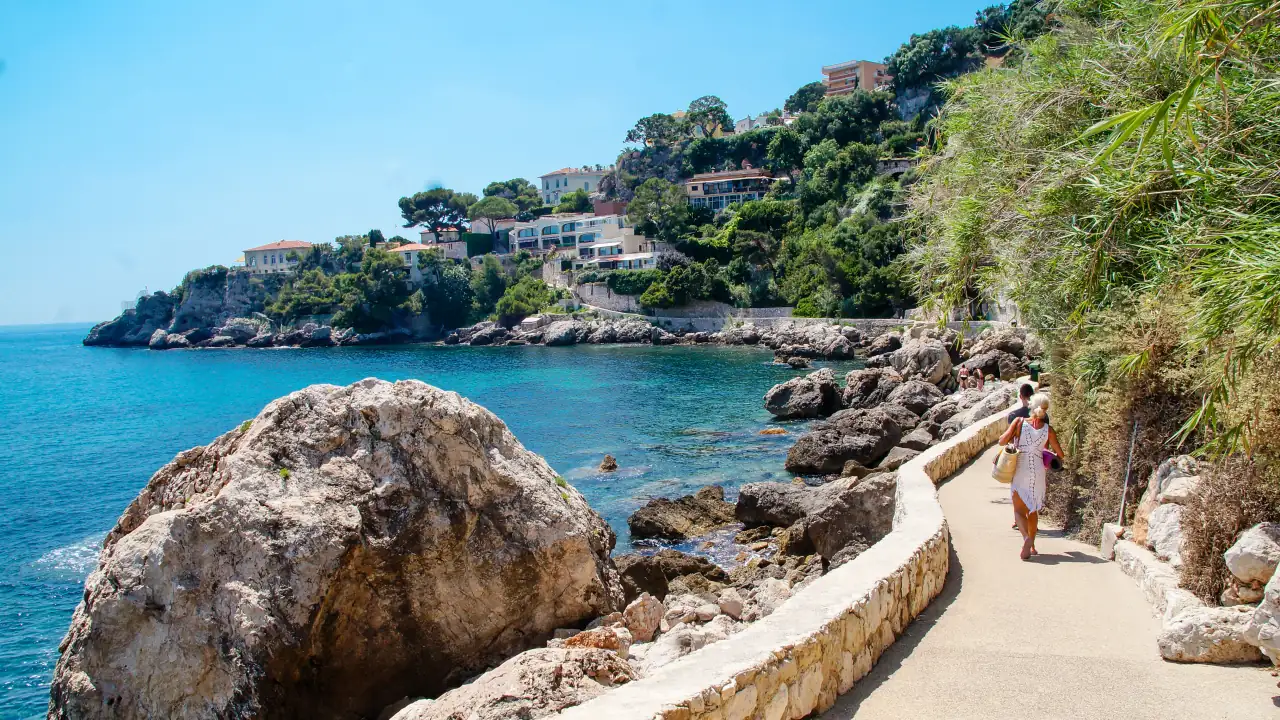
Opening photograph: the coastal path by the Cap-d’Ail Information Office, 9 August 2017, licensed CC BY-SA 4.0. Cropped to 16:9, resized and converted to WebP. It documents the coast in 2017 and does not prove that the path is open in 2026.

Build a route that still works if the coast closes
| Module | Official description | Design question | Check before going |
|---|---|---|---|
| Château des Terrasses park | Free public park, advertised open daily | How does planting frame a distant view? | Event or temporary works |
| Sacha-Guitry Park | Free public park, advertised open daily | How do thresholds connect villa, town and garden? | Current use around the building |
| Douaniers Garden | Free Mediterranean public garden | How can a short plant vocabulary stay legible? | Current access and hours |
| Coastal path | Link between Marquet and Mala | What can be observed in the rock, route and low coastal vegetation? | Sea conditions, orders, stairs and open segment |
The first three remain a coherent garden study without the path. Never step around a barrier to complete an itinerary.
Why this guide does not give one definitive path length
The official pages do not use a single measurement. The official 2025-2026 practical guide publishes a route length of 3.60 km. The official English coastal-path overview publishes 2.5 km. Published descriptions of the partially accessible section also vary.
Those figures may count different limits or sections. Ask what is actually open and suitable for your party rather than planning around false precision. A level pavement to a viewpoint is not evidence that the complete route is step-free.
Read Cap-d’Ail with the Chatelain Method
The Chatelain Method — Observe → Diagnose → Correct → Prevent keeps the lesson practical.
- Observe view direction, useful shade, wind exposure and how boundaries filter the scene.
- Diagnose which forms appear beside a slope, rock or villa, without inferring why they were chosen.
- Correct your own garden with one framed view, transition or repeated layer.
- Prevent overgeneralisation by recording maintenance access, water context and local winter conditions as separate questions. The visit does not size or resolve them.
Riviera planting is not a British hardiness catalogue. The RHS hardiness scale supplies temperature terminology; it does not turn this visit into a species recommendation.
Château des Terrasses: a view needs a foreground
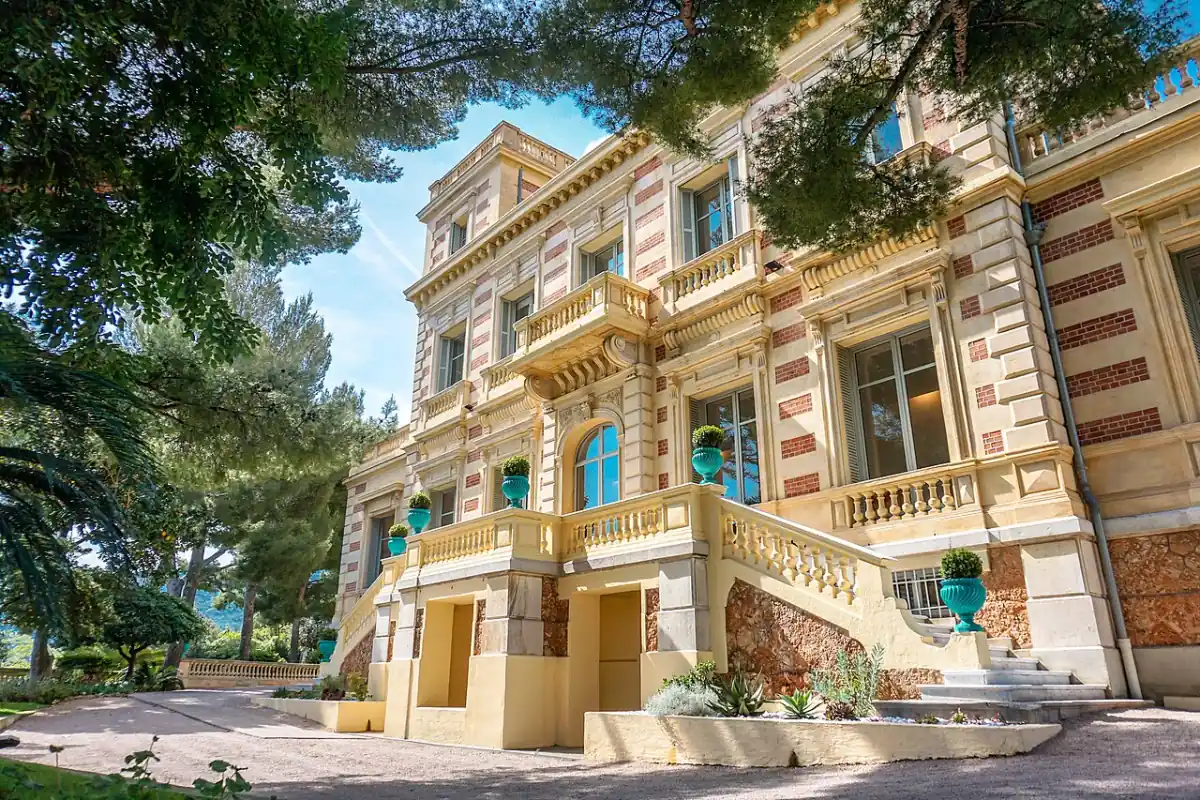
The official page for Château des Terrasses park advertises free, daily access. Around the villa, terraces and vegetation do not merely leave the sea visible: they create foreground, side screens and moments of reveal.
.jpg)
Turn away from the panorama and identify what frames it. A dark tree mass, a wall edge or the lip of a terrace can give depth to open water. A completely exposed boundary often makes the scene feel flatter.
At home: choose one borrowed view — a mature tree, roofline or evening sky — and narrow the side vision with planting or a pergola. Check the view from a seat and from indoors before building. One deliberate opening is more convincing than a boundary stripped bare.
The photograph records visible composition around a historic villa; it does not document the park’s maintenance conditions.
Sacha-Guitry Park: make the approach part of the garden
The official Sacha-Guitry page also advertises free, daily access. Its useful lesson lies in thresholds: town to canopy, canopy to villa, villa to view.
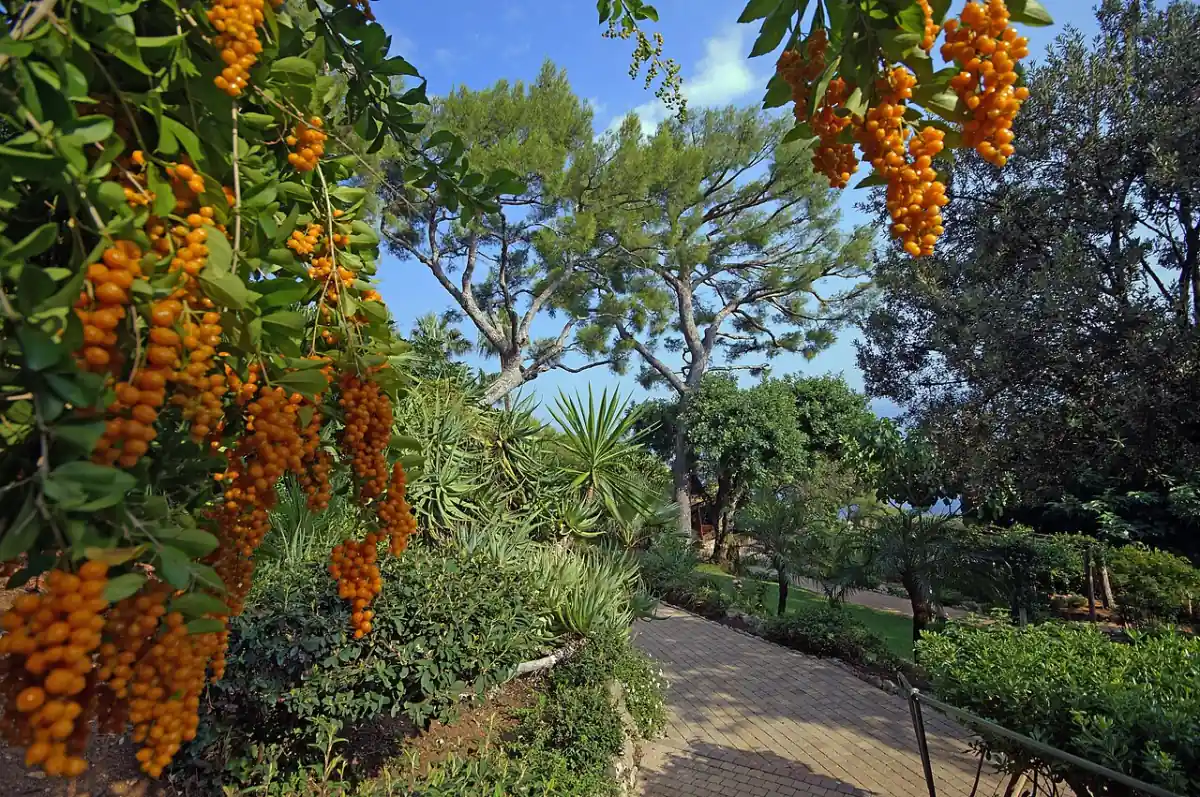

Notice how path width and enclosure alter near the building. A shaded pause can make the final reveal more effective than a straight, fully exposed approach.
At home: give the route from gate to door a purpose. A low hedge or small tree can briefly screen the entrance, then reveal it. Our internal circulation sketch records bags, bins, tools and thorny masses on separate layers; it is a documentary diagram rather than a specification.
Douaniers Garden: a collection needs a framework
The official description of the Douaniers Garden presents citrus and Mediterranean planting in a public garden opened in 2014. The reported number of introduced varieties signals a collection, but it is not the reason the design is useful.
Look for repeated leaf masses and a limited number of silhouettes. In this carnet, they remain compositional observations; the visit does not establish why the collection was grouped or maintained in this way.
At home: select three shape families — perhaps an evergreen mass, a vertical accent and low cover — and repeat them. Substitute locally suitable plants. For a potted citrus, our internal worksheet separates the intended shape, container constraints and site context; it remains a documentary aid, not a technical specification inferred from the visit.
No Douaniers photograph appears here because the audit found no documentary file with sufficiently clear reuse terms. A photograph from another Cap-d’Ail park would mislabel the place.
Compare the coastal path without treating it as a garden
The path is not a heritage garden. If open, observe it as a separate coastal landscape, not as proof of why nearby gardens were designed in a particular way.
Observe where plants occupy cracks, where the route turns around folded ground and where bare surfaces persist. Stay on the route and do not collect material.
Limit of the comparison: the path lets you compare exposed edges, sheltered folds and different boundary forms. This is a visual comparison, not a technical study of a private site.
Three sensible versions of the day
- Villa parks only: Terrasses, Sacha-Guitry and Douaniers when the sea route is closed or steps are unsuitable.
- Parks plus a confirmed short coast section: use only the part officially open and appropriate to the group.
- Longer sequence: only after checking conditions, footwear, return route and heat.
Carry water and sun protection, and turn back at barriers or rough sea. A shorter, attentive route provides more garden insight than a rushed completion.
Frequently asked questions
Is the Cap-d’Ail coastal path open?
Its usable section can change with waves or works. Check the town or official tourism information on the day; an undated article cannot guarantee access.
How long is the Cap-d’Ail coastal path?
The official 2025-2026 practical guide publishes a route length of 3.60 km. The official English coastal-path overview publishes 2.5 km. The official corpus therefore does not provide one consistent measurement; plan from the segment actually open.
Are the villa parks free?
Official pages currently advertise free access to Château des Terrasses, Sacha-Guitry Park and the Douaniers Garden. Events or works may still change the arrangement.
What is the easiest idea to borrow?
Frame one view, improve the gate-to-door transition and repeat a small number of plant shapes. Those are compositional ideas; species choice is not inferred from a Riviera visit.
To turn those observations into a site-specific plan, continue with our outdoor design guides.
Official sources
- Official Cap-d’Ail trails and gardens hub
- Château des Terrasses park
- Sacha-Guitry Park
- Douaniers Garden
- Cap-d’Ail coastal path
- Official coastal paths overview
- RHS hardiness ratings
Written and checked by the editorial team of Les Jardins d’un Châtelain.
Editorial status — documentary selection. Official operator information is cited and conflicting measurements remain visible. No personal test visit, ranking, ticket sale or commercial partnership is claimed.