Fire Pit and Outdoor Fireplace: Landscape Design and Safety
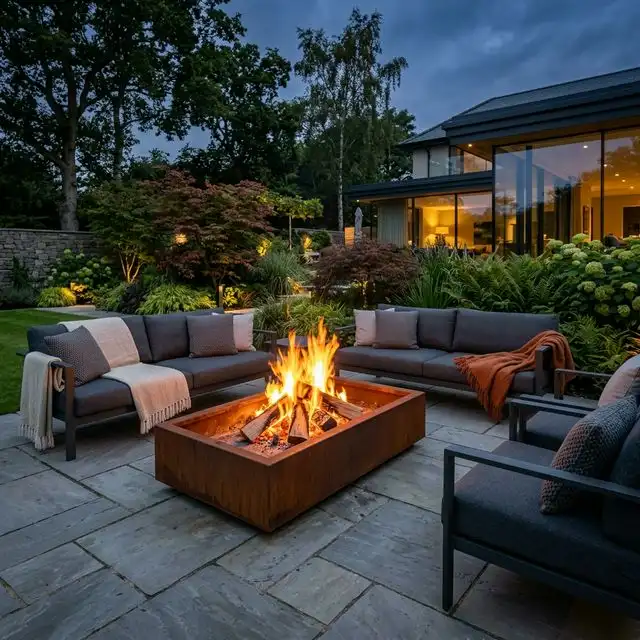
An outdoor fire — whether a portable fire pit or a built fireplace — genuinely transforms how a garden gets used after dark, but it demands real discipline around materials and fire safety. The single most important rule: keep at least 3 metres between the flame and anything combustible — a wooden fence, a shed, the house itself, or an overhanging tree canopy.
The Chatelain Method for an outdoor fire
You observe what surrounds the spot — decking, hedges, overhanging branches; you diagnose the real clearance needed in every direction; you correct with a non-combustible base and safe distances; you prevent disaster by never leaving a fire unattended.
Fire pit or garden fireplace: steel, cast iron or masonry?
A cheap pressed-steel bowl rusts through after a single wet season, which is why the better options are more durable: Corten steel self-patinates into a stable, weather-resistant surface, while cast iron is heavier and holds its heat for longer after the fire dies down, giving it real stability against wind. A built masonry fireplace is a permanent structure — it needs a properly sized flue, or smoke will blow back over guests in any wind, and its core must be built in fire-rated brick, ideally by a professional installer.
Safety distances that actually matter
| From | Minimum distance | Why |
|---|---|---|
| House, shed, fence, hedge | 3m in every direction | Radiant heat and sparks can ignite combustible structures |
| Overhanging tree canopy | 3m vertical clearance minimum | Rising heat can scorch and kill foliage, or ignite dry branches |
| Seating | 1.5m « no-go zone » | Radiant heat and spark range |
| Any decking (wood or composite) | Never placed directly on it | A fire pit base can reach very high temperatures, enough to scorch timber or melt composite in under an hour |
The Chatelain note. The most dangerous mistake is setting a metal fire pit straight onto a wood or composite deck. Always use a non-combustible base — a paving slab, a fire-resistant mat, or a dedicated gravel zone — underneath. Use a mesh spark screen, and allow 45-60 minutes for full cool-down before leaving it unattended or covering it.
Local rules and smoke
Check your council’s rules before installing a permanent fireplace or burning regularly, particularly if you live in a smoke control area — burning unauthorised fuels there can carry a fine. Consider wind direction and your neighbours: never site a fire pit where smoke will regularly drift into their garden.
FAQ
How far should a fire pit be from the house or a fence?
At least 3 metres in every direction from any combustible structure, and 3 metres of vertical clearance from any tree canopy above.
Can I put a fire pit on my decking?
No, never directly. Always use a non-combustible base (paving, a fire mat, gravel) between the fire pit and any wood or composite surface.
How long does a fire pit take to cool down safely?
Allow 45-60 minutes after the flames die down before it’s safe to leave unattended or move.