Dry-Stone Wall: Structure the Garden With Elegance
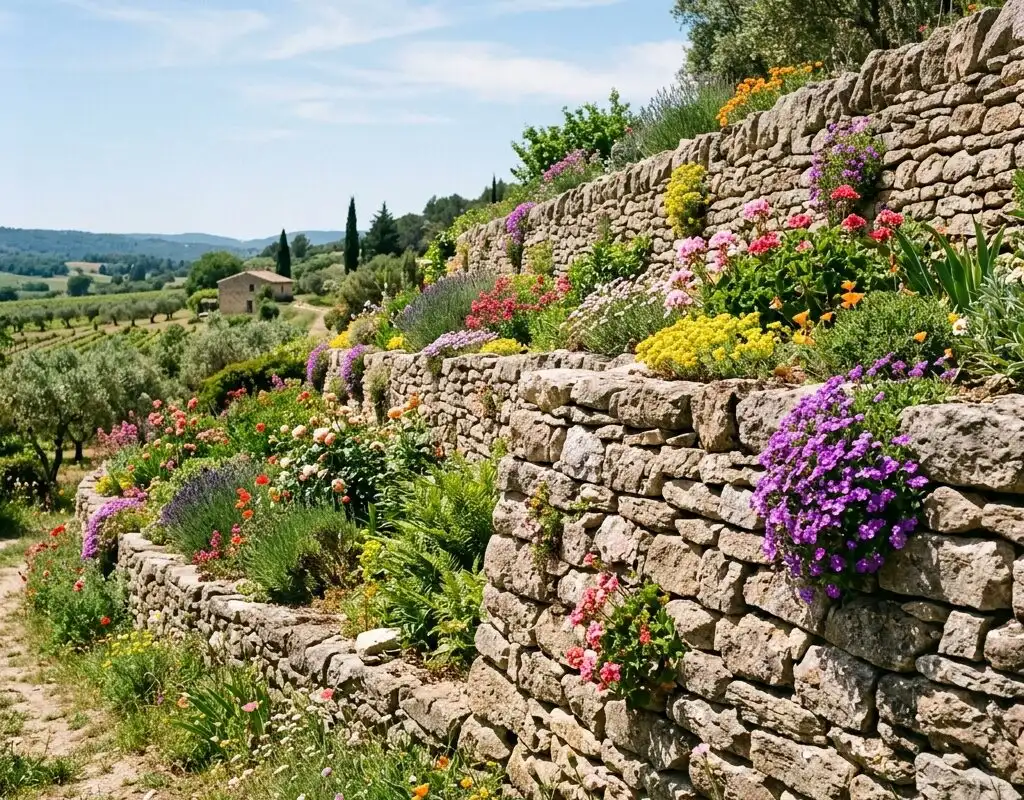
A dry-stone wall is built without mortar: stability comes from how the stones interlock, a slight batter (leaning back into the slope) and natural drainage. Beautiful, durable and a haven for wildlife, it’s the most elegant way to structure a sloped garden. Here’s the step-by-step method.
The Chatelain Method for dry-stone walling
You observe the slope and soil type; you diagnose a sensible height and the volume of stone needed; you correct with a solid base and the right batter; you prevent collapse through drainage and bonding stones. Dry stone breathes — that’s its strength.
The principles of a stable wall
- Foundation: a trench, a bed of draining stones, wide base stones.
- The batter: lean the face slightly into the bank (roughly 10-15%) so it bears against the earth.
- Wedging: every stone rests on two others, wedged with smaller chips.
- Through-stones: long stones laid crosswise, tying the face to the back.
- Drainage: a backfill of loose stone behind the wall clears water — the number one enemy.
- Capping: flat or upright stones crown and lock the top.
Step by step
| Step | Action | Watch out for |
|---|---|---|
| 1. Trench | Dig the base onto stable ground | Below the topsoil |
| 2. Draining bed | Crushed stone rubble | Essential at the base |
| 3. First course | Large stones, flat faces up | The base makes the wall |
| 4. Building up | Stagger joints, wedge, place through-stones | Never align joints |
| 5. Backfill | Stone rubble + drainage | Clear water from the bank |
| 6. Capping | Coping stones | Locks the whole structure |
The Chatelain note. Beyond about 1m in height, or for a genuine retaining wall, bring in a professional dry-stone waller: the craft is inscribed on UNESCO’s Intangible Cultural Heritage list — it’s real skilled knowledge, not just stacking stones.
Integrating it into the garden
The wall pairs naturally with paths, is highlighted with grazing light, and hosts rockery plants in its crevices.
FAQ
Does a dry-stone wall hold without cement?
Yes: cohesion comes from the layout, the batter and the weight of the stones. Well built, a dry-stone wall lasts decades, even centuries.
What’s the maximum height for a DIY dry-stone wall?
Stay reasonably under 1m for a self-build. Beyond that, especially for retaining, bring in a professional.
Why does drainage matter so much?
Water building up behind the wall pushes the stones out. A rubble backfill clears that pressure — it’s the key to longevity.
Is dry stone good for wildlife?
Very much so: its gaps shelter insects, lizards and small wildlife, and host rockery flora. It’s a living wall.