Côte d’Azur Gardens: Design Lessons for Your Own Garden
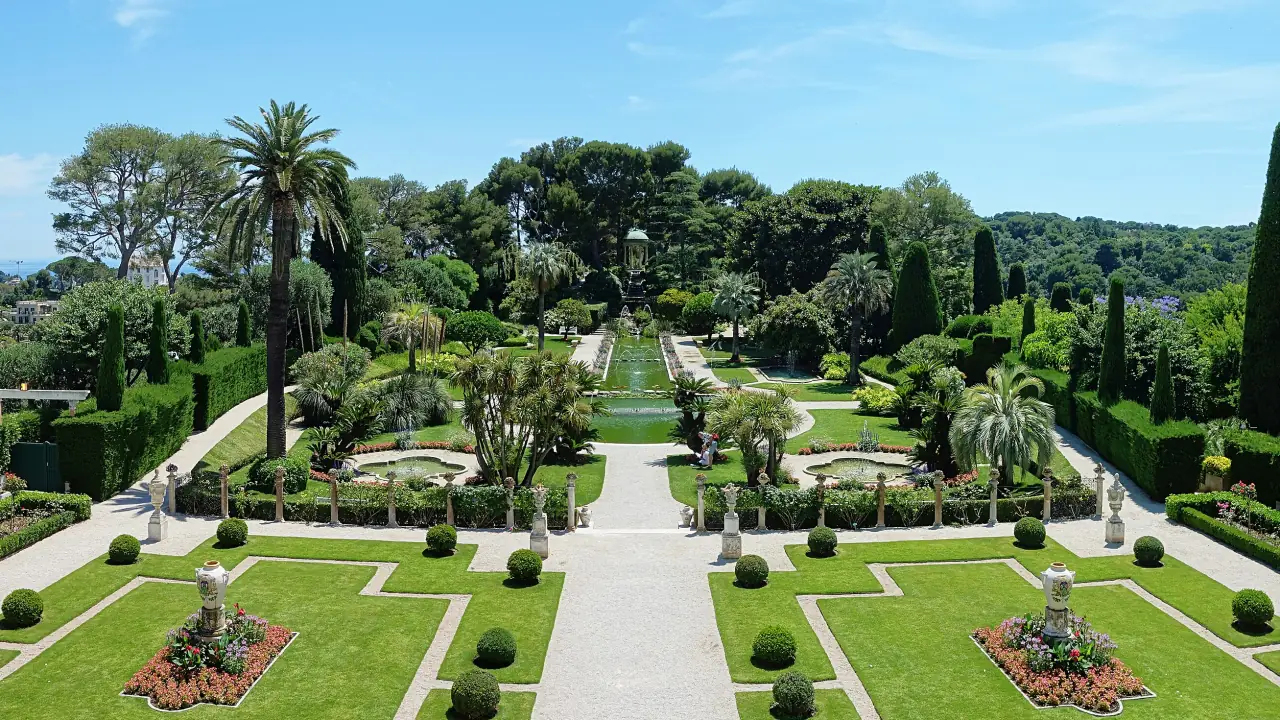
The remarkable gardens of the Côte d’Azur share something most guides never mention: almost none of them are flat. Èze is a staircase, Monaco clings to a cliff, Ephrussi crowns a peninsula, Beaulieu and Cap-d’Ail slope down to the sea. These are gardens of slope, built by people who solved the same problem we face: how to grow something beautiful on ground that refuses to be level.
We have walked through them ourselves, not as sightseers but with a practitioner’s question in mind: what transfers to a domain that is actually worked, and what belongs permanently to the visitor’s garden? This notebook gathers what we kept, what we set aside, and where to go and see each thing for yourself.
The slope is the real subject
A sloped garden is not a flat garden tilted. Water runs instead of soaking in, soil migrates downhill, sun exposure changes every twenty metres, and upkeep costs physical effort. Every interesting answer on the Riviera circles back to this one problem.
The historic response is the restanque, the dry-stone retaining wall that turns a continuous slope into a series of cultivable terraces. It holds the soil, slows the water, creates a microclimate against sun-warmed stone, and makes the work possible at all. We ourselves grow on restanques, and walking these gardens is what made us understand how completely this structure governs everything else.
The second lesson is that a slope is not fought, it is read. A dry, mineral south face does not call for the same planting as a cooler north-facing reverse. The Èze Exotic Garden demonstrates this over a few dozen metres of elevation change, its flora shifting with orientation alone.
What we kept, and what we deliberately left out
These visits mainly served to sharpen our own criteria. Three things came up often enough to become house rules.
Slope management comes before anything else. Before choosing a plant, decide where the water goes, where the soil stops, and how people move through. The gardens that hold up over time are the ones where structure was decided first; the ones built as a plant collection eventually turn into clutter.
Species that are both acclimatable and ornamental. Much garden writing treats these as opposites, as if you had to choose between a sober garden and a beautiful one. These gardens prove otherwise: a plant suited to limestone, summer drought and wind can be a genuinely handsome plant. The compromise is not necessary, only slower to find.
And one thing we deliberately rejected: wide visitor paths. They work beautifully at Ephrussi or Parc Phoenix, and rightly so, since those places receive thousands of visitors. On a working holding, a wide path takes up considerable ground for a need that does not exist. We do not have that footfall, so we do not have that path.
That is the reading principle that lets you reuse these gardens without copying them: a garden built to be walked through and a garden built to be worked are not the same, even on identical terrain. Visitor circulation is sized for a crowd; ours is sized for a wheelbarrow.
The constraint these gardens never show you
There is a reality of terrace cultivation that no visit reveals, because it happens outside opening hours: everything that goes up or down has to be carried.
Plants, tools, compost, containers: on narrow terraces linked by steps or short ramps, every movement costs time and effort. It is the single most structuring constraint on the holding, and it shapes the design itself. You do not plant what you cannot service. You do not plan a heavy-feeding bed where every bag has to be carried up by hand.
This constraint explains several choices that would otherwise look arbitrary. Water arrives through a drip line rather than a watering can. Young plants are raised on site rather than bought and hauled up. Light equipment is preferred to powerful equipment, because a tool you can carry by hand across a narrow terrace beats an engine you cannot bring up at all.
A visitor garden has staff, a service access and usually a budget. A working holding has its own two arms. That is the most useful difference to keep in mind while standing in front of an admirable garden.
Nine places, and what each one teaches
Èze: reading a slope instead of correcting it
The Exotic Garden sits atop the village, on a steep drop. Its interest lies in refusing to flatten the site into uniformity: the south face is dry and mineral, planted with cacti and succulents, while cooler exposures host different flora entirely. It is the clearest accessible demonstration that a single garden can hold several microclimates, provided each is treated on its own terms. See the official Jardin remarquable listing.
Saint-Jean-Cap-Ferrat: one axis, then successive rooms
The Villa Ephrussi de Rothschild gathers several distinct garden styles around a central composition. The lesson is not to imitate the collection, well beyond a private garden’s reach, but to notice the method: one strong central axis, then rooms opening off it, each announced by a threshold. Translated home, that means one committed line of sight rather than three competing axes. The official garden plan shows this organisation clearly.
Monaco: building with the cliff
Monaco’s Exotic Garden is fixed to a rock face. It shows what can be made of ground nobody would otherwise consider cultivable, and the structural role of the rock itself, which stores heat and shelters roots. For a dry, sloped garden it is a direct reference. See Preparing your visit.
Menton: microclimate as a resource
Menton concentrates several botanical gardens, including Val Rahmeh, managed by France’s National Museum of Natural History, and Serre de la Madone. Their richness comes from the town’s sheltered microclimate, which allows species impossible a few kilometres away. The lesson is twofold: a microclimate can be identified and used, but it cannot be transported. See Val Rahmeh (MNHN) and Serre de la Madone.
Beaulieu-sur-Mer: structure before species
Villa Kérylos offers a garden built around architecture, with a restrained, coherent plant palette. It shows what a garden gains by limiting its own vocabulary. The town also maintains an Olivaie garden where the olive tree carries local memory as much as ornament. See Villa Kérylos and the gardens of Beaulieu.
Villefranche-sur-Mer: framing before decorating
The Citadel gardens use existing stonework as a frame. The garden does not sit beside the monument, it occupies its gaps. A useful reminder for anyone with a wall, a ruin or an old terrace: existing structure is a compositional asset, not an obstacle to hide. See the Citadel.
Cagnes-sur-Mer: a working garden that became a visitor garden
The Collettes estate, around the Renoir museum, keeps old gnarled olive trees and the character of a cultivated property rather than a designed park. It is probably the closest thing here to a real working holding, with trees that carry an age and a function before a decorative role. Practical information on the town’s website.
Cap-d’Ail: landscape as an extension of the garden
The Château des Terrasses park opens onto the coastline. The composition does not stop at the property line, it absorbs the view. At home, this means deciding what you frame and what you screen, rather than treating the boundary as an ending. See the official listing.
Nice: several worlds, one thread
Parc Phoenix brings together very different habitats on one site, and the Botanical Garden organises its collections by habitat rather than by colour. This logic is directly reusable: group plants by genuine need, exposure and water, before thinking about visual harmony. See Parc Phoenix and the Botanical Garden.
Choosing species: acclimatable and ornamental
What the plantings that hold up in these gardens have in common is simple: they belong there. On the Mediterranean coast, that means tolerating a dry summer, often calcareous soil, and salt-laden wind, without permanent rescue watering.
Lime deserves particular attention, since it governs iron uptake and causes lime-induced chlorosis in species not suited to it. A plant magnificent on acid soil can turn durably yellow a few kilometres away. That is the first question to settle before any purchase, decided by a soil analysis rather than trial and error.
Our own criterion is therefore double, and non-negotiable: the plant must hold up under real local conditions, and it must earn its place ornamentally. Give up on either half and you get a garden that suffers or a garden that bores.
A UK reader’s limit
Nothing here should be read as a hardiness promise for a British garden. Winter wet can matter as much as minimum temperature, and a plant thriving on a dry Riviera cliff may rot through a wet UK winter long before frost becomes the issue. Check each species against a recognised hardiness rating before assuming a Mediterranean success will repeat at home. Where a plant is unsuitable, the more reliable transfer is its role in the composition, an upright accent, a silver mound, an evergreen rosette, filled by a genuinely hardy substitute.
Planning a visit that actually feeds your own garden
These gardens are alive and their access conditions change. Seasonal hours, closures for works, coastal paths interrupted after weather events: none of it stays fixed in an article. Always check the operator’s official page on the day you travel, which is also why we publish no price or timetable here.
A few working habits, so the visit actually serves your own garden:
- Choose one or two places, not five. A garden read slowly teaches more than four rushed through.
- Photograph the transitions rather than the beds: thresholds, changes of level, the join between stone and planting. That is where the craft sits.
- Notice what is maintained, and at what cost. An immaculate edge implies a regular pass you will have to keep up yourself.
- Note one applicable idea per visit. Rarely can more than that actually be implemented.
- On coastal paths and hilltop parks, respect closures tied to fire risk and weather.
Frequently asked questions
Can a dry Riviera garden be recreated inland or further north?
Partly. Structure, drainage and grouping by habitat transfer well. The most frost-tender species do not, since even a short distance inland changes winter minimums, and the UK climate changes them further still.
Do you need dry-stone terraces on every sloped plot?
Not necessarily, but you must solve the same problem: hold the soil and slow the water. A terrace does this durably. Other answers exist, from a planted bank to a level hedge, with varying durability.
What is the most common mistake in front of these gardens?
Trying to copy the image rather than the method. These places have maintenance resources a private garden does not. What transfers is the reasoning, rarely the result.
Are these gardens accessible with limited mobility?
It varies a great deal, and the slope is often steep. Several sites offer partial adapted routes. The operator’s official page is the only reliable source on this point.
Official sources
- French Ministry of Culture, Jardin remarquable label, Èze
- Villa Ephrussi de Rothschild, garden plan
- Monaco Exotic Garden
- MNHN, Val Rahmeh botanical garden, Menton
- Serre de la Madone, Menton
- Villa Kérylos, Beaulieu-sur-Mer
- Beaulieu-sur-Mer tourist office, gardens
- Villefranche-sur-Mer Citadel
- Cagnes-sur-Mer, Renoir museum
- Château des Terrasses park, Cap-d’Ail
- City of Nice, Parc Phoenix
- City of Nice, Botanical Garden
- Garden Ninja, UK plant hardiness ratings explained
Opening photograph: the formal French garden of the Villa Ephrussi de Rothschild, by Velvet, 15 juin 2018, under CC BY-SA 4.0. Image cropped to 16:9, resized to 1,280 × 720 px and converted to WebP; the derivative remains under the same licence. This dated view documents the site, not its condition in 2026.
