Stop Wild Boar Damaging a Garden: When Electric Fencing Makes Sense
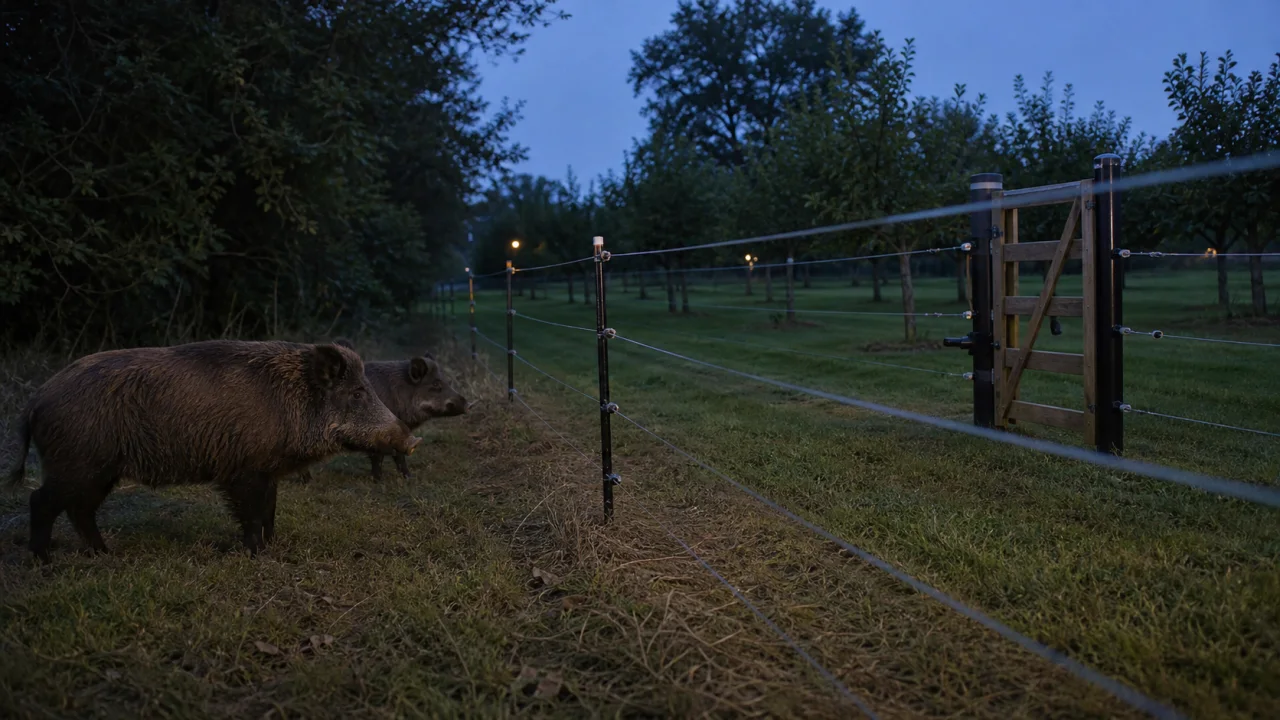
For a defined vulnerable area — a young orchard, kitchen garden, restored lawn or valuable border — a properly designed electric fence will often offer the most practical balance of initial cost, speed and deterrence. It is not a powered string around a field. It is a complete system: closed route, low conductors suitable for pigs, compliant energiser, effective earthing, controlled vegetation, secure gateways and frequent checks.
The estate has experienced real boar damage, but no photographs or mapped entry points were available. This guide therefore does not promise a universal layout or boar-proof garden. Start by documenting the damage and protecting the part of the garden-care system that justifies a maintained boundary.
If an animal is present, do not corner it or approach a sow with young. Take people and pets inside, leave an escape route and call the police if there is an immediate danger to the public. Shooting, poisoning, snaring or improvised capture is outside domestic garden management and may be unlawful.
Compare exclusion with attractant control and short-term deterrence
Forestry Commission guidance treats permanent, temporary and electric fencing as distinct access-management tools for pigs and wild boar. Electric fencing requires more maintenance than many physical fences, but it is comparatively easy to assemble, move and reuse. That makes it attractive around a limited crop or landscape feature, not automatically around every boundary.
| Option | Main strength | Decisive weakness | Appropriate use |
|---|---|---|---|
| Remove attractants | Low cost and immediately sensible | Does not block a fixed route or neighbouring food source | Always the first layer |
| Sound, light or scent deterrent | Fast to deploy | Habituation, nuisance and variable results | Temporary support while evidence is gathered |
| Strong permanent mesh or solid barrier | Long service if properly specified | Groundworks, cost, gates and wildlife movement | Small high-value area needing long-term exclusion |
| Electric fence | Reusable and adaptable | Earthing, vegetation, energy, gateways and inspection | A perimeter that somebody can check regularly |
| Population management | May address wider pressure | Requires land rights, licences and competent coordination | Work with the relevant authorities and land managers |
Do not judge the options by purchase price alone. Count the route, corners, gateways, vegetation control, earthing, inspections and repair response. A cheap fence that loses power on the nights when fruit falls is not a low-cost solution.
Apply the Chatelain Method to tracks and breaches
The Chatelain Method has four stages: observe, diagnose, correct and prevent.
Observe. Before repairing the lawn, photograph rooting, prints, hair, pushed soil and damage beneath existing boundaries. Note date, weather, gateway position and fallen fruit, feed, compost or other attractants. A dated sequence is more useful than a guess about how many animals visited.
Diagnose. Separate the feeding site from the entry point. A lawn can be damaged well inside the property while the breach sits under a gate, beside a ditch or at the end of an unfenced watercourse. Map children, dogs, horses, visitors and maintenance routes that may also meet the proposed fence.
Correct. Remove or secure manageable food sources, then close the chosen perimeter with a system specified for the ground and target animal. An electric line that stops at every gate is not a closed fence.
Prevent. Keep a log for conductors, energiser, earthing, vegetation, insulators, gateways and measured performance according to the manufacturer’s instructions. After a breach, investigate the failed link before adding another random strand.
Why a limited electric perimeter is often the sensible choice
An electric fence deters; it does not physically resist like a buried wall. Its lighter structure can surround only the asset at risk and can often be moved or reused. The Forestry Commission notes that reusable components are one advantage of electric systems, while also stressing their higher maintenance requirement.
The choice becomes weaker where nobody can inspect the route, the terrain contains many hollows, public contact is likely, or permanent protection is required with little maintenance. In those cases, a strong physical barrier or a combined system may justify its higher installation burden.
Never connect a fence wire directly to mains electricity or assemble an improvised transformer. Use an energiser intended for electric fencing, installed and earthed in accordance with the product instructions and applicable standards. HSE guidance highlights electric shock and fall risks around electrified barriers. The system must be conspicuous, signed where required and kept away from play areas and uncontrolled public access.
Design the weakest points first
The lowest part of the fence matters because pigs investigate and push close to the ground, but no height or voltage copied from another species or country is universal. The installer must account for piglets, soil, vegetation, route length and equipment instructions.
Plan specifically for:
- gateways, including how electrical continuity and safe access are maintained;
- ditches, culverts, banks and hollows beneath the apparent fence line;
- vegetation that touches conductors and drains the system;
- corners and insulators under mechanical load;
- earthing suited to the soil and the energiser;
- interfaces with metal fences, water and other electrical systems;
- visitors, children, pets, livestock and non-target wildlife.
A light on the energiser does not prove that the useful pulse reaches the far end. Agree where and how to test the line, what the product instructions require and who responds to an alarm or fault.
Remove reasons to return
Collect fallen fruit near occupied areas, secure animal feed and make compost inaccessible to large mammals while considering smaller wildlife. Never feed wild boar to divert them; this establishes a reliable food source and can increase risky encounters.
Do not create a blind corner that traps an animal between barriers. A fence protects a crop; it should not become an improvised containment pen. For recurring activity, coordinate with the landowner, local authority, Forestry Commission or relevant wildlife and police contacts according to location. Wider population pressure cannot be solved by one garden owner alone.
Read every new breach as a fault report
After an incident, isolate the installation as directed before inspection. Look for a broken conductor, overgrown section, open gate, earth fault, drained power supply, failed insulator or unprotected ditch. Match the tracks to the fault and correct that mechanism.
If the perimeter was closed and performing to specification, ask a competent installer to reassess visibility, layout and pressure. A local permanent guard around one young planting may complement the electric boundary. This is risk-led reinforcement, not proof that more wire always means more protection.
Frequently asked question
Will an electric fence guarantee that no wild boar gets into the garden?
No. It can be a strong deterrent when correctly specified, powered, earthed and maintained, but a gate, power loss, vegetation, ditch or installation error can create a route. The defensible promise is a regularly checked system with rapid fault correction, not zero entry.
Evidence, method and limits
Our contribution. The decision table compares whole-life effort and the breach audit turns each incident into a specific correction.
Method. UK search intent was checked against current Forestry Commission guidance on mammal access, HSE electrical-safety principles and the government pig-welfare code for earthing as a limited technical reference.
Limits. Without a survey, route length, soil, topography and electrical design, we do not prescribe conductor heights, voltages or energiser ratings. A competent installer and applicable local standards remain decisive.
Sources and further reading
- Forestry Commission — Modifying mammal access to trees, for permanent, temporary and electric fencing choices.
- HSE — Electrified security fences, for electrical shock and access risks; it is not a wild-boar performance specification.
- GOV.UK — Code of practice for the welfare of pigs, for proper design, maintenance and earthing as a limited technical boundary.
Written and checked by the editorial team of Les Jardins d'un Châtelain.