Fungus Gnats in Potting Soil: Natural Radical Treatment
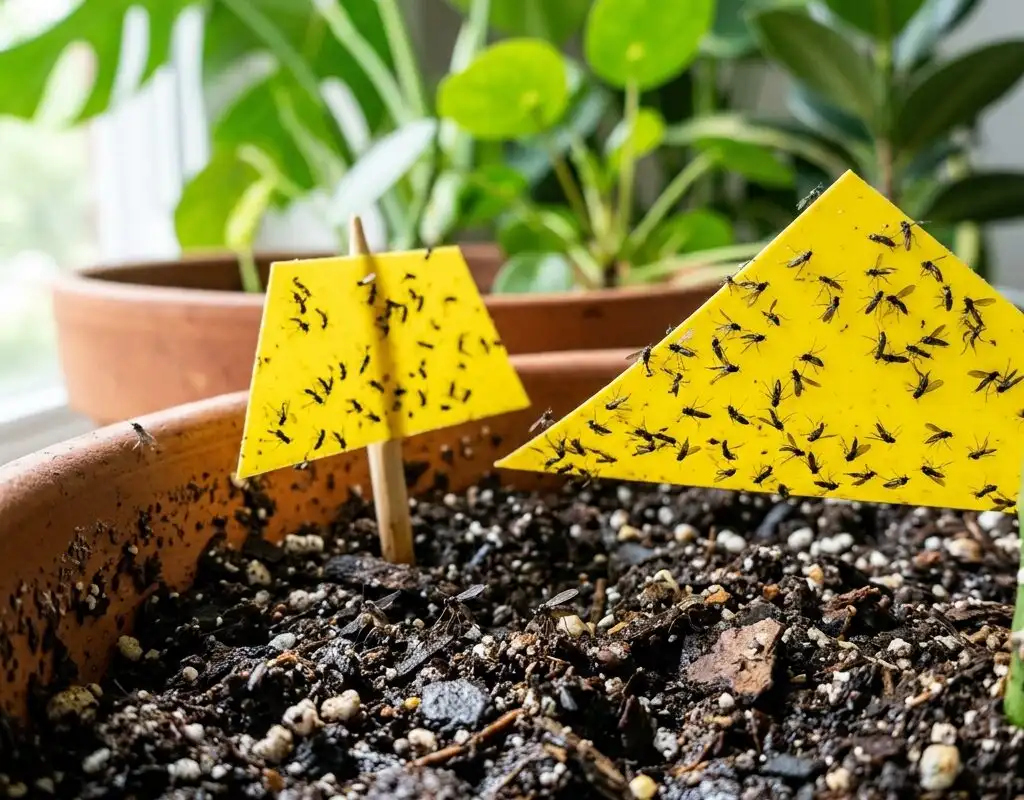
Fungus gnats (sciarid flies) are the small black flies that rise in a cloud when you water houseplants or seed trays. The adults are just a nuisance, but their larvae feed on fine roots underground and can weaken or even kill seedlings. The most effective, fully natural fix combines two targeted actions: beneficial nematodes for the larvae in the soil, and yellow sticky traps for the flying adults.
The Chatelain Method against fungus gnats
You observe the small flies rising when you water; you diagnose larvae in the top few centimetres of moist compost; you correct with nematodes and sticky traps together; you prevent recurrence by letting the surface dry out between waterings.
Understanding the enemy: the fungus gnat life cycle
The adult fly lives only a few days and does no direct damage to the plant beyond being a nuisance. But a single female can lay up to 300 eggs in the top few centimetres of moist, organically rich compost. The eggs hatch within days into small translucent white larvae with black heads, which feed on decaying organic matter, fungi, and — critically for seedlings and young houseplants — the fine root hairs, which can stunt growth or kill the plant outright.
Solution 1: nematode drench — the professional’s tool
Nematodes of the species Steinernema feltiae are microscopic roundworms that occur naturally in soil. Mixed into lukewarm water (around 15-20°C) and watered into the compost, they actively hunt down fungus gnat larvae, enter their bodies, and release bacteria that kill the larva within days.
The Chatelain note. Nematodes are a living product with a short shelf life — use them as soon as possible after purchase (they keep about a week refrigerated). Keep the compost surface lightly moist for several days after application, since nematodes need a thin film of water to move through the soil and find their prey. They’re harmless to humans, pets, plants and earthworms, and work best at soil temperatures of 8°C or above.
Solution 2: drying out the surface and a sand barrier
Fungus gnats need constant moisture to lay eggs and for larvae to survive. Letting the top 3-4cm of compost dry out between waterings starves both. To stop egg-laying altogether, cover the compost surface with a 1-2cm layer of fine sand or aquarium gravel: it dries almost instantly after watering, so females can’t dig into it to lay, and any larvae already present can’t complete their life cycle through it.
Solution 3: a cinnamon rinse
Cinnamon has real antifungal properties and can help reduce the micro-fungi in compost that larvae feed on, while its scent is a mild repellent to adults. Boil 1 litre of water with 2 tablespoons of ground cinnamon (or 3 cinnamon sticks) for 10 minutes, let it cool completely, strain it to avoid clogging your watering can, then use it to water affected plants. Treat it as a useful supporting measure alongside nematodes and traps, not a standalone cure for a serious infestation.
FAQ
What’s the fastest way to get rid of fungus gnats?
Combine a nematode drench (Steinernema feltiae) for the larvae with yellow sticky traps for the adults — together they break both ends of the life cycle within a couple of weeks.
Are nematodes safe for my houseplants and pets?
Yes — they’re completely harmless to humans, pets, plants and earthworms, and act only on fungus gnat larvae and a few other soil-dwelling pest insects.
Why do fungus gnats keep coming back?
Usually because the compost stays constantly moist. Letting the top few centimetres dry out between waterings removes the conditions eggs and larvae need to survive.